How to Train Technicians in EV Systems
Electric vehicles are changing what “good technician” means. It’s no longer enough to be strong in mechanical diagnostics and general electrical work.
EV systems demand disciplined high-voltage safety habits, deeper electronics knowledge, software-aware troubleshooting, and confidence working around lithium-ion batteries and thermal management.
The good news is that EV technician training can be built as a repeatable program—one that scales from entry-level awareness to advanced diagnostics and leadership.
The goal of EV technician training isn’t to turn every tech into a battery engineer. It’s to create a shop culture where technicians can identify risks, follow safe work practices, diagnose efficiently, document accurately, and keep customers safe.
Done right, EV technician training also reduces comebacks, improves cycle time, and helps retain techs who want modern career paths.
This guide lays out a proven approach: establish safety standards, define skill levels, build hands-on labs, create assessments, and keep training current as EV platforms evolve. You’ll also see future-facing predictions—because EV systems, charging standards, and service workflows are still moving fast.
Define EV Roles and Skill Levels Before You Train
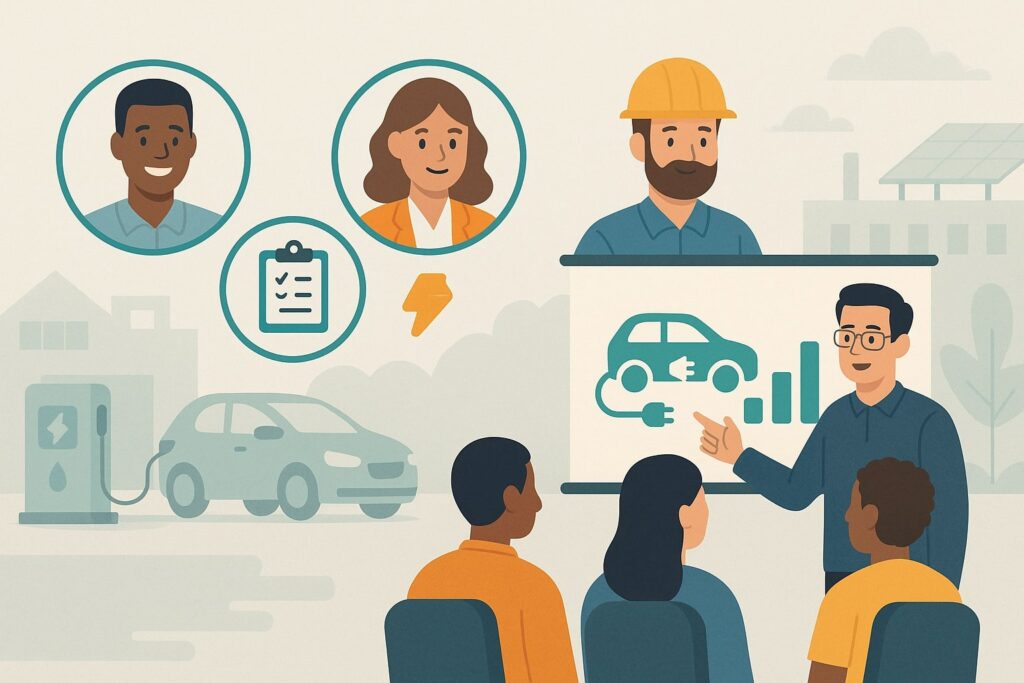
The most common reason EV technician training fails is trying to teach everyone everything at once. EV service work includes multiple job roles: inspection and maintenance, repair diagnostics, battery service support, charging/EVSE troubleshooting, post-collision safety checks, and sometimes emergency response coordination. Each role requires a different level of access to energized systems and a different depth of knowledge.
Start by separating technicians into training levels such as: Awareness (works around EVs but does not disable HV), Qualified Service (can place vehicles in a safe state and perform routine work), and Advanced Diagnostics (performs deep troubleshooting, component replacement, and complex verification).
This mirrors how many industry safety programs treat “qualified persons” and controlled work boundaries: not everyone needs to perform every high-risk task, but everyone must understand hazards and procedures.
Use real work orders to map what each level actually does. For example: tire/brake service on an EV may still involve HV awareness, regen behavior, and lift-point discipline.
A drivability complaint may involve inverter, motor, BMS, CAN messages, and software updates. When EV technician training is aligned to actual tasks, it becomes practical instead of theoretical.
Finally, connect training levels to a measurable credential path. Many shops use ASE’s advanced L3 exam as a benchmark for hybrid/EV diagnostic knowledge across high- and low-voltage systems.
Build a Task-to-Skill Matrix That Matches Your Shop’s Reality
A task-to-skill matrix is your “training GPS.” List your top EV services (battery cooling faults, charging concerns, isolation faults, HV interlock issues, thermal events, post-collision checks, etc.) and identify the knowledge required: electrical fundamentals, HV disable, insulation testing, scan-tool workflows, wiring repair standards, and validation procedures.
Keep the matrix tied to your tooling. If you do not have HV-safe meters, insulated tools, CAT-rated test equipment, or the correct PPE program, do not assign tasks that require them. EV technician training must match capability—otherwise it trains people into unsafe improvisation.
Also include non-technical skills that determine success: documentation quality, customer explanation skills, and disciplined troubleshooting. EV diagnostics often relies on data capture and step-by-step elimination. A technician who can write clean notes and follow test plans will outperform a “parts cannon” every time.
Update the matrix quarterly. New vehicle architectures, charging behavior changes, and software releases can quickly shift what technicians must know. That’s why EV technician training should be treated like a living system, not a one-time class.
Create Clear “No-Go” Boundaries and Escalation Rules
Training becomes safer when people know exactly where their responsibility ends. Define “no-go” boundaries such as: opening battery packs, working inside energized HV enclosures, bypassing interlocks, probing connectors without approved procedures, or attempting repairs after flooding/fire exposure without a defined protocol.
Escalation rules should be simple. If a technician sees signs of battery damage, thermal runaway risk, or water intrusion, the correct response is not bravery—it’s containment, isolation, and escalation.
Emergency guidance from safety agencies consistently emphasizes assuming HV components can be energized after damage, fire, or flooding.
In EV technician training, reward technicians who stop and escalate early. That mindset prevents injuries and expensive facility incidents. In the long run, your best techs are the ones who stay disciplined under pressure.
Make High-Voltage Safety the Foundation of EV Technician Training
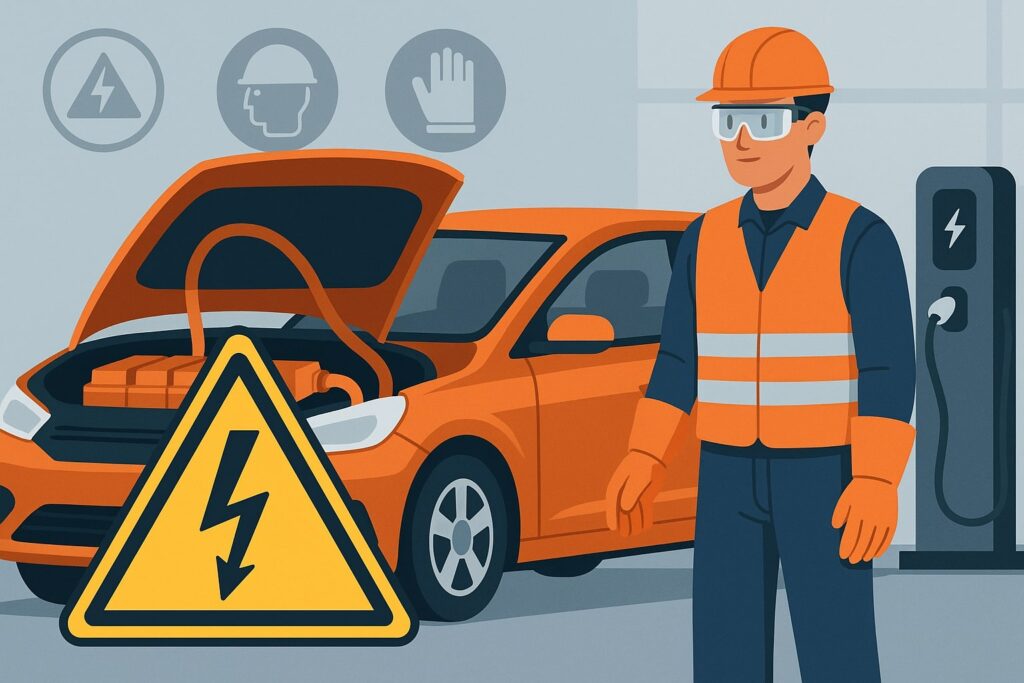
High-voltage safety is not a module. It’s the foundation everything else sits on. If your EV technician training does nothing else, it must create consistent habits around hazard identification, lockout/tagout discipline, safe verification of de-energized states, and PPE usage.
A strong safety program includes: written procedures, role-based authorization, training records, periodic refreshers, incident reporting, and audits.
It also includes “behavior standards”—for example: no jewelry, correct footwear, correct glove inspection, and no shortcuts around barriers. EV service adds additional realities: capacitors can hold charge, HV cables can be damaged internally, and battery packs can re-energize circuits if the design allows.
Lockout/tagout principles matter because unexpected energization can injure technicians. OSHA’s control of hazardous energy standard (29 CFR 1910.147) sets minimum requirements and emphasizes training workers to follow energy control procedures.
Finally, align your program to recognized industry safety frameworks. Many EV-focused shop standards define what an “electrically safe work condition” means and how to verify it before service work proceeds.
Train “Electrically Safe Work Condition” as a Repeatable Ritual
Technicians should be able to recite the ritual without hesitation: identify the HV system, disable and isolate according to OEM procedure, apply lockout/tagout controls, verify absence of voltage using proper test methods, and only then proceed.
In EV technician training, this must be practiced hands-on—multiple times—until it becomes muscle memory. Use real vehicles and training benches. Create checklists that technicians must sign and supervisors must countersign until proficiency is proven. Build a culture where the checklist is not “paperwork,” but a safety tool.
Also teach technicians what “safe state” is not. Simply turning the vehicle off or disconnecting the 12V battery may not be enough.
Different platforms have different discharge times, service disconnect designs, and verification steps. EV technician training should include reading and following OEM service information precisely, with zero improvisation.
The fastest tech in the bay is not the winner. The technician who is safe, consistent, and accurate is the winner—because EV mistakes scale into serious outcomes.
Teach PPE, Arc Flash Awareness, and Human Factors
Even if your shop rarely performs energized work, EV technician training should still cover PPE logic and arc-flash awareness. Electrical safety standards emphasize controlling risk through safe work practices, lockout/tagout, and PPE selection.
Training should include how to inspect HV gloves, how to store them, how to use leather protectors, how to keep gloves clean and dry, and when gloves must be removed from service. Include face protection rules, insulated tool rules, and meter category ratings.
Human factors are just as important. Most incidents happen when technicians are tired, rushed, distracted, or overconfident. Build “stop points” into your procedures: before removing covers, before testing, before reconnecting HV, and before returning a vehicle to the customer.
EV technician training should normalize pausing and double-checking—especially after interruptions. Make supervisors model the behavior. Culture always beats posters.
Teach EV Architecture and Subsystems in a Diagnostic-Friendly Way
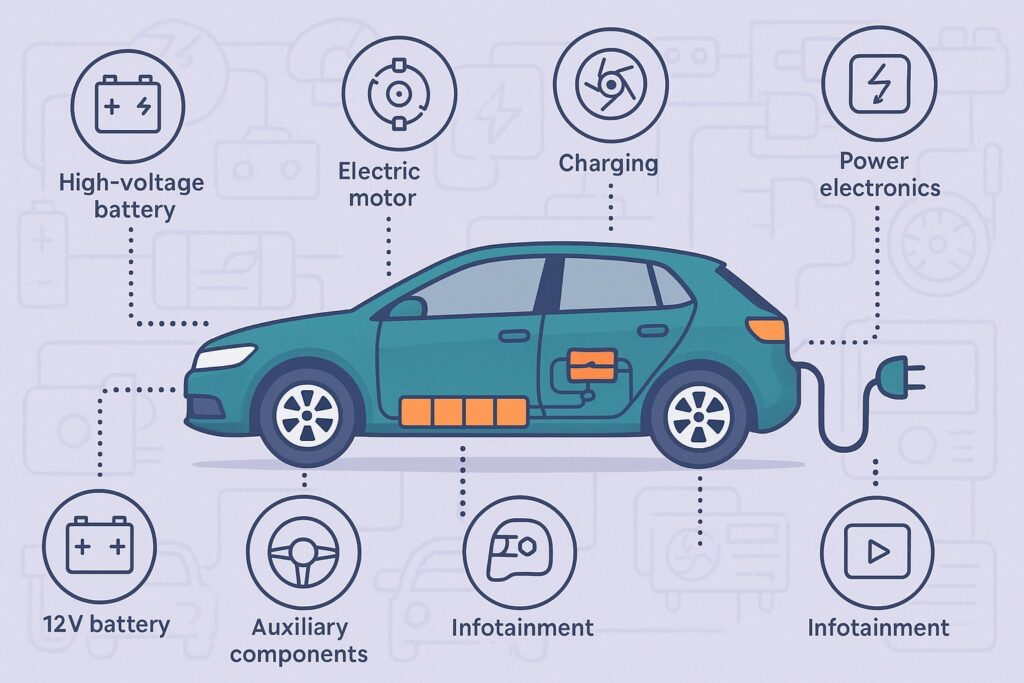
Once safety is established, EV technician training should build a strong mental model of EV architecture. Technicians need to understand how energy flows, what modules control what, and where common failure modes appear. Without architecture knowledge, diagnostics become random guessing.
Start with the big blocks: high-voltage battery pack (cells, modules, contactors, fuses), battery management system (BMS), inverter, motor(s), DC-DC converter, onboard charger, charge port/communication, thermal management, and low-voltage networked control modules.
Then connect those blocks to symptoms: reduced power, charging stopped, isolation fault, warning lights, thermal derate, and “no start.”
A key point: many EV problems are not “broken parts.” They can be software calibration, connector fretting, coolant leaks into sensors, harness damage, or communication timeouts. EV technician training must emphasize verifying the concern, capturing freeze-frame data, checking service bulletins, and using guided test plans.
Also teach how charging differs from “fueling.” The vehicle contains the charger for AC charging, while the external equipment supplies power and signaling. That concept helps technicians troubleshoot complaints more accurately, especially when customers call everything a “charger.”
Train Battery Packs, BMS Logic, and Thermal Runaway Awareness
Battery packs are not just big batteries. They are managed systems with voltage sensing, temperature sensing, contactor control, balancing logic, and safety interlocks. EV technician training should explain how the BMS protects the pack, what causes derating, and what conditions trigger isolation faults or shutdown.
Include realistic discussions about thermal runaway and why damaged packs must be handled carefully. Even if your shop does not service stationary battery energy storage, fire-propagation testing standards exist because lithium-ion thermal events are a real hazard category.
Technicians don’t need to memorize test methods, but they should understand why damaged cells and packs are treated as high risk.
Teach safe storage and quarantine procedures for suspect vehicles. Teach what not to do: do not park a damaged EV inside without policy, do not charge a vehicle with suspected pack damage, and do not ignore warning signs such as burning smell, popping sounds, or unusual heat.
The future trend: more energy-dense cells, faster charging, and more compact pack packaging. That improves customer experience but raises the importance of disciplined safety and inspection habits—making EV technician training even more critical over time.
Cover Motors, Inverters, Regenerative Braking, and Drive Unit Failures
Many technicians understand motors conceptually, but EV service requires practical troubleshooting: resolver/sensor issues, inverter gate driver problems, coolant intrusion, bearing noise, and reduction gear lubrication. EV technician training should connect these failure modes to scan data and test steps.
Regenerative braking changes everything: brake wear patterns, customer complaints (“grabbing” feel), and brake system diagnostics.
Teach blended braking logic, brake-by-wire components, and how to verify brake complaints safely. Include a process for validating repairs: road test procedures that capture regen behavior, noise/vibration, and thermal derate events.
Also teach “what good looks like.” EVs are quiet, so customers notice subtle noises. EV technician training should include NVH basics specific to electric drivetrains: inverter whine, motor harmonics, axle click, and mount issues.
As EV platforms evolve, drive units will become more integrated. That often means fewer serviceable subcomponents and more replacement modules. Training should prepare technicians to diagnose correctly before expensive assemblies are ordered.
Build Hands-On Lab Training That Mirrors Real-World EV Work
If EV technician training is mostly slides, it won’t stick. EV service is physical: safe disable steps, connector handling, torque discipline, sealing, coolant bleeding, and careful reassembly. A hands-on lab environment is where technicians build confidence.
Start with low-risk training benches: HV connector mockups, service disconnect practice, insulated tool handling, meter verification exercises, and CAN breakout box demonstrations. Then move to vehicle-based labs where technicians perform safe disable, remove undertrays, inspect HV harness routing, and practice re-energizing procedures.
Labs should be structured like real diagnostic work orders. Give a symptom, provide scan tool data, require a test plan, and grade technicians on process—not just the final answer. EV technician training should reward correct isolation of the root cause, not fast guessing.
Make labs repeatable. Record the fault setup steps and store them in a trainer binder. Rotate technicians through stations. Use simple rubrics: safety steps completed, data captured, correct test equipment used, correct conclusion, and correct documentation.
The future trend: more remote diagnostics and over-the-air updates. That doesn’t reduce hands-on needs—it increases the need to validate physical systems when software is not the cause.
Teach Tooling Mastery: Scan Tools, Meters, Insulation Testing, and SI Access
Tool mastery is a competitive advantage. EV technician training should include deep practice with scan tools: reading live data, pulling freeze-frame, running actuator tests, performing service functions, and exporting reports.
Technicians should also understand proper meter usage and safe test methods. Include exercises on verifying meter function before and after testing, using the correct range, and avoiding back-probing high-risk circuits unless procedures allow.
Insulation resistance testing and isolation fault diagnosis is a common EV pain point. EV technician training should teach technicians what isolation means, how coolant leaks can create conductive paths, and how to localize faults using OEM test procedures.
Finally, teach service information navigation as a skill: wiring diagrams, connector views, location drawings, DTC trees, and TSB searches. The technician who can quickly find the correct OEM steps is the technician who fixes EVs efficiently.
Make Quality Control and Post-Repair Validation Part of the Lab
EV repairs require strong validation. EV technician training should include post-repair checklists: clear codes, run self-tests, confirm no leaks, confirm thermal management performance, confirm charging behavior, and confirm no new DTCs.
Include “return-to-customer” steps: verify charge port door function, verify customer charging settings, confirm no warning messages, and explain what was repaired in plain language. Because EVs are still new to many customers, communication is part of quality.
Also include a safety re-check. Before returning a vehicle, confirm that HV covers are installed, harnesses are clipped properly, seals are intact, and fasteners are torqued. These steps prevent come-backs and reduce the chance of future thermal or electrical issues.
In the future, validation will increasingly include cybersecurity and software integrity checks. EV technician training programs should begin introducing basic concepts now: module programming hygiene, secure tool access, and accurate documentation of software versions.
Integrate Charging Systems and EVSE Troubleshooting Into Your Training Plan
Charging complaints are among the most common EV service issues, and they’re also where confusion is highest. EV technician training must teach the difference between vehicle-side charging components and external charging equipment.
Start with the basics: AC Level 1/Level 2 vs DC fast charging, onboard charger role, DC-DC converter role, charge port temperature monitoring, and communication signaling. Teach the concept that the EVSE is not “the charger” for AC charging; it supplies power and signaling while the vehicle converts AC to DC internally.
Then teach connector standards at a practical level. Technicians should recognize common connector types and understand what pins or signaling are responsible for readiness and safety interlocks. SAE J1772 is a widely used standard for AC charging connectors and signaling.
Include customer-environment troubleshooting: weak outlets, shared circuits, extension cords (often a bad idea), Wi-Fi issues with smart EVSEs, utility demand response programs, and scheduling settings. EV technician training should build technicians who can solve real customer problems, not just replace parts.
Future prediction: multi-standard charging environments and adapter solutions will continue to evolve, so technicians will need ongoing updates on connector ecosystems and charging behaviors.
Teach Failure Modes: “Won’t Charge,” “Charges Slowly,” and “Stops Charging”
Build a charging diagnostic playbook inside EV technician training. For “won’t charge,” teach technicians to check: customer steps, charge port condition, latch/lock function, DTCs, EVSE faults, and service bulletins.
For “charges slowly,” teach load calculations, temperature derating, battery SOC effects, and the difference between AC supply limits and vehicle acceptance limits. Teach technicians to collect evidence: kW, voltage, amperage, charge session logs, and ambient temperature.
For “stops charging,” teach intermittent causes: overheating connectors, ground faults, communication interruptions, and software-handshake issues. Teach controlled reproduction: same EVSE, different EVSE, different location, and then isolate.
These workflows prevent unnecessary module replacement and increase first-time fix rate—two major outcomes of strong EV technician training.
Include EVSE Safety, Facility Readiness, and Customer Education
If your shop installs or advises on EVSE, your EV technician training should include facility readiness basics: panel capacity, dedicated circuits, grounding, GFCI requirements, and safe cord management. Even if another trade performs installation, technicians should know how to recognize unsafe setups and advise customers appropriately.
Teach technicians to educate customers without blame. Many charging problems originate from home electrical limitations or misunderstood settings. A technician who can explain clearly builds trust and reduces repeat visits.
Future prediction: smart charging, bidirectional charging, and grid-interactive features will increase. That will add complexity to customer complaints and make “charging literacy” a core part of EV technician training.
Use Certifications and Structured Curricula to Standardize Progress
A training program is easier to manage when it has milestones. EV technician training should blend internal learning with recognized external benchmarks. That keeps your standards consistent across locations and reduces the burden on a single “EV guru.”
Many shops use the ASE L3 exam as a way to validate advanced hybrid/EV diagnostic knowledge, including high- and low-voltage electrical/electronic troubleshooting and supporting system diagnosis.
You can also use industry electrical safety standards tailored to electrified vehicles as internal policy anchors. Documents focused on xEV high-voltage electrical safety describe concepts such as an “electrically safe work condition” and reference lockout/tagout alignment.
In parallel, consider structured training providers for foundational engineering concepts, system design, and emerging tech—especially if you want to develop diagnostic leaders or trainers.
The key is to integrate credentials into a practical pathway. Certifications should not be trophies. They should represent real capability in your bays.
Build an Internal “EV Technician Training Ladder” With Pay and Role Alignment
Technicians train faster when there is a visible career path. Create a ladder: EV Awareness Tech → EV Service Tech → EV Diagnostic Tech → EV Team Lead/Trainer. Attach clear requirements: safety competency, lab completion, shadow hours, assessment scores, and real-world repair outcomes.
Tie the ladder to compensation and responsibilities. That avoids resentment and prevents unqualified technicians from being pressured into unsafe work. EV technician training works best when it is voluntary but incentivized—technicians should want to climb the ladder.
Also create “support roles.” For example, an apprentice can assist with teardown, documentation, and parts coordination while a qualified tech handles HV steps. This increases throughput while staying safe.
Future prediction: as EV adoption grows, technicians with validated EV capability will have strong leverage. Shops that build EV technician training ladders now will retain talent better and reduce hiring pressure later.
Standardize Training Records, Audits, and Refreshers
EV technician training must be auditable. Track: completed modules, hands-on labs, incident reviews, tool sign-offs, and authorization levels for HV tasks. This protects technicians and the business.
Refreshers matter because skills decay, and platforms change. Schedule refresher labs for safety rituals, charging diagnostics, and isolation fault workflows. Keep updates short and focused.
Also run audits: random checklist reviews, observed disable/verify steps, and tool condition checks. The point is not punishment. The point is to prevent “drift” where shortcuts become normal.
Over time, training records also help scheduling. You can dispatch EV work to technicians with the right authorization level and reduce bottlenecks.
Train for Incidents: Post-Collision, Fire, Flooding, and Safe Handling
EV incidents require special handling because high-voltage components can remain energized and batteries can be damaged in ways that are not obvious. EV technician training should include incident recognition, containment steps, and escalation protocols.
Start with post-collision basics: identify HV cable routing, recognize signs of pack intrusion, check for coolant leaks, and follow OEM disable steps before touching damaged areas. Then cover thermal event awareness: unusual heat, smoke, off-gassing smells, popping noises, or warnings related to the battery.
Emergency guidance for damaged EVs commonly emphasizes treating the high-voltage battery and components as energized after damage, fire, or flooding. This principle should be taught clearly in EV technician training, along with a conservative response plan.
Also teach communication. If a vehicle is unsafe to store inside, technicians must know who to call, where to place the vehicle, and how to document the condition. Don’t rely on tribal knowledge—make it a written playbook.
Future prediction: more standardized rescue sheets and emergency response documentation availability will improve safety, but shops must train people to actually use these resources under stress.
Build a Quarantine and Storage Policy for High-Risk EVs
A quarantine policy answers: where to park a suspect vehicle, how far from structures, what to do about charging, and who is authorized to move it. EV technician training should include this policy as a required module, because the first minutes matter.
Teach technicians how to recognize high-risk conditions: pack damage indicators, heavy underside impact, signs of water intrusion, or thermal warnings. Teach “do not charge” triggers. Teach how to document with photos, notes, and timestamps.
Make sure your policy is coordinated with local fire guidance and your facility constraints. A policy that exists only on paper won’t help. EV technician training should include drills: “vehicle arrives after flood exposure,” “customer reports battery warning and smell,” and “post-collision tow-in.”
Also include customer handling scripts. Clear, calm communication reduces conflict and helps customers understand why extra precautions are necessary.
Coordinate With First/Second Responder Concepts Without Overstepping
Your technicians are not firefighters, but they do need basic literacy around responder guidance so they can communicate effectively during incidents. Some recommended practices and guides exist to help responders handle electrified vehicles safely.
In EV technician training, cover what technicians should do while waiting for responders: keep distance, avoid water application unless instructed by professionals, keep the area clear, and provide vehicle information and disable points if available.
Also teach what technicians should not do: don’t attempt heroic battery interventions, don’t open packs, and don’t move a suspect vehicle into enclosed spaces.
Future prediction: as EV fleets grow, coordination between service facilities and responders will become more formal. Shops that train for calm, standardized communication will handle incidents better and protect staff.
Turn Training Into Performance With Coaching, KPIs, and Culture
EV technician training succeeds when it changes behavior in the bay. That requires coaching, measurement, and a culture that values process.
Start with a small set of KPIs that match your goals: safety checklist compliance, diagnostic accuracy (first-time fix), average time-to-diagnosis for common EV complaints, and comeback rate. Pair KPIs with coaching, not punishment. The goal is improvement.
Shadowing is powerful. Pair a developing technician with an experienced EV diagnostic tech for structured hours. Give the trainee a role: data capture, SI navigation, and documenting test steps. Then gradually increase responsibility as competence is proven.
Culture is the multiplier. Technicians must feel psychologically safe to say “I’m not qualified for this task yet.” EV technician training should be the reason a technician can refuse unsafe work without fear. That’s how you prevent incidents.
Future prediction: as EV systems become more software-defined, your best “EV techs” will be the ones who combine electrical discipline with data-driven diagnostics. Training culture now will determine whether your shop thrives later.
Create Repeatable Coaching Loops After Every EV Repair
After each EV job, do a quick debrief: What was the symptom? What data was most helpful? What test confirmed the root cause? What could have been done faster or safer? This takes five minutes, but it compounds into real skill growth.
Capture these lessons into internal “EV case studies.” EV technician training becomes stronger when it includes your shop’s actual failures and wins—not generic examples. Make case studies searchable by DTC, symptom, and vehicle model.
Encourage techs to contribute. Recognition matters. When a technician solves a tough isolation fault with clean documentation, celebrate the process.
This creates an upward spiral: better training → better repairs → stronger morale → better retention → better training.
Keep the Program Current With Quarterly Updates and Future-Ready Modules
EV platforms evolve quickly: new chemistries, new cooling designs, more sensors, and new charging behaviors. Schedule quarterly EV technician training updates that include: new platform notes, top new DTC patterns, new tooling needs, and updated safety reminders.
Add future-ready modules gradually: cybersecurity basics, OTA update implications, ADAS calibration interactions with EV power management, and charging ecosystem changes. You don’t need to teach everything at once—but you should start building literacy.
Shops that treat EV technician training as a living program will outperform shops that treat it as a one-time event.
FAQs
Q.1: What is the safest way to start EV technician training for a shop that has never serviced EVs?
Answer: The safest start is to build EV technician training around risk control first, not repairs first. Begin with a written safety policy, role definitions, and tool readiness.
Before anyone touches high-voltage components, ensure you have appropriate PPE, insulated tools, and clear procedures for disabling and verifying systems according to OEM instructions.
Your first training sessions should be “awareness plus habits”: recognizing high-voltage components, understanding why damage/flooding/fire changes risk, and practicing safe approach boundaries.
Next, restrict early work to low-risk tasks that still build EV familiarity—like inspections, tire service, brake service with regen awareness, and scan/health checks—while a small group advances into qualified HV procedures.
EV technician training should also include lockout/tagout concepts because unexpected energization is a known hazard category in servicing equipment, and training workers to follow energy control procedures is a core safety expectation.
Finally, scale slowly with hands-on labs and mentorship. The goal is competence and consistency. Speed comes later.
Q.2: How long does it take to become competent through EV technician training?
Answer: Competence depends on the technician’s starting point and the scope of work. A strong traditional electrical diagnostic technician can become productive on basic EV service faster than someone who struggles with wiring diagrams and scan data.
In practical terms, EV technician training often progresses in phases: a few weeks to build safety habits and architecture basics, a few months to become consistent on routine service and common complaints, and longer to become truly advanced in isolation faults, inverter/motor issues, and complex charging diagnostics.
The fastest path is structured: clear skill ladder, hands-on labs, supervised real repairs, and assessments. External benchmarks can help standardize “advanced” expectations. For example, ASE’s L3 exam is designed to evaluate hybrid/EV technician knowledge for diagnosing high- and low-voltage electrical and supporting system issues.
The most important factor is not time—it’s repetition with feedback. EV technician training should create deliberate practice, not just exposure.
Q.3: Do technicians need to be electricians to succeed in EV technician training?
Answer: No, but they do need disciplined electrical fundamentals. EV technician training does not require a technician to wire buildings or design circuits. It requires the ability to work safely around high voltage, interpret wiring diagrams, use meters correctly, and follow structured diagnostic steps.
Technicians should be comfortable with concepts like voltage drop, continuity testing, signal integrity, and network communication basics. They should also understand that many EV issues are not purely mechanical. They can be software-driven, communication-related, or sensor/coolant related.
A key differentiator is process discipline. EV technician training should emphasize following OEM procedures precisely, including disable/verify steps and test plans. That’s more about professionalism and attention to detail than about being an electrician.
Q.4: What are the most common mistakes shops make when implementing EV technician training?
Answer: The biggest mistake is skipping the “system” part of EV technician training. Shops sometimes send one technician to a class and assume the shop is now “EV-ready.” Without written procedures, tool readiness, defined authorization levels, and repeatable labs, the knowledge doesn’t transfer safely.
Another common mistake is focusing on parts replacement instead of diagnostics. EV modules can be expensive, and misdiagnosis is costly. EV technician training should teach data capture, guided testing, and root-cause verification.
A third mistake is ignoring charging complaints or treating them as customer problems. Charging issues are a major driver of service visits and confusion. EV technician training must include charging basics and troubleshooting workflows, including clarifying the role of EVSE versus the vehicle’s onboard systems.
Finally, many shops fail to refresh training. EV platforms evolve, and training must evolve too.
Q.5: How should EV technician training address fire, flooding, or collision-damaged vehicles?
Answer: EV technician training should treat these as special categories with stricter rules. Teach technicians to assume high-voltage components may be energized after damage, fire, or flooding, and to follow conservative procedures for isolation, quarantine, and escalation.
Training should include a facility policy: where to park suspect vehicles, whether charging is allowed, who makes decisions, and how to document conditions. It should also include basic literacy around emergency documentation resources and responder guidance so technicians can communicate effectively during an incident.
Most importantly, EV technician training must remove “hero culture.” The correct response is often to stop work, isolate risk, and escalate.
Q.6: What will EV technician training look like in the next 3–5 years?
Answer: EV technician training will become more software-aware and more standardized. Expect more emphasis on secure diagnostic workflows, module programming hygiene, and data-driven troubleshooting.
Charging ecosystems will continue to evolve, so training will expand to include multi-standard charging behaviors and smarter EVSE interactions.
At the same time, high-voltage safety discipline will stay central—because energy density and fast-charging capabilities are increasing. EV technician training will likely include more scenario-based drills around thermal events and post-collision safety, and more formal documentation habits.
Shops that build a living EV technician training program—updated quarterly, measured with KPIs, and reinforced through coaching—will be the ones that attract and keep top technicians.
Conclusion
Training technicians in EV systems is not about dumping information into a classroom. It’s about building a capability inside your operation: safe work habits, clear role boundaries, diagnostic excellence, and the confidence to handle modern vehicles responsibly.
The best EV technician training programs start with safety rituals, build architecture understanding, and then scale into hands-on labs that mirror real work orders.
Standardization matters. Written procedures, lockout/tagout discipline, and “electrically safe work condition” practices keep technicians consistent and protected. Practical diagnostic training—scan tools, service information mastery, and structured test plans—keeps your repairs accurate and profitable.
Charging literacy reduces confusion and repeat visits. And incident training ensures your shop responds calmly and correctly when vehicles arrive damaged, flooded, or after a thermal event.
Most importantly, EV technician training must be treated as a living system. EV technology will keep evolving. The shops that update training regularly, measure performance, and build a strong safety culture will be the ones that lead—not chase—the future of service.