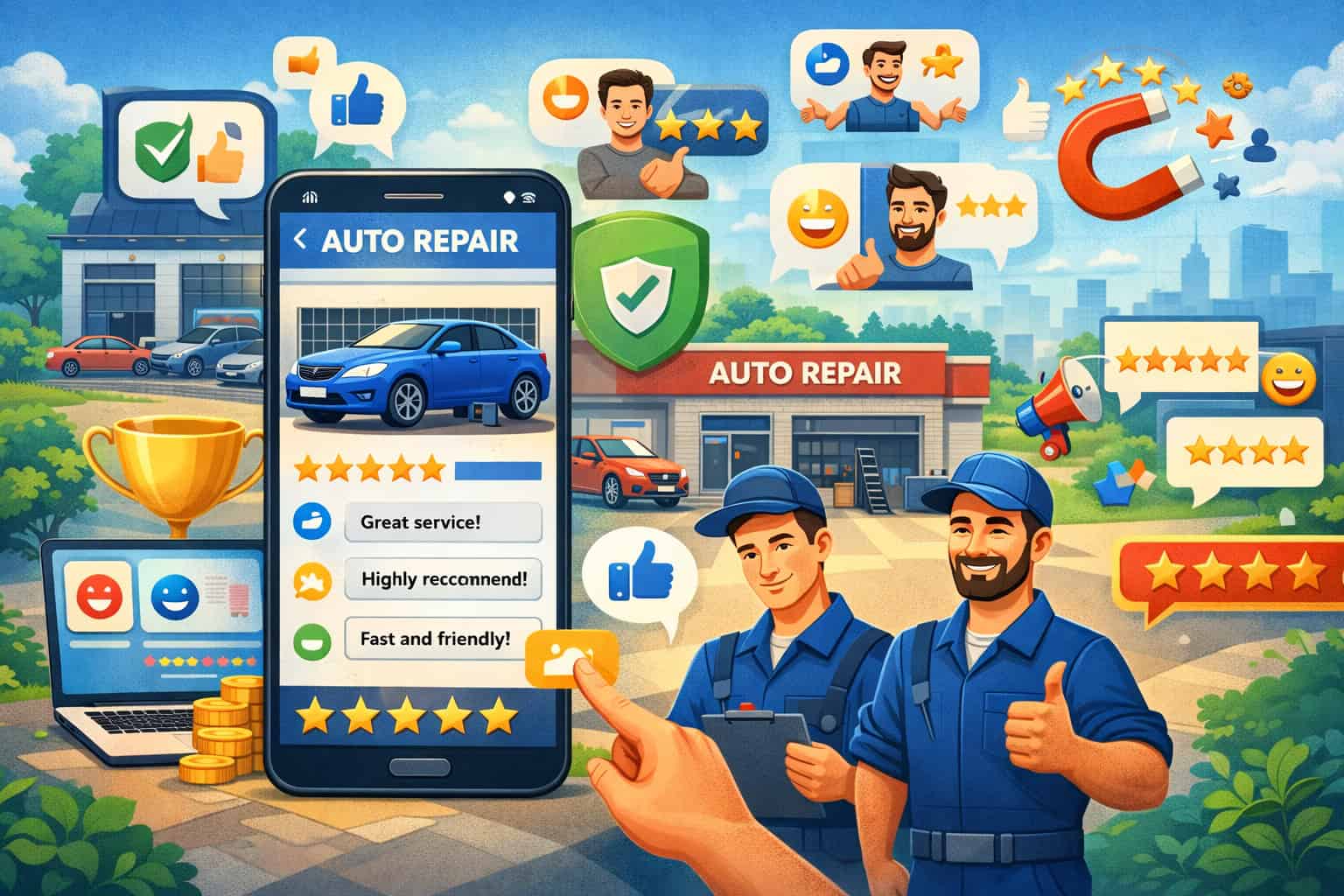
Reputation Management for Auto Repair Shops: The Complete Guide to Reviews, Trust, and Long-Term Growth
Reputation management for auto repair shops isn’t just about getting more five-star reviews. It’s about building trust at every touchpoint—phone calls, estimates, repairs, follow-ups, and the way you handle problems when they happen.
In a local service business, your reputation is your storefront. Before a driver calls, they typically scan ratings, read recent comments, and look for signals that your shop is honest, consistent, and professional.
The reality is simple: people feel vulnerable when their vehicle has issues. They worry about safety, cost, and whether they’re being treated fairly. That emotional context makes reputation management for auto repair shops a core business function, not a marketing side project.
The shops that win aren’t always the cheapest. They’re the ones that communicate clearly, document work, treat customers with respect, and respond thoughtfully online.
A strong reputation also protects your margins. When your shop is known for transparency and quality, customers are less likely to price-shop and more likely to approve needed work. They also come back for maintenance, refer family members, and forgive the occasional mistake because trust has already been established.
This guide breaks down reputation management for auto repair shops into practical systems you can implement—review generation, response templates, customer experience design, local visibility, and future trends like AI-driven search and messaging. The goal is to help you earn trust, defend it, and turn it into steady growth.
Understanding Reputation Management for Auto Repair Shops and Why It Impacts Revenue

Reputation management for auto repair shops is the process of shaping what customers believe about your shop before they ever meet you, while they’re in your care, and long after they drive away.
It includes online reviews, but it also includes offline word-of-mouth, community presence, social proof, and the stories people tell about how you treated them.
A shop’s reputation directly influences conversion rates. If two nearby shops offer similar services and similar pricing, the shop with higher ratings, more recent reviews, and professional responses usually wins the call.
That means reputation management for auto repair shops affects not only marketing outcomes, but also front-desk workload, technician schedules, and overall profitability.
Reputation also affects the type of customer you attract. When you consistently communicate clearly, document repairs, and educate drivers, you build a customer base that values quality and preventative maintenance.
That reduces conflict, increases average repair order value, and increases lifetime value. In contrast, a weak or inconsistent reputation often attracts bargain-only customers who are harder to satisfy.
Finally, reputation management for auto repair shops is a resilience strategy. Economic slowdowns, staffing challenges, and unexpected errors happen. A strong reputation gives you a buffer because customers view you as trustworthy.
They give you the benefit of the doubt, and they’re more likely to work with you to resolve concerns rather than leaving damaging public feedback.
The Psychology of Trust in Auto Repair and How to Design a Trust-First Experience

Reputation management for auto repair shops becomes easier when your operation is designed around trust. Most customers cannot verify the technical details of a repair. They evaluate you using “trust signals” like clarity, cleanliness, professionalism, and consistency. When those signals are strong, customers feel safe saying yes to repairs.
Trust begins with first contact. A friendly greeting, clear scheduling, and accurate expectations reduce anxiety. If a customer feels rushed or dismissed, they become defensive and skeptical. Reputation management for auto repair shops starts with how you make people feel in the first 60 seconds.
Trust is reinforced through transparency. Customers want to understand the “why” behind a repair. When you explain symptoms, causes, risks, and options in plain language, you reduce fear. When you show photos or videos, you reduce uncertainty. When you provide itemized estimates and explain priorities, you reduce suspicion.
Trust is protected when you handle surprises correctly. If you discover additional issues mid-repair, customers need a calm explanation, proof, updated pricing, and options. No one likes a surprise bill. In reputation management for auto repair shops, the most common negative reviews come from miscommunication—not from the repair itself.
Trust is amplified by consistency. Customers notice patterns. If every interaction feels organized, you look competent. That competence becomes your reputation. You don’t “ask” for trust. You earn it through a system customers can feel.
Customer Expectations at Each Stage of the Repair Journey
Reputation management for auto repair shops improves when you map the customer journey and meet expectations at each stage. Customers evaluate you repeatedly: when they find you online, when they call, when they drop off, when you present an estimate, when they pick up, and when they need help later.
At discovery, customers expect clear service information, easy directions, and visible proof you’re legitimate. They look for ratings, recent reviews, and signs of specialization.
During the call, they expect someone who listens, asks good questions, and provides realistic timing. When they arrive, they expect a professional environment, a clear check-in process, and respectful communication.
During diagnosis, customers expect updates. Silence often creates distrust. Even if you’re still investigating, a quick message that you’re working on it reduces anxiety.
When presenting the estimate, customers expect clarity: what’s urgent, what can wait, and why. They also expect pricing to match what you said unless there’s a justified change explained in advance.
At pickup, customers expect a clean vehicle, a clear invoice, and confidence that the issue is resolved. They also expect guidance: what to watch for, what maintenance is next, and whether there’s a warranty. Reputation management for auto repair shops becomes smoother when customers leave feeling informed instead of confused.
After the repair, customers expect you to stand behind your work. If they have a follow-up question, they want a helpful answer, not defensiveness. Meeting these expectations consistently creates the kind of word-of-mouth that online reviews simply echo.
Building Transparency with Photos, Estimates, and Service Explanations
Reputation management for auto repair shops accelerates when you make transparency a default habit. Customers don’t need to become mechanics, but they do need to feel respected and informed. Visual evidence is one of the fastest ways to build trust because it reduces doubt.
Photos of worn brake pads, leaking components, or damaged belts help customers understand why the repair is needed. Short videos with a simple explanation can be even more effective. The key is to avoid jargon.
Use clear language: what you found, what it means, and what happens if it’s ignored. This transforms “sales pressure” into “professional guidance.”
Written estimates should be itemized and prioritized. Customers appreciate knowing which repairs are safety-related, which prevent future damage, and which are optional for now. Provide options when possible.
For example, offer a “good, better, best” approach if parts or service levels vary. Transparent options reduce the feeling of being trapped.
Transparency also includes time expectations. If parts delays happen or diagnosis takes longer, explain it early. When customers are prepared, they are more patient. In reputation management for auto repair shops, timing frustration is a common cause of negative feedback, even when the mechanical work is excellent.
Finally, be transparent about guarantees and limitations. Clear warranty policies, explained in simple terms, reduce misunderstandings. Customers don’t just remember what you fixed. They remember how you communicated. Transparency turns uncertainty into trust, and trust turns into reviews and referrals.
Review Ecosystems That Matter Most for Auto Repair Shops
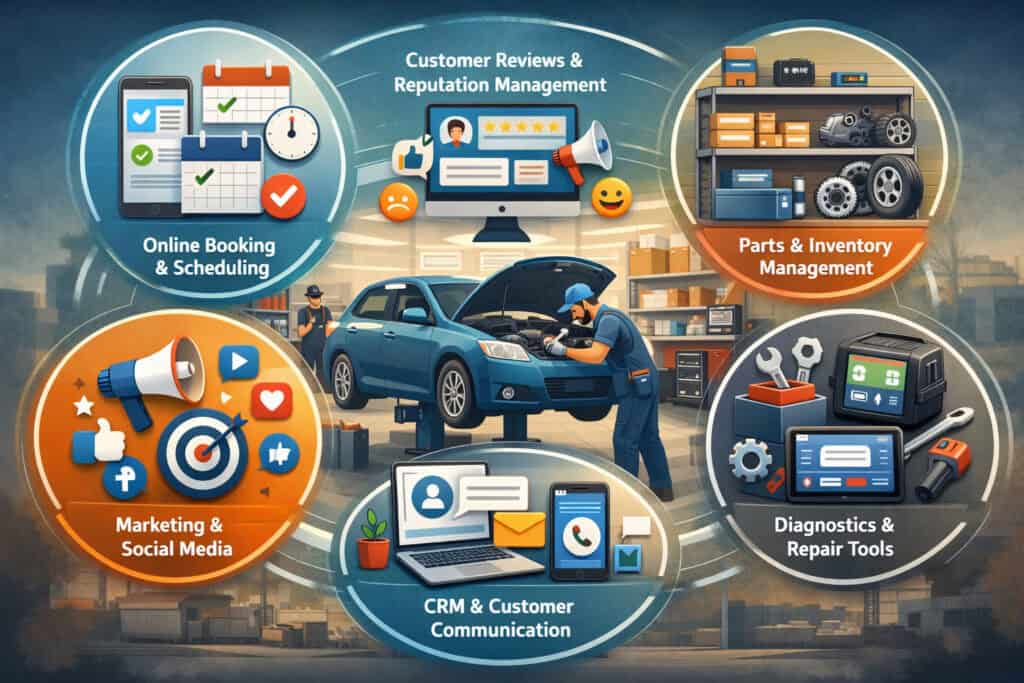
Reputation management for auto repair shops must focus on the platforms customers actually use when choosing a nearby shop. Most customers will see your rating and review volume before they ever see your website. That means your review ecosystem is a core asset, like your tools and your team.
The most important platforms are the ones that appear in local results and maps. Customers also evaluate “freshness.” A high rating with only old reviews often feels risky. A steady stream of recent reviews builds confidence and improves visibility. Reputation management for auto repair shops should prioritize consistent review activity, not occasional bursts.
Beyond star ratings, customers read content. They look for mentions of honesty, fair pricing, clear communication, quality repairs, quick turnaround, and professionalism. They also look for proof that you handle issues responsibly.
A shop with a few negative reviews—but thoughtful, respectful responses—often converts better than a shop that looks perfect but silent.
Your goal is to build a balanced review profile: strong average rating, high enough volume to look established, and enough recent reviews to look active.
You also want variety: different services, different customer types, and comments that show consistency. Reputation management for auto repair shops is not about gaming the system. It’s about earning public evidence of your everyday quality.
How to Earn More Positive Reviews Without Sounding Pushy
Reputation management for auto repair shops works best when review requests feel natural and customer-centered. Many shops avoid asking because they fear being awkward. But customers who are genuinely happy often appreciate a simple request—especially if you make it easy.
The first rule is timing. Ask when the customer is most satisfied: right after a successful pickup, after a clear explanation, or after you’ve solved a stressful issue. If the customer says, “Thank you” or “I really appreciate this,” that’s your cue. A simple line like, “If you have a minute, a quick review helps local drivers find us,” feels respectful and reasonable.
The second rule is simplicity. Don’t make customers search for where to review you. Use a short link or a QR code on the invoice and at the counter. If you send text receipts or follow-up messages, include the link there. Reputation management for auto repair shops improves when the review process takes under 30 seconds.
The third rule is consistency. Train your team to ask in the same friendly way. Rotate who asks, but keep the message consistent. Customers notice when a business has a real system. It feels professional, not desperate.
Finally, never pressure customers or offer rewards in a way that feels like buying reviews. Focus on gratitude and community impact. Over time, the steady flow of authentic reviews becomes one of your strongest marketing advantages.
What to Do When You Get a Negative Review
Reputation management for auto repair shops is tested most during negative reviews. The good news is that a negative review isn’t always a disaster. In many cases, it becomes a trust builder when handled professionally. Potential customers don’t expect perfection. They expect accountability.
Start by controlling the emotional response. Read the review carefully and identify the real complaint: price surprise, delay, miscommunication, perceived attitude, or unresolved problem. Then respond quickly, ideally within a day or two, so it looks like you’re engaged and responsible. A slow response can look like avoidance.
Your public response should do three things: acknowledge, clarify, and invite resolution. Acknowledge the customer’s frustration without arguing. Clarify key facts only if needed and without exposing private details. Invite the customer to contact you directly so you can make it right. This shows future customers you have standards.
If the review is fair, fix the process behind it. Reputation management for auto repair shops isn’t just reputation—it’s operational improvement. If delays are common, improve your scheduling and updates. If billing surprises happen, improve estimate approvals and communication.
If the review is misleading or abusive, stay calm. Respond politely and document your records. In many cases, a calm, professional tone is more persuasive than proving your point. The goal is not to “win” the argument. The goal is to protect trust with everyone reading.
A Step-by-Step Reputation Management System You Can Run Weekly
Reputation management for auto repair shops becomes sustainable when it’s a routine, not a reaction. Many shop owners are busy, and reputation work gets pushed aside until something goes wrong. A weekly system keeps you in control and prevents small issues from becoming public problems.
Start with monitoring. Check your main review platforms at least twice a week. Set alerts so you don’t miss new reviews. When you reply promptly, you show attentiveness. You also train your customers to expect that you care.
Next, collect feedback internally. Ask your front desk and techs what customers are saying. Note patterns: complaints about timing, clarity, pricing, or communication. Internal feedback is like an early warning system. It lets you fix issues before they become negative reviews.
Then, run a review request rhythm. Identify completed jobs with satisfied customers and send a simple follow-up request. The key is to do it consistently, not aggressively. Reputation management for auto repair shops improves when review volume grows steadily over time.
Finally, publish trust content. That can be short posts explaining common repairs, photos of your team, or quick tips. It doesn’t need to be complicated. The point is to look active, helpful, and real. A weekly system, even small, compounds into a powerful reputation advantage.
Daily and Weekly Habits That Keep Your Online Reputation Healthy
Reputation management for auto repair shops is easier when the workload is split into small habits. Daily, your team should watch for customer friction points: unclear estimates, long wait times, missed calls, or confusing invoices. Those moments turn into reviews. Fix them early.
A daily habit is closing the loop with customers. If someone calls and you miss it, return the call quickly. If a vehicle is delayed, send a message before the customer asks. Being proactive reduces frustration. In reputation management for auto repair shops, proactive updates often prevent negative reviews more than anything else.
Weekly, review your latest feedback and track trends. Look at review content, not just star ratings. What words are customers using? Are they praising honesty and speed? Are they complaining about pricing or communication? Use those insights to coach your team and refine your scripts.
Weekly, you should also audit your “first impression” assets: your business profile details, hours, service categories, photos, and messaging. Customers trust businesses that look accurate and active. Outdated photos or wrong hours create doubt and frustration.
Finally, weekly training matters. A 10-minute team discussion on communication, customer empathy, and documentation can improve your reputation faster than any ad campaign. Reputation management for auto repair shops is built in the bays and at the counter, then reflected online.
Measuring Reputation: KPIs That Actually Matter for Repair Businesses
Reputation management for auto repair shops improves when you measure the right metrics. Star rating alone isn’t enough. A shop with a high rating but low review volume can still lose business to a competitor with more recent reviews and better visibility.
Start with review volume and review velocity. Volume shows credibility. Velocity (how many you get per month) shows you’re active. Next, track recency. If your last review is months old, customers may assume you’re inconsistent or no longer operating at the same standard.
Track response rate and response time. Customers notice when owners respond. Even happy reviews benefit from a short “thank you” because it shows you’re present. Reputation management for auto repair shops should aim for consistent responses, especially for negative reviews.
Track sentiment themes. Create a simple list of common topics: communication, honesty, pricing fairness, speed, cleanliness, professionalism, warranty support. Count how often each theme appears. This helps you identify what’s working and what needs improvement.
Finally, tie reputation to revenue signals: inbound calls, booked appointments, estimate approvals, and repeat customer rate. Reputation management for auto repair shops is not a vanity project. When you track the full picture, you can see how trust converts into real growth.
Local Visibility and Reputation: How Search and Trust Work Together

Reputation management for auto repair shops and local visibility are deeply connected. Local search platforms tend to reward businesses that look trustworthy and active. Even without obsessing over algorithms, you can understand the basic truth: customers click what looks reliable.
Local visibility is influenced by relevance, proximity, and prominence. Proximity is geography. You can’t control where the customer is. Relevance comes from your services, categories, and content. Prominence is where reputation management for auto repair shops plays a major role—reviews, ratings, activity, and overall credibility.
Your online presence should be consistent across the web. Your business name, address, and phone number should match everywhere. Consistency reduces confusion and increases trust. Customers also trust clear service descriptions: what you do, what you specialize in, and what your process looks like.
Photos matter more than many shops realize. Customers want to see the building, the waiting area, the team, and the work environment. Fresh photos signal that you’re active and professional. Reputation management for auto repair shops should include a simple photo routine: add a few new images monthly, especially of your team and shop.
Finally, local visibility and reputation feed each other. More visibility brings more customers. More customers means more opportunities for reviews. More reviews build more trust, which boosts visibility. A consistent system creates a flywheel that compounds over time.
Optimizing Your Business Profile for Trust, Calls, and Bookings
Reputation management for auto repair shops should treat your primary business profile as your digital front desk. Customers decide whether to call based on what they see there: hours, phone, directions, service list, photos, and reviews.
Make sure hours are accurate and updated for holidays. Wrong hours create immediate frustration and bad reviews. Add your core services and specialties clearly.
Customers search for specific needs: brakes, diagnostics, AC repair, suspension, oil changes, transmissions, electrical issues, alignments, inspections, and fleet maintenance. If your services are unclear, you lose relevance.
Use photos that show professionalism. Add images of your signage, parking, waiting area, shop floor, and team. Customers want to see that your shop is real and organized. Reputation management for auto repair shops improves when customers feel confident before they arrive.
Your business description should communicate values and processes. Mention transparency, digital inspections if you offer them, clear estimates, and warranty support. Avoid fluff. Be specific about what makes the customer experience better.
Finally, use messaging and appointment features if available. Many customers prefer texting. Quick responses convert more leads and reduce missed calls. A well-managed profile becomes a silent salesperson that supports reputation management for auto repair shops every day.
Using Content and Social Proof to Dominate Your Service Area
Reputation management for auto repair shops is strengthened by content that proves expertise and character. Content doesn’t have to be complicated. It just needs to answer the questions customers are already asking.
Start with educational posts: “How to know if your brakes need service,” “Why check engine lights matter,” “What happens during a diagnostic,” “How often to rotate tires,” “Signs your battery is failing.” Keep it simple. Short explanations build authority. Over time, customers begin to view you as a helpful expert, not just a repair provider.
Use social proof consistently. Share anonymized customer praise (with permission if needed). Share before-and-after photos. Share team highlights. Customers trust people, not logos. Reputation management for auto repair shops improves when your brand feels human and accountable.
Community involvement also matters. Sponsor a local event, support a school fundraiser, or participate in a safety campaign. Then share it. This builds goodwill and differentiates you from faceless competitors. Local businesses with community ties often earn more loyalty and more forgiving customers.
Finally, don’t underestimate simple consistency. Posting once a week is better than posting daily for a month and then disappearing. Reputation management for auto repair shops is about steady signals of trust. When content and social proof are consistent, they reinforce your reviews and increase conversions.
Handling Complaints, Disputes, and Refund Requests Without Damaging Your Reputation
Reputation management for auto repair shops depends on how you handle conflict. Every shop eventually faces a disagreement: a customer thinks the price is too high, the timeline was too long, or the repair didn’t solve the problem as expected. What matters is the process you follow.
Start with empathy and listening. Customers want to feel heard. Even if you’re confident your team did quality work, interrupting or dismissing concerns escalates the situation. Use calm language and reflect the concern back: “I understand why that feels frustrating.” This doesn’t admit fault. It shows respect.
Next, gather facts and document everything. Pull the repair order, estimates, approvals, photos, and technician notes. Reputation management for auto repair shops becomes easier when your documentation is strong, because it reduces ambiguity. If a mistake happened, own it quickly and outline the fix. If the issue is complex, explain what you can do to investigate.
Offer solutions that feel fair. Sometimes that’s rechecking the vehicle, adjusting a labor charge, discounting a future service, or clarifying the difference between a related issue and the original issue. The goal is not to “win.” The goal is to protect trust while staying financially responsible.
Finally, close the loop publicly when appropriate. If a customer leaves a negative review, and you resolve it, invite them to update their review. Don’t demand. Ask politely. Many customers will update when they feel respected. This is a powerful part of reputation management for auto repair shops.
De-Escalation Scripts for Front Desk Staff
Reputation management for auto repair shops often rises or falls at the front desk. A skilled service advisor can turn tension into trust with the right words. Scripts don’t make your team robotic. They make them consistent under stress.
When a customer is upset, start with acknowledgement: “I can see why you’re frustrated, and I’m glad you called so we can address it.” This lowers the temperature. Next, ask a clarifying question: “Can you tell me what happened from your perspective?” People calm down when they feel heard.
If the issue is about price, use a transparency script: “Let’s review the estimate and approvals together so we’re on the same page. Then we can talk about options.” This shifts from emotion to facts. If the issue is about timing, use a proactive accountability script: “I’m sorry the timeline wasn’t clear. Here’s what happened and what we can do now.”
If the customer is demanding a refund immediately, avoid arguing. Use a process script: “I want to be fair and make this right. The fastest path is for us to inspect the vehicle, review the work performed, and then decide the best resolution.” This protects your shop while showing responsibility.
End every interaction with a clear next step and time expectation. “We’ll look at it today by 3 PM and call you with what we find.” Reputation management for auto repair shops improves when customers feel the situation is organized and controlled, not chaotic.
Turning a Service Failure into a Reputation Win
Reputation management for auto repair shops includes the art of recovery. Even excellent shops make mistakes: a part fails early, a noise persists, an appointment gets delayed, or communication breaks down. The shops with the best reputations aren’t those with zero issues. They’re the ones that recover quickly and professionally.
Start with speed. When a customer reports a problem, prioritize the follow-up. Nothing creates anger like feeling ignored. Offer a same-day or next-day recheck when possible. Fast attention signals that you stand behind your work.
Next, be clear and honest. If the issue relates to your work, own it. If it’s a separate issue, explain the difference in simple terms with evidence. Show photos, measurements, and notes. Customers can accept bad news when it’s explained respectfully.
Then, offer a resolution that feels generous but sustainable. Sometimes that means absorbing labor, providing a discount, or giving priority scheduling. The cost of a fair recovery is often far less than the cost of a damaged reputation. Reputation management for auto repair shops is a long game, and small short-term sacrifices can protect long-term revenue.
Finally, communicate closure. After the issue is resolved, send a follow-up message confirming what was done and what the warranty coverage is. If the customer has posted publicly, invite them to update their review. Many customers will write something like, “They made it right,” which is one of the strongest trust signals a future customer can see.
Future Trends: Where Reputation Management for Auto Repair Shops Is Headed
Reputation management for auto repair shops is evolving as customer behavior changes. More drivers are using voice search, messaging, and AI-powered recommendations. That means your reputation is increasingly summarized and filtered before customers even see your full review list.
One major trend is “answer-first” search. Customers ask questions like “best brake repair near me” or “honest mechanic for diagnostics.” The platforms will surface businesses that have strong relevance and strong trust signals—reviews, responsiveness, and consistent business information.
This makes reputation management for auto repair shops even more valuable because it influences how you’re ranked and how you’re summarized.
Another trend is the rise of messaging as the default channel. Many customers prefer texting over calling. Faster response times and clear written communication will become a competitive advantage.
Shops that treat messaging like a serious service channel—quick replies, clear estimates, respectful tone—will win more business and earn better reviews.
AI-generated review summaries are also becoming more common. Instead of reading 30 reviews, customers may see a short summary like “Customers praise clear estimates and fast turnaround.”
That means the themes in your reviews matter. Reputation management for auto repair shops should intentionally reinforce themes you want: honesty, transparency, professionalism, and quality.
Finally, expect more demand for documentation. Digital inspections, photos, and clear service records will become standard expectations. Shops that adopt transparency tools will have an easier time earning trust and defending against disputes.
How AI, Voice Search, and Messaging Will Change Local Trust Signals
Reputation management for auto repair shops will increasingly be influenced by how platforms interpret your reputation, not just how customers read it. AI systems look for patterns: consistency in sentiment, responsiveness, and service categories.
If your reviews repeatedly mention “honest,” “clear,” “explained,” and “fair,” those words become reputation signals that can be summarized and recommended.
Voice search is also shifting how customers choose shops. When someone asks a voice assistant for a nearby mechanic, they usually hear only a few options. That makes the top positions more valuable. Reputation management for auto repair shops helps you compete for those limited spots by building prominence through reviews and activity.
Messaging will become a core trust channel. Customers will evaluate your professionalism based on response speed, clarity, and tone. A sloppy or delayed response can cost you the appointment and potentially lead to negative feedback. A fast, helpful response can secure the job and create a great first impression.
AI also increases the importance of consistency across platforms. If your shop details, services, and customer sentiment are consistent, you appear reliable. If information is scattered or outdated, you appear risky.
Reputation management for auto repair shops in the coming years will be less about “marketing tricks” and more about operational consistency, clear communication, and documented transparency.
Preparing Your Shop Now for the Next 3–5 Years of Reputation Competition
Reputation management for auto repair shops over the next few years will reward shops that systematize trust. Start by strengthening fundamentals: consistent estimate approvals, clear explanations, documented inspections, and proactive updates. Those basics create the review themes that future platforms will highlight.
Invest in tools that support transparency. Digital inspection reports, photo documentation, and customer-friendly explanations reduce disputes and increase confidence. They also make it easier for customers to praise your shop in detail, which improves your reputation signal quality.
Build a structured follow-up process. After service, send a simple “How did we do?” message, and include an easy review link for satisfied customers. If someone isn’t satisfied, route them to a private resolution path before they post publicly. Reputation management for auto repair shops improves when issues are caught early.
Train your team on communication, not just technical skills. Tone, empathy, and clarity are competitive advantages. Many negative reviews are really communication failures. Fixing that increases ratings faster than any advertising spend.
Finally, keep your presence active. Add fresh photos, post helpful tips, and respond to reviews consistently. In the next 3–5 years, customers will trust shops that look alive, organized, and accountable.
Reputation management for auto repair shops is becoming a visibility strategy, a customer experience strategy, and a long-term resilience strategy all at once.
FAQs
Q.1: How long does reputation management for auto repair shops take to show results?
Answer: Reputation management for auto repair shops can show early results in a few weeks, but the strongest impact builds over months.
If you implement consistent review requests and respond to feedback quickly, you may notice more calls and bookings within the first month. Customers often react to review freshness, so even a small flow of new reviews can improve conversions quickly.
The longer-term results come from consistency. As review volume grows, your reputation becomes more stable and less affected by occasional negative feedback.
Over time, you also build stronger sentiment themes like “honest,” “transparent,” and “professional,” which makes future customers more confident. Reputation management for auto repair shops is like preventive maintenance: small consistent actions prevent bigger problems and compound into stronger performance.
A realistic approach is to measure progress monthly. Track how many reviews you earn, how recent they are, and whether your rating improves. Also track business outcomes like calls and appointments. When you treat reputation as a weekly system, the results become predictable and scalable.
Q.2: What rating should auto repair shops aim for to attract more customers?
Answer: Reputation management for auto repair shops generally benefits from a strong average rating combined with steady review volume. Many customers view anything above the “good” threshold as acceptable, but they also compare you to nearby competitors. A high rating with detailed feedback and recent activity tends to convert best.
However, the goal isn’t just a number. Customers read reviews to detect trust signals. If your reviews mention clear estimates, honest recommendations, and quality repairs, you will attract better-fit customers even if your rating isn’t perfect.
Reputation management for auto repair shops should focus on consistency and credibility rather than chasing perfection.
A small number of lower-star reviews isn’t always harmful if your responses are calm and professional. In fact, a mixed review profile can look more authentic. The key is to show that you respond, resolve, and learn. That’s what builds confidence and drives bookings.
Q.3: Should auto repair shops respond to every review?
Answer: Reputation management for auto repair shops is stronger when you respond to most reviews, especially negative ones. Responding to positive reviews shows gratitude and presence.
Responding to negative reviews shows accountability and professionalism. Customers pay attention to how you handle criticism because it predicts how you’ll handle issues with them.
You don’t need to write long replies. Short, sincere responses work well: thank the customer, mention you appreciate their trust, and invite them back. For negative reviews, keep it calm, acknowledge the concern, and invite a direct conversation to resolve it.
Consistency matters. If you respond only when reviews are negative, you can look defensive. If you respond to many reviews over time, you look engaged. Reputation management for auto repair shops is partly about showing that real people stand behind the business.
Q.4: What if a review is fake or unfair?
Answer: Reputation management for auto repair shops should include a strategy for unfair or fake reviews. First, avoid emotional reactions. Respond politely, briefly, and professionally. State that you take feedback seriously and invite the reviewer to contact you with details so you can investigate. This signals fairness to everyone reading.
Next, check your records. If you can’t find the customer, that’s useful information—but don’t reveal private details publicly. Keep your response general. The goal is to protect trust without escalating conflict.
Also, strengthen your review flow. When you consistently earn authentic reviews, one unfair review has less impact. A steady stream of real feedback acts like reputation insurance. Reputation management for auto repair shops is easiest when your overall profile is strong enough to absorb occasional noise.
Q.5: What’s the fastest way to improve reputation management for auto repair shops?
Answer: Reputation management for auto repair shops improves fastest when you fix communication and review consistency. Start by improving estimated clarity, proactive updates, and documentation. Those changes reduce negative experiences immediately.
Then implement a simple review request process. Ask happy customers at pickup and follow up with a text link. Do it consistently, not aggressively. Even a few new reviews per week can change your online appearance quickly.
Finally, respond to reviews and keep your business profile accurate and active. Fresh photos, accurate hours, and clear services improve first impressions. Reputation management for auto repair shops is often won by small operational habits that customers feel and then describe online.
Conclusion
Reputation management for auto repair shops is not a one-time campaign. It’s a repeatable system that turns everyday service quality into public trust. When your shop communicates clearly, documents repairs, respects customers, and resolves issues professionally, reviews become a natural byproduct—not a desperate request.
The most effective approach is to combine operations and marketing. Build transparency into estimates and inspections. Train your team to handle concerns calmly. Follow up consistently and make reviews easy to leave. Keep your local presence accurate, active, and human with photos and helpful content.
As search and customer behavior evolve—more messaging, more voice search, more AI summaries—the shops that win will be the ones with consistent trust signals. Reputation management for auto repair shops will increasingly reward clear communication, fast responsiveness, and documented honesty.