How Auto Shops Can Increase Daily Throughput Without Hiring More Staff
With each passing day, it is becoming difficult to run an auto shop. Expansion, customer demands, and low profit margins all add to the pressure on today’s shops. Most owners believe that hiring additional technicians, service advisors, and support staff is the only way to increase their income.
While there is a major shortage of qualified technicians, most issues auto repair facilities face stem not from a lack of human resources but from ineffective management systems. Each facility, whether operated from one bay or multiple bays, can increase its daily production by implementing operationally sound systems and optimizing workflows.
This guide provides several easy-to-understand strategies to help you improve output, reduce downtime, and optimize your operations—all without adding to your employee base.
How Auto Shops Can Improve Output & Reduce Downtime – Easy Strategies
Understand What Limits the Productivity in Auto Shops
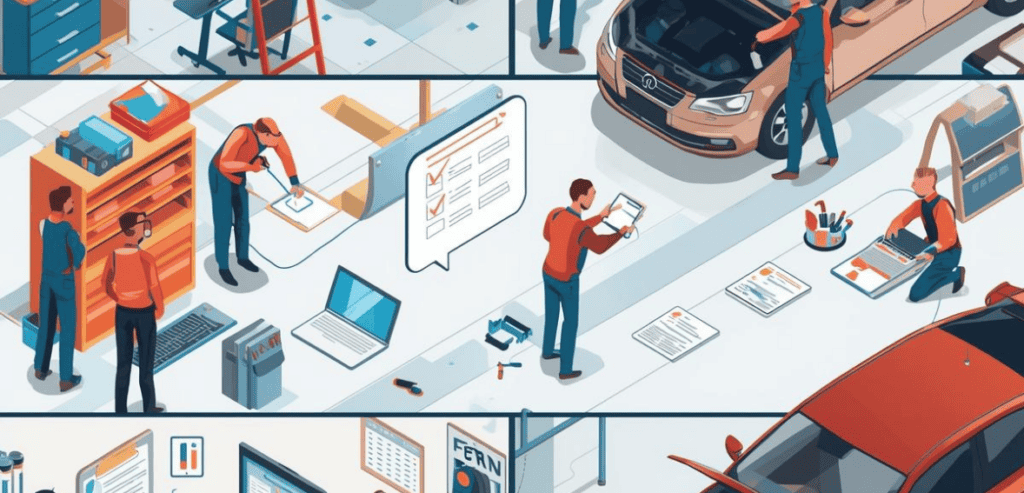
The first step in resolving waste is identifying the source, which is necessary to address any wasteful activities. Most often, the reason an auto shop has low capacity is not because of a lack of skills or any fault by an employee. It relates to other factors, such as excessive friction.
The time a technician spends finding tools, clarifying work orders, or waiting for supervisor approval reduces productivity. The time lost in these activities affects not only the in-hand task but also delays subsequent jobs on the schedule. Once the problems and their sources are identified, you can determine the targeted solutions to unlock productivity.
Map Your Current Auto Shop Workflows
To increase productivity, you must first identify where time and profit are lost. Illustrating the whole workflow from when the customer comes into contact with the auto shop to when they recover their vehicle. This will include initial contact, inspection, check-in, approval, repairs, quality control, customer delivery or vehicle return, and payment.
When these tasks are listed, inefficiencies will become visible rather than hidden. Throughout this process, there will be instances when the vehicle is parked idle while technicians wait for information or approvals, resulting in delays. Working through these problems will optimize the automotive repair process and maximize productivity.
Optimize Job Scheduling and Bay Utilization

A majority of auto repair shops are typically not overworked. Immediate gains can be achieved by examining how repair shops schedule jobs. The goal should be to set up the shop schedule to maximize efficiency based on the type of repair, rather than on a first-come, first-served basis. Scheduling by job type will help streamline the repair process.
Analysis of complex repairs should typically be completed early, and maintenance or quick repairs should be scheduled for later. This will reduce technician downtime and eliminate common slowdowns.
Reducing the time a vehicle is idle or waiting for repair is equally important to maximizing an auto repair shop’s efficiency. Vehicles at a repair facility often face long waits. By reducing wait times through faster inspection and quicker customer follow-up, an auto repair facility can increase the number of vehicles completed in a day.
Reducing Decision Fatigue Through Standardized Processes
Inconsistency in procedures causes delays for everyone involved in an auto shop’s operations. If no two technicians use the same process or documentation style, service advisors will have to clarify issues for customers, and technicians will experience delays in obtaining approvals for their work.
Standard operating procedures provide everyone in the auto shop with a clear, efficient method for doing their work. By using standardized inspection checklists, repair processes, and quality control procedures, rework is eliminated. Technicians will know exactly what they are supposed to do, in what order they should perform their tasks, and how to document their findings. Service advisors can easily review inspection results and make recommendations to customers without wasting time.
Therefore, standardization does not compromise the quality of craftsmanship in auto shops. Instead, standardization eliminates unnecessary variables, enabling highly skilled technicians to perform their work at peak efficiency without delays.
Using Digital Inspections

The time required to complete the process from start to finish is lengthened by using paper inspections and verbal explanations. Often, customer delays in approving work stem from a lack of a complete understanding of the issue and a lack of trust in technical recommendations.
Digital vehicle inspections help eliminate the barrier by enabling customers to easily review photos, videos, and written inspection notes.
Using digital inspections will reduce wait times, improve workflow, and enable more vehicles to be completed within a day at the automotive repair shop. Hence, taking advantage of to increase its automotive workflow optimization.
Train for Specialization, Not Generalization
Having a lot of versatility has its advantages, but expecting each technician to handle all types of repairs can slow down repair processes. If your technicians specialize in specific areas, they will perform those repairs faster and more accurately.
If one technician is assigned to analysis, another to suspension, and another to maintenance, a rhythm and pace can be established for those repairs. Repeating the same work allows technicians to increase their efficiency and reduce the risk of errors.
Auto repair shops that strategically align technicians’ strengths with the types of work they perform often see improvements in productivity and customer satisfaction.
Improve Communication Between Front and Back of the Shop
Miscommunication can occur and significantly impact productivity at several auto repair facilities. Using software on a single platform helps everyone stay in sync with one central location for real-time job status updates, automated repair, and shared notes. Having a single area where all information is stored, and technicians can collaborate efficiently.
Another area where production can be severely hampered is by unnecessary interruptions. Each time a technician has to go to a service, it costs valuable time. Using tools such as internal messaging applications, establishing clear documentation procedures, and improving service advisor training enable technicians to focus on their work.
They authorize repairs electronically, reducing customer decision times significantly and helping protect daily production levels.
Monitor Performance with Technology

To improve your business, you need to understand how well you’re doing overall by measuring performance. Using a variety of KPIs, inefficiencies can be proactively addressed across all levels of the business.
Knowing metrics such as average repair order time, technician productivity, bay utilization rates, and the number of cars serviced each day can help you pinpoint problem areas in your operation and identify where you are losing throughput within the shop. As auto shop owners analyze this data over time, they start to notice trends in their shop’s operation.
Technology does not replace experience; it provides the owner of your auto shop with valuable insights to make quicker, more informed business decisions.
Minimize Rework with Better Quality Control
Rework is one of the biggest productivity killers. Time spent on vehicles that come to the shop due to missed repair issues or incomplete repairs is time that could have been spent on new vehicles. Establishing basic quality control measures before delivering a vehicle, such as a final inspection checklist and a test-drive procedure, helps minimize comebacks and protects the shop’s daily capacity to take on new work.
By minimizing rework, auto repair shops create more available time, maintain a strong reputation, and improve their ability to deliver consistent daily work volumes.
Encourage Productivity
Many shop owners do not recognize how important their culture is. Once teams understand how their actions affect throughput and profit, they are more likely to find better ways to work together and be productive.
Clearly defining expectations, recognizing high performance, and sharing daily goals will help foster accountability across teams. Small rewards tied to productivity milestones will help keep teams focused without putting undue pressure on them.
By fostering a culture of steady progress and avoiding rush, auto shops will develop long-term solutions that do not depend on hiring more employees.
Balance Speed with Customer Experience
Customer trust must not be compromised to achieve increased throughput. In fact, faster service can enhance the customer experience, provided it is delivered transparently and with quality.
Anxiety is reduced by providing clear estimates, reasonable timelines, and regular customer updates, and indecisiveness can lead to bottlenecks. Customers will approve faster by knowing what to expect from their vehicle repair process, reducing the number of vehicles in the shop that need to be processed before dispatch.
For auto repair shops, operational efficiency and customer satisfaction are not mutually exclusive; they benefit one another.
Conclusion
The most successful auto repair shops are those that concentrate on optimizing automotive workflow, rather than just working harder. These businesses often eliminate friction from their operations, empower their employees, and let efficiency create growth. This strategic approach is not only wise but also critical to succeed in today’s competitive marketplace.
If you want to service more vehicles, increase profits, and reduce stress while operating with fewer personnel, the solution is to implement an optimal system.
When an auto repair business prioritizes efficiency and adopts automotive workflow optimization as an ongoing process, it will see enhanced customer satisfaction and improved profitability, along with reduced costs and risks associated with payroll growth.
FAQs
1. Are auto shops able to boost daily production without adding personnel?
Yes, there are many opportunities for an auto shop to increase efficiency by addressing workflow bottlenecks, reducing queue times, and improving scheduling.
2. What affects daily production the most in an auto shop?
The greatest impact on daily output is due to delays from customer responses in approvals, parts availability, and internal communications.
3. How do digital inspections benefit auto shops?
Digital inspections provide visual proof to the customer via digital photos and videos of the required work to expedite client approval and process vehicles through the shop quickly.
4. Is improving your schedule more helpful than increasing your number of technicians?
Yes. Leveraging better schedules and job assignments can provide available capacity without increasing labor costs.
5. When can an auto shop expect to see the result of workflow improvements?
Many shops have seen results within a few weeks after optimizing their processes to minimize downtime.