
Automotive Business Risk Management
Automotive businesses manage valuable vehicles, specialized equipment, customer data, hazardous materials, skilled employees, payment transactions, and time-sensitive services every day. A single breakdown in these areas can delay work, create unexpected costs, damage customer trust, or interrupt operations.
Automotive business risk management provides a structured way to understand these exposures and decide what should be prevented, reduced, transferred, monitored, or accepted.
It does not require eliminating every possible risk. Instead, it helps owners and managers protect critical assets while continuing to serve customers, employ staff, and pursue sustainable growth.
A practical risk program connects everyday procedures with financial controls, workplace safety, cybersecurity, insurance, customer communication, and emergency planning. The approach should match the organization’s size, services, facility, workforce, technology, vehicle volume, and operating environment.
What Automotive Business Risk Management Means
Automotive business risk management is the ongoing process of identifying events that could harm a business, evaluating how serious those events may be, and establishing controls to reduce their likelihood or impact.
The process applies to more than accidents and insurance claims. Automotive business risks can include incorrect repairs, equipment failure, employee injuries, stolen vehicles, damaged customer property, parts shortages, cash-flow problems, fraud, cyber incidents, environmental spills, customer disputes, and extended facility closures.
Effective automotive risk management protects several connected areas:
- Employees and contractors
- Customers and visitors
- Customer-owned vehicles
- Vehicle inventory and loaner units
- Buildings, tools, lifts, diagnostic equipment, and mobile service vehicles
- Cash, receivables, inventory financing, and profit margins
- Customer, employee, vehicle, and payment information
- Supplier relationships and parts availability
- Licenses, records, warranties, and operating permissions
- The organization’s reputation and ability to continue operating
Risk management does not mean avoiding every activity that could create a loss. Repairing vehicles, conducting test drives, storing inventory, accepting payments, towing disabled vehicles, and operating car-wash equipment all involve risk.
The objective is to operate within acceptable limits. A business may accept a minor scheduling risk but require strict controls for vehicle lifts, customer data, high-value inventory, or payment refunds.
Managers should distinguish between inherent risk and residual risk. Inherent risk is the exposure that exists before controls are applied. Residual risk is what remains after procedures, training, technology, insurance, and supervision have been introduced.
Creating an Automotive Risk Management Framework

A risk management framework turns general concerns into assigned, documented, and measurable actions. It should be practical enough for employees to use rather than becoming a document that remains unread.
The basic process is:
- Identify possible risks.
- Evaluate likelihood and potential impact.
- Prioritize the most serious exposures.
- Select preventive and response controls.
- Assign responsibility for each control.
- Document procedures and escalation points.
- Monitor incidents, warning signs, and performance.
- Update the plan when operations change.
Identifying, Evaluating, and Prioritizing Risks
Risk identification should examine every stage of the operation. A repair shop might review scheduling, intake, key handling, diagnosis, parts ordering, repair, quality control, invoicing, payment, and vehicle return.
A dealership may also examine vehicle acquisition, title documentation, inventory financing, test drives, trade-ins, and lot security.
Employees should participate because they often see problems that are not visible in management reports. Technicians may notice unreliable equipment, service advisors may identify repeated approval disputes, and accounting staff may recognize unusual refunds or reconciliation differences.
After identifying a risk, consider two questions:
- How likely is this event under current conditions?
- How serious would the consequences be?
Impact should include safety, financial loss, operational downtime, customer harm, regulatory exposure, data loss, and reputational damage. A low-frequency event may still require immediate attention when its potential consequences are severe.
Priorities should be based on evidence rather than personal preference. Incident reports, comeback records, equipment logs, customer complaints, chargeback reports, inventory differences, and near-miss observations can reveal where controls are weakest.
Building and Maintaining a Risk Register
A risk register is a central record of identified risks and the actions used to manage them. It can be maintained in a spreadsheet, management system, or controlled document.
Each entry should include:
- Risk description
- Affected asset or operation
- Possible causes
- Potential consequences
- Existing preventive controls
- Warning signs
- Assigned risk owner
- Response procedure
- Required insurance or contractual protection
- Review date
- Current status
For example, a repair shop might record the risk of customer vehicles being damaged while stored overnight. Existing controls could include intake photographs, designated parking, restricted key access, lighting, cameras, fencing, and closing inspections.
The response procedure could explain how to secure the scene, document damage, notify management, contact the customer, preserve records, and report the incident to the appropriate insurer.
Risk owners do not need to perform every control personally. They are responsible for confirming that procedures remain current, employees are trained, warning signs are reviewed, and corrective actions are completed.
An owner or manager can use this framework alongside a broader review of automotive business challenges to connect recurring operating problems with specific risk controls.
Common Automotive Business Risks and Controls

The following table provides a starting point for an automotive risk assessment. Controls should be adapted to the organization’s services, facility, equipment, contractual duties, workforce, and applicable requirements.
| Risk category | Example risk | Possible business impact | Warning signs | Preventive control | Response action |
| Operational | Diagnostic or repair error | Rework, delays, added costs, customer dispute | Repeat complaints, incomplete repair orders | Inspection standards, technical review, final quality checks | Stop release, reinspect, document findings, contact customer |
| Financial | Insufficient cash for payroll or suppliers | Delayed payments, restricted operations | Falling cash balance, overdue receivables | Cash forecast, reserves, spending approvals | Prioritize critical payments and revise forecasts |
| Safety | Improper lift use | Injury, vehicle damage, shutdown | Missing inspections, unusual noises, unsafe positioning | Training, pre-use checks, maintenance schedule | Stop equipment use, secure area, report incident |
| Inventory | Vehicle theft or unrecorded movement | Asset loss, financing problems | Missing keys, record differences, unusual access | Tracking, controlled keys, lot inspections | Preserve records, notify management and appropriate parties |
| Supply chain | Critical part unavailable | Repair delay, idle bays, dissatisfied customer | Repeated back orders, late deliveries | Alternative suppliers, availability checks, reorder points | Update schedule, source approved alternative, notify customer |
| Cybersecurity | Compromised email or software account | Data exposure, fraud, downtime | Unusual logins, changed payment instructions | Multifactor authentication, access control, updates | Isolate access, reset credentials, preserve logs, activate response plan |
| Payment | Unauthorized card-not-present transaction | Chargeback, lost goods or services | Mismatched details, unusual order behavior | Verification procedures and transaction monitoring | Retain evidence, investigate, respond through required channel |
| Employee | Internal theft or access misuse | Financial loss, data exposure | Unexplained adjustments, after-hours access | Role-based permissions, review logs, separation of duties | Suspend access, preserve evidence, investigate consistently |
| Compliance | Missing required disclosure or record | Complaint, penalty, operating restriction | Incomplete forms, expired permissions | Compliance calendar and document review | Correct records and obtain qualified guidance |
| Environmental | Improper fluid or battery handling | Spill, cleanup cost, unsafe exposure | Unlabeled containers, leaks, mixed waste | Labeled storage, inspections, disposal procedures | Contain spill, protect people, document and report as required |
| Reputation | Poorly handled customer dispute | Lost trust, negative reviews, lost referrals | Repeated complaints, delayed responses | Written approvals, updates, complaint process | Review evidence, communicate professionally, document resolution |
The table should not be treated as a universal checklist. A mobile mechanic will have different priorities from a collision center, while a vehicle retailer will face greater inventory, title, financing, and test-drive exposure.
Review the table with employees and ask for actual examples. Specific observations such as “three keys were left outside the cabinet last week” are more useful than broad statements such as “key control needs improvement.”
Operational Risk and Workplace Safety
Automotive operational risk arises when people, equipment, parts, information, utilities, or procedures fail to work as expected. Common examples include equipment breakdowns, incorrect parts, incomplete documentation, overbooking, poor quality control, internet outages, lost keys, and inconsistent handoffs between employees.
A useful repair-shop operations guide explains how scheduling, intake, inspections, estimates, parts coordination, workflow, quality checks, payments, and reporting affect one another.
Preventing and Responding to Operational Failures
Standard operating procedures should cover tasks that create repeated exposure. Examples include appointment intake, vehicle movement, key handling, parts verification, equipment inspections, customer authorization, final checks, invoice adjustments, refunds, and incident escalation.
Equipment should have an inspection and maintenance schedule based on manufacturer instructions, actual use, operating conditions, and qualified professional guidance. Employees should know how to identify abnormal sounds, leaks, damaged cords, unstable movement, warning lights, or calibration concerns.
When a failure occurs, the first priority is to protect people and property. The business should stop the affected activity, secure equipment or vehicles, preserve relevant records, and assign a person to coordinate the response.
The incident should then be reviewed for root causes. Replacing a failed part may restore the equipment, but it does not explain whether inspections were missed, maintenance was delayed, employees lacked training, or the equipment was being used outside its intended conditions.
Track operational indicators such as:
- Repairs waiting for parts
- Jobs waiting for customer approval
- Equipment downtime
- Repeated invoice corrections
- Lost or misplaced keys
- Comeback work
- Schedule overruns
- Unplanned vehicle movement
- Missed final inspections
Managing Workplace Health and Safety
Automotive work may involve lifts, power tools, batteries, welding, chemicals, heavy components, moving vehicles, noise, sharp materials, slippery surfaces, and repetitive physical tasks.
Official automotive workplace safety guidance identifies chemical and physical hazards involving refinishing materials, welding fumes, noise, lifts, tools, and oil or grease on walking surfaces.
Safety responsibilities should be assigned rather than assumed. Managers should determine who conducts inspections, maintains training records, replaces protective equipment, checks chemical labels, investigates incidents, and verifies that corrective actions are completed.
Training should be specific to the employee’s role and equipment. A new technician may require instruction on lift points, battery handling, tool guards, vehicle movement, emergency stops, spill response, and reporting near misses. Refresher training may be appropriate after equipment changes, unsafe observations, incidents, or extended absences.
Fatigue is also an operational risk. Excessive overtime, rushed work, heat, poor scheduling, and repeated interruptions can increase mistakes. Managers should watch for declining concentration, shortcuts, incomplete notes, and unusual rework.
This discussion is general education, not legal or regulatory advice. Requirements should be verified for the facility, workforce, equipment, materials, and jurisdiction.
Protecting Customer Vehicles and Managing Inventory Risk
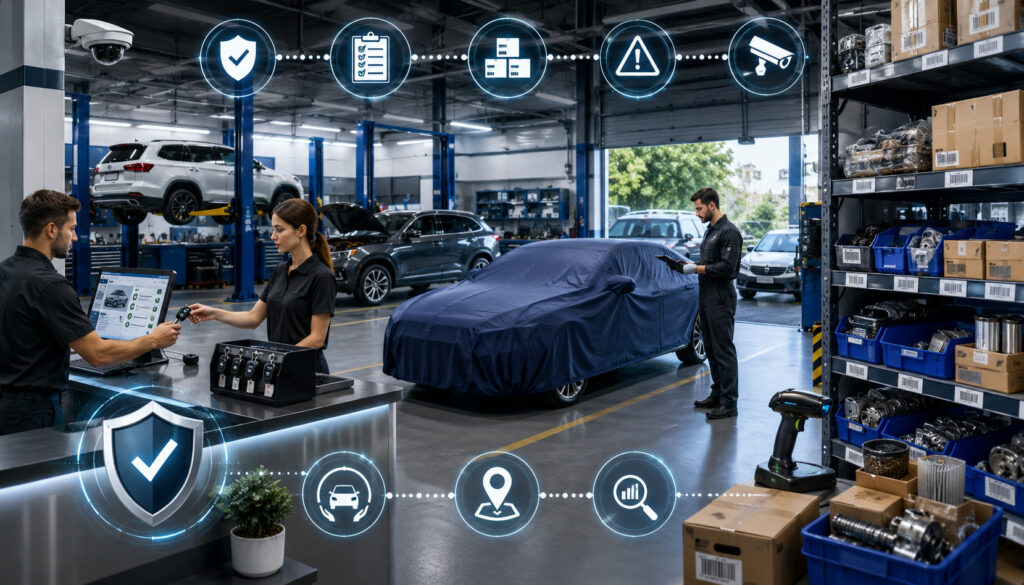
Vehicles may be exposed while being inspected, repaired, stored, transported, cleaned, tested, displayed, rented, or returned. Because condition disputes can be difficult to resolve after the fact, documentation and controlled custody are central to dealership risk management and auto repair shop risk management.
Customer Vehicle, Test-Drive, Rental, and Loaner Controls
Vehicle intake should record identifying information, mileage, fuel level when relevant, visible damage, personal property concerns, warning lights, keys received, and the customer’s stated reason for the visit. Photographs should be clear, time-associated, and stored with the work record.
Key controls should identify who received, moved, used, and returned each key. Keys should not be left in unattended vehicles, open work areas, or locations accessible to unauthorized people.
Before a test drive, the business should confirm authorization, the purpose of the drive, the permitted driver, expected route or operating conditions, and any known vehicle limitations. Employees should document mileage and unusual conditions discovered during the drive.
Rental and loaner procedures may include:
- Driver and identity verification
- Vehicle condition reports
- Permitted-use restrictions
- Fuel and mileage records
- Maintenance confirmation
- Key and document control
- Damage reporting instructions
- Tracking where appropriate
- Defined return procedures
Contract terms, insurance responsibilities, and liability questions can vary. Businesses should obtain qualified guidance rather than assuming a standard form is enforceable in every situation.
Controlling Vehicle Inventory Risk
Vehicle inventory risk includes theft, weather damage, vandalism, depreciation, aging stock, inaccurate records, title problems, carrying costs, and changing customer demand. Inventory may also be exposed when vehicles are transferred between sites, taken for service, loaned, photographed, or used for demonstrations.
A daily or scheduled lot-control process should compare physical vehicles with inventory records. Investigate missing keys, unexpected mileage, undocumented movement, open windows, low batteries, warning lights, fluid leaks, tire damage, and vehicles parked outside assigned areas.
Access controls should cover employees, contractors, delivery drivers, cleaning crews, and after-hours visitors. High-value keys and documents should have stricter controls than general office supplies.
Management should monitor:
- Days held in inventory
- Financing or carrying expense
- Price reductions
- Reconditioning delays
- Missing documentation
- Unresolved title or ownership issues
- Damage awaiting repair
- Unexplained mileage
- Inventory-record differences
Appropriate insurance can transfer part of the financial exposure, but it does not replace physical security, accurate records, controlled access, or timely inventory reviews.
Supply-Chain and Vendor Risk Management
Automotive supply chains can be disrupted by parts shortages, delivery delays, defective components, inaccurate orders, supplier failure, price changes, transportation interruptions, and dependence on a single source.
Vendor management should begin before an urgent order is needed. Businesses should evaluate whether a supplier consistently provides correct parts, reliable delivery estimates, traceable components, understandable warranties, secure ordering methods, and responsive problem resolution.
Purchase controls should require employees to verify the vehicle, part number, specification, quantity, price, delivery expectation, return conditions, warranty terms, and repair order before submitting an order. Received items should be compared with the purchase record before installation or resale.
Counterfeit, damaged, or unsuitable components can create product liability, safety, and reputation risks. Employees should be trained to question inconsistent packaging, altered labels, unusual pricing, missing documentation, or components that do not match expected specifications.
Practical supply-chain controls include:
- Maintaining approved supplier lists
- Identifying alternative sources for critical items
- Recording supplier delays and order errors
- Using reorder points for frequently consumed materials
- Separating ordered parts by vehicle or job
- Retaining warranty and return documentation
- Reviewing price changes before customer estimates are finalized
- Avoiding excessive stock that may become obsolete
- Monitoring supplier cybersecurity and account access
A business should also plan how it will communicate a delay. Customers should receive updated completion expectations before the original deadline passes. The record should explain what is delayed, what alternatives were considered, and whether the customer approved any change.
Financial, Cash-Flow, Pricing, and Profitability Risks
Automotive financial risk can develop even when sales appear strong. Inventory purchases, payroll, rent, equipment payments, supplier bills, insurance, utilities, taxes, refunds, warranty work, and financing obligations may require cash before customer payments are collected.
Managing Cash Flow and Financial Controls
A rolling cash forecast should estimate incoming and outgoing cash rather than relying only on revenue. The forecast should account for seasonal demand, delayed receivables, deposits, inventory purchases, financing payments, large equipment expenses, insurance reimbursements, chargebacks, and planned tax obligations.
Financial controls should define who may:
- Approve purchases
- Add or change vendors
- Issue refunds
- Adjust invoices
- Write off balances
- Accept customer credit
- Change payroll records
- Move money between accounts
- Access accounting reports
Separation of duties reduces the risk that one employee can create, approve, and conceal an improper transaction. Smaller businesses may not be able to separate every function, but owners can add compensating controls such as independent statement reviews, approval alerts, transaction limits, and periodic external review.
Reserves should be based on actual operating exposure rather than a universal formula. A business with expensive inventory, weather-sensitive operations, or long insurance receivables may need a different buffer from a mobile service provider with lower fixed costs.
This information is educational and should not be treated as investment, accounting, tax, or financing advice.
Controlling Pricing and Profitability Risk
Pricing risk occurs when the business charges less than the full cost of delivering a service or fails to update prices as costs change. Common causes include incorrect labor rates, underestimated repair time, unrecorded technician hours, missing shop supplies, untracked parts costs, excessive discounts, and unprofitable warranty obligations.
Job costing should compare estimated and actual labor, parts, subcontracted work, materials, discounts, and rework. A profitable-looking invoice may produce a weak margin when technician time, processing costs, waste disposal, equipment use, and administrative effort are excluded.
Review profitability by service category rather than only by total revenue. Routine maintenance, complex diagnostics, collision work, detailing, towing, fleet contracts, ecommerce orders, and warranty services may have very different cost structures.
Managers should investigate:
- Services with frequent overruns
- Jobs requiring repeated corrections
- Discounts that lack approval
- Parts sold below target margin
- Unbilled diagnostic time
- High warranty or comeback costs
- Technician time that cannot be matched to work orders
- Customer segments with slow payment patterns
Pricing reviews should support sustainable service rather than surprise increases. Estimates, authorization procedures, and customer communication should remain clear whenever pricing changes.
Payment Processing, Fraud, Cybersecurity, and Data Privacy
Automotive businesses may accept payments at a counter, through mobile devices, by telephone, through invoices, online, or through recurring account arrangements. Each method creates different verification, access, fraud, and reconciliation concerns.
Reducing Payment and Refund Risk
Payment risks include stolen credentials, card-not-present fraud, chargebacks, refund abuse, employee misuse, duplicate charges, insecure devices, weak permissions, and differences between invoices, transactions, settlements, and deposits.
Employees should not write payment information on repair orders, email it through unsecured channels, or retain it without a defined business and compliance need.
A small-merchant payment security guide explains that encryption and tokenization can reduce the usefulness of payment data if it is intercepted or stolen, while also emphasizing the importance of reducing unnecessary storage.
Access should reflect job responsibilities. A service advisor may need to accept a payment but not change bank details, create users, or issue large refunds without approval.
Daily reconciliation should compare:
- Completed invoices
- Recorded payment methods
- Refunds and adjustments
- Payment-system totals
- Settlement reports
- Bank deposits
- Outstanding differences
Chargeback evidence may include the signed or digital authorization, invoice, work order, customer communications, proof of delivery or vehicle release, refund policy, and transaction record. Retention procedures should reflect contractual and applicable recordkeeping requirements.
Protecting Systems and Sensitive Information
Automotive businesses may store customer contact details, vehicle information, employee records, photographs, repair history, accounting data, ecommerce credentials, supplier accounts, and payment-related information. Connected diagnostic systems, cameras, mobile devices, scheduling platforms, and remote access can expand the number of entry points.
Strong passwords should be unique, and multifactor authentication should be enabled where supported, particularly for email, accounting, administrator, cloud, vendor, and remote-access accounts. Official multifactor authentication guidance explains that requiring more than one verification method adds protection when a password is compromised.
Additional controls include:
- Role-based system permissions
- Prompt removal of former-user access
- Software and device updates
- Tested backups
- Approved-device rules
- Email and phishing awareness
- Secure wireless configurations
- Vendor-access reviews
- Screen-lock requirements
- Encryption where appropriate
- Incident-reporting instructions
An automotive cloud security practices guide provides additional context for protecting cloud accounts, permissions, integrations, backups, and vendor access.
No security measure eliminates all risk. The business should maintain an incident-response plan covering isolation, credential changes, log preservation, qualified technical assistance, required notifications, customer communication, recovery, and post-incident review.
Employee, Compliance, and Environmental Risks
People are essential to automotive operations, but staffing gaps, insufficient training, misconduct, turnover, fatigue, and dependence on key employees can create significant operational exposure.
Employee and Staffing Controls
Technician shortages may increase overtime, schedule pressure, and dependence on a small number of experienced workers. Businesses should avoid assigning work beyond an employee’s training, authorization, or demonstrated ability.
Documented procedures and cross-training reduce dependence on one person. Critical knowledge involving supplier accounts, payroll, customer approvals, software administration, equipment operation, and closing procedures should not exist only in an employee’s memory.
Role-based access should apply to physical and digital resources. A technician may need customer vehicle keys but not payroll records. A bookkeeper may need accounting reports but not unrestricted refund permissions.
Background checks may be appropriate for certain responsibilities where permitted and relevant. The process should be consistent, job-related, respectful of applicant rights, and reviewed with qualified guidance.
Performance reviews should consider technical quality, documentation, safety, communication, attendance, access use, and compliance with procedures. Employees also need a reliable way to report safety concerns, harassment, suspected theft, fraud, or unethical conduct without retaliation.
Succession planning is especially important when one owner or manager controls all banking, passwords, vendor relationships, approvals, and customer escalations.
Compliance and Environmental Controls
Automotive compliance risks may involve licensing, workplace practices, safety, consumer disclosures, repair authorizations, vehicle sales, financing, warranties, advertising, environmental handling, employment, privacy, and payment security.
Requirements vary by business model and jurisdiction. Owners should maintain a compliance calendar for renewals, inspections, filings, training, waste records, insurance documents, and policy reviews.
Automotive materials requiring controlled handling may include oil, fuel, batteries, tires, refrigerants, paint, solvents, filters, absorbents, and wastewater. Official vehicle-maintenance environmental guidance explains that floor drains, sinks, and other disposal systems receiving vehicle-maintenance fluids may create regulated environmental exposure.
Practical environmental controls include:
- Labeled and compatible containers
- Closed storage where required
- Secondary containment
- Routine leak inspections
- Accessible spill materials
- Employee training
- Approved waste and recycling providers
- Disposal and pickup records
- Separation of incompatible materials
- Clear wastewater procedures
After a spill, employees should protect people, stop the source when safe, prevent spreading, follow the site response procedure, preserve documentation, and obtain professional assistance where needed.
Insurance, Customer Disputes, and Reputation Risk
Insurance transfers part of a financial risk to another party under defined terms. It does not prevent injuries, vehicle damage, cyber incidents, fraud, or customer disputes.
Automotive businesses may consider coverage such as:
- General liability
- Commercial property
- Garage liability
- Garagekeepers coverage
- Commercial auto
- Workers’ compensation
- Product liability
- Cyber coverage
- Business interruption
- Equipment breakdown
- Employment-related coverage
Coverage names, limits, deductibles, exclusions, endorsements, eligibility, and claims requirements vary. A business should explain its operations accurately to qualified insurance professionals, including vehicle storage, test drives, towing, mobile work, loaner vehicles, ecommerce sales, customer property, hazardous materials, and subcontracted services.
Policies should be reviewed after changes in services, locations, equipment, staffing, revenue, inventory, or technology. Owners should also understand exclusions rather than assuming a familiar policy name covers every exposure.
Customer disputes often involve estimates, unauthorized work, delays, parts quality, warranties, billing, refunds, or vehicle condition. Written estimates, photographs, approvals, inspection notes, invoices, and status updates provide a shared record.
General consumer guidance about auto repairs emphasizes reviewing repair charges, warranties, estimates, and authorization expectations. Businesses can use these expectations to make their own communication and documentation more transparent.
When a complaint occurs:
- Listen without interrupting.
- Review the work order and evidence.
- Separate confirmed facts from assumptions.
- Explain what the business can investigate.
- Set a realistic response time.
- Document discussions and decisions.
- Escalate safety, legal, insurance, or fraud concerns.
Professional complaint handling protects reputation even when the business and customer initially disagree.
Automotive Business Continuity and Emergency Planning
Automotive business continuity focuses on keeping critical operations available or restoring them after disruption. Possible events include fire, flooding, severe weather, equipment failure, power loss, internet outage, cyberattack, supplier disruption, employee shortage, facility closure, or payment-system downtime.
A continuity plan should identify critical services, acceptable downtime, minimum staffing, required equipment, essential data, key suppliers, emergency contacts, and alternative work methods. Official business continuity planning guidance recommends organizing responsibility, documenting a continuity plan, and testing the plan rather than assuming it will work.
Backup procedures may include:
- Printed emergency contacts
- Offline customer and vehicle release procedures
- Manual payment or invoice instructions
- Tested data restoration
- Alternate internet access
- Safe shutdown procedures
- Backup equipment or service providers
- Alternative parts suppliers
- Temporary vehicle-storage arrangements
- Customer notification templates
- Insurance and asset documentation
- Remote access for authorized employees
Emergency communication should explain what happened, which services are affected, what customers should do, and when another update will be provided. Avoid making promises before the operational situation is understood.
After recovery, reconcile manual invoices, payments, inventory movements, employee time, customer approvals, repairs, refunds, and data entered during the disruption. Conduct a post-incident review and update the plan based on what worked and what failed.
Risk Priorities by Automotive Business Type
Risk priorities should reflect how each business earns revenue and handles vehicles, equipment, customers, and information.
New- and used-vehicle dealerships usually place greater emphasis on inventory financing, theft, weather exposure, title documentation, test drives, trade-ins, advertising, financing disclosures, and aging inventory.
Independent repair shops often prioritize diagnosis, authorization, vehicle custody, lift safety, parts availability, technician training, quality control, comeback work, and scheduling.
Collision centers may face added exposure involving refinishing chemicals, welding, structural repairs, supplements, insurer communication, parts delays, vehicle storage, and long repair cycles.
Mobile mechanics depend on route planning, portable tools, mobile payment security, technician safety, customer-property access, weather conditions, commercial vehicles, and reliable communication.
Parts retailers should focus on stock accuracy, theft, counterfeit components, compatibility errors, product liability, warranties, returns, supplier performance, and ecommerce fulfillment.
Automotive ecommerce sellers may prioritize card-not-present fraud, account takeover, payment-page security, inventory accuracy, shipping damage, return abuse, privacy, and third-party platform access.
Rental and leasing businesses need strong driver verification, maintenance schedules, condition records, mileage monitoring, damage reporting, permitted-use rules, tracking, and return inspections.
Fleet-service providers often manage preventive maintenance deadlines, vehicle availability, account authorizations, consolidated billing, parts planning, roadside incidents, and service-level commitments.
Towing companies may face risks involving roadside safety, vehicle loading, property custody, storage security, dispatch accuracy, driver fatigue, equipment maintenance, and disputed vehicle condition.
Car washes and detailing businesses commonly focus on vehicle movement, chemical handling, water systems, equipment entanglement, customer-property concerns, slips, damage documentation, and weather-sensitive demand.
These differences explain why copying another organization’s risk plan can be ineffective. Controls should match the actual operating model rather than the general automotive category.
Common Automotive Risk Management Mistakes
One of the most common mistakes is relying only on insurance. Insurance may reimburse certain covered losses, but it cannot restore every customer relationship, recover all lost time, or correct poor operating procedures.
Other recurring mistakes include:
- Failing to document vehicle condition
- Allowing uncontrolled access to keys
- Skipping equipment inspections
- Treating employee training as a one-time event
- Depending on one supplier
- Storing payment information unnecessarily
- Sharing software accounts
- Failing to reconcile payments and refunds
- Using outdated emergency contacts
- Ignoring minor customer complaints
- Operating without backup procedures
- Failing to review policy exclusions
- Leaving risk ownership undefined
- Updating procedures only after a serious incident
A useful review of common automotive business mistakes can help managers identify weak operational habits that may not initially appear on an insurance or compliance checklist.
Another mistake is treating risk management as a one-time project. New employees, suppliers, software, equipment, services, locations, and payment methods can introduce exposures that did not exist when the original plan was written.
Finally, businesses sometimes create controls that employees cannot realistically follow. Procedures should be tested during normal operations and revised when they create confusion, duplicated work, or undocumented workarounds.
Building an Automotive Risk Management Plan
A written automotive risk management plan should explain what must be protected, who is responsible, how controls operate, and what happens when an incident occurs.
Use the following process:
- List assets and critical operations: Include employees, customer vehicles, inventory, buildings, keys, equipment, data, supplier relationships, cash, records, software, utilities, and reputation.
- Identify internal and external risks: Review workflows, prior incidents, near misses, complaints, chargebacks, outages, equipment logs, supplier performance, and environmental conditions.
- Rate likelihood and impact: Use consistent descriptions such as low, moderate, and high rather than unsupported mathematical precision.
- Prioritize severe exposures: Address risks that could seriously harm people, customers, business continuity, data, or financial stability.
- Assign risk owners: Name the role responsible for monitoring each risk and completing corrective actions.
- Establish preventive controls: Use training, inspections, permissions, approvals, physical security, documentation, maintenance, reconciliation, and vendor controls.
- Create response procedures: Explain who stops work, protects people, secures property, preserves evidence, communicates with customers, and contacts qualified assistance.
- Review insurance coverage: Compare actual operations with declared activities, limits, exclusions, deductibles, and documentation requirements.
- Train employees: Provide role-specific instruction and practical scenarios rather than distributing policies without explanation.
- Test emergency plans: Practice responses to outages, equipment failure, unavailable staff, cyber incidents, fires, spills, and payment downtime.
- Track incidents and warning signs: Maintain records of injuries, near misses, damage, complaints, rework, fraud attempts, supplier failures, and unexplained financial differences.
- Review and update the plan: Revisit it after incidents, operational changes, new technology, staffing changes, insurance renewals, facility changes, or recurring warning signs.
A management review should ask:
- Are controls actually being followed?
- Do employees understand escalation procedures?
- Have new risks appeared?
- Are incidents repeating?
- Are insurance descriptions still accurate?
- Can critical data be restored?
- Are emergency contacts current?
- Have suppliers or systems become single points of failure?
The completed plan should be accessible to the people who need it. Sensitive details such as passwords, security layouts, and banking controls should be protected separately.
Frequently Asked Questions
What is automotive business risk management?
It is a structured process for identifying events that could harm an automotive business and selecting practical ways to prevent, reduce, transfer, monitor, and respond to them. It covers people, vehicles, equipment, finances, data, suppliers, customers, compliance, reputation, and continuity. The process should be updated as operations change.
What are the biggest risks facing automotive businesses?
The most important risks depend on the business model. Common exposures include workplace injuries, vehicle damage, theft, equipment breakdowns, diagnostic errors, parts shortages, cash-flow pressure, fraud, cyber incidents, compliance failures, environmental spills, customer disputes, and prolonged operating interruptions.
How can an auto repair shop reduce liability risks?
A shop can use consistent vehicle intake records, photographs, written estimates, documented approvals, trained technicians, equipment inspections, quality-control checks, secure key handling, accurate invoices, and professional complaint procedures. It should also verify applicable requirements and maintain insurance aligned with its actual operations.
How should dealerships manage vehicle inventory risks?
Dealerships should combine physical inventory checks, controlled key access, vehicle tracking, title-document controls, lot inspections, security measures, mileage reviews, aging reports, and appropriate insurance. Differences between physical vehicles and inventory records should be investigated promptly rather than corrected without explanation.
What insurance may an automotive business need?
Possible coverages include general liability, property, garage liability, garagekeepers, commercial auto, workers’ compensation, product liability, cyber, business interruption, equipment breakdown, and employment-related coverage. Needs vary according to services, property, vehicles, employees, contracts, storage practices, and jurisdiction.
How can automotive businesses reduce payment fraud?
They can use secure payment devices, limit permissions, avoid unnecessary storage of card information, monitor unusual transactions, control refunds, verify card-not-present activity, protect ecommerce accounts, and reconcile invoices, transactions, settlements, and deposits. Employees should know how to escalate suspicious activity.
Why is cybersecurity important for automotive companies?
Automotive businesses depend on email, scheduling, accounting, diagnostic, ecommerce, payment, camera, inventory, and customer-management systems. A compromised account can interrupt operations, expose information, redirect payments, or enable fraud. Password controls, multifactor authentication, updates, backups, training, and response planning reduce exposure.
How can businesses manage parts and supply-chain disruptions?
Businesses should evaluate suppliers, record performance, identify alternative sources, verify availability before promising completion dates, maintain reasonable stock for frequently used items, and document warranties and returns. Customers should receive early updates when shortages affect price, timing, or repair options.
What should be included in an automotive risk register?
A risk register should identify the risk, affected operation, cause, possible impact, existing controls, warning signs, risk owner, response actions, insurance or contractual protection, status, and review date. It should record specific exposures rather than vague concerns.
How often should a risk management plan be reviewed?
The plan should be reviewed regularly and whenever significant changes occur. Triggers include new services, equipment, software, locations, payment methods, suppliers, staffing models, insurance terms, incidents, near misses, complaints, or recurring control failures.
How can employee training reduce automotive business risks?
Training helps employees use equipment correctly, document work, protect vehicles, handle payments, recognize fraud, manage chemicals, secure data, respond to emergencies, and escalate unusual situations. Training should be role-specific, documented, practiced, and refreshed when procedures or exposures change.
Conclusion
Effective automotive business risk management requires more than purchasing insurance or reacting to incidents. It combines regular risk assessment, documented procedures, trained employees, secure technology, accurate records, financial controls, appropriate coverage, supplier planning, customer communication, and tested emergency responses.
The strongest plans address both prevention and recovery. They explain how to reduce the likelihood of an incident and what employees should do when controls fail.
Every risk plan should reflect the organization’s business model, services, facility, equipment, workforce, customers, technology, vehicles, inventory, financial obligations, and operating environment.
By reviewing risks regularly and learning from incidents, near misses, complaints, and operational changes, automotive businesses can protect people and assets while maintaining dependable service.