
Automotive Business Models Explained
The automotive sector includes far more than vehicle manufacturing and sales. It supports dealerships, independent repair shops, parts distributors, rental fleets, software providers, detailing operations, towing companies, charging services, online marketplaces, and many other specialized businesses.
These automotive business models differ significantly in how they attract customers, generate revenue, control costs, and manage risk. A dealership may invest heavily in property and vehicle inventory, while a mobile mechanic can operate with fewer fixed assets but must carefully manage travel time and appointment density.
A software provider may rely on monthly subscriptions, whereas a collision-repair facility earns mainly from labor, parts, and insurance-related repair work.
Understanding these differences helps entrepreneurs avoid choosing a business based only on apparent demand or revenue potential. A model that works well for an experienced technician may be unsuitable for an investor without technical knowledge.
Likewise, an asset-heavy operation may create attractive expansion opportunities but expose the owner to depreciation, financing costs, and changing market conditions.
This guide explains the major automotive industry business models, their customers, revenue sources, operating requirements, risks, advantages, and growth opportunities. It is educational rather than legal, tax, financial, or investment advice.
Licensing, insurance, employment, environmental, franchise, consumer-protection, and operating requirements should always be verified for the specific location and business.
What Is an Automotive Business Model?
An automotive business model explains how an organization creates value for customers and turns that value into sustainable revenue. It identifies who the customers are, what problem the business solves, how services or products are delivered, what resources are required, and how the operation expects to earn more than it spends.
For example, an independent repair shop creates value by diagnosing and correcting vehicle problems. It may earn money from labor charges, parts markups, inspections, maintenance packages, diagnostic fees, and fleet-service agreements.
Its largest expenses may include technician wages, property, equipment, insurance, software, parts, waste handling, utilities, and training.
A complete automotive business model normally defines:
- Target customers: Individual drivers, dealers, fleets, insurers, repair shops, parts retailers, or other businesses.
- Value proposition: Convenience, expertise, availability, lower downtime, broader selection, faster service, or specialized knowledge.
- Revenue sources: Vehicle sales, labor, subscriptions, rentals, commissions, parts, referral income, or service contracts.
- Sales channels: Physical locations, websites, mobile applications, field-service teams, marketplaces, or business-to-business relationships.
- Operating structure: Facilities, employees, contractors, vehicles, tools, software, inventory, and supplier relationships.
- Cost structure: Fixed expenses, variable costs, financing, warranties, returns, customer acquisition, and compliance.
- Key partnerships: Manufacturers, lenders, parts suppliers, insurers, technology providers, towing networks, and fleet operators.
- Risk exposure: Depreciation, liability, fraud, skills shortages, equipment failure, supply interruptions, and changing regulations.
Many automotive businesses combine more than one model. A dealership may sell vehicles, arrange financing, operate a service department, sell parts, and offer protection products. A tire shop may combine retail sales, installation labor, alignments, fleet contracts, and seasonal storage.
Vehicle Sales and Automotive Retail Business Models

Vehicle retail is one of the most visible parts of the automotive industry, but dealerships and direct-sales operations do not all function in the same way. Their inventory sources, manufacturer relationships, financing arrangements, compliance responsibilities, and after-sales services can differ substantially.
New-Vehicle Dealerships
A new-vehicle dealership generally operates through a franchise relationship with a manufacturer. The agreement permits the dealership to represent specific vehicle lines while requiring it to follow standards for property appearance, signage, employee training, customer service, technology, inventory reporting, warranty work, and sales processes.
Revenue may come from new-vehicle sales, trade-ins, used-car sales, dealership financing, protection products, warranties, service contracts, parts, repairs, and manufacturer incentives. Vehicle sales often attract customers, while service and parts departments support longer-term relationships and recurring visits.
Major operating costs include showroom property, vehicle inventory, inventory financing, sales staff, service technicians, diagnostic equipment, parts stock, advertising, insurance, technology, and manufacturer-required improvements.
Vehicle allocation can also affect performance because a dealership may not receive the exact models, features, or quantities local buyers want.
The largest risks include slow inventory turnover, financing costs, price competition, manufacturer dependence, changing consumer demand, and expensive facility requirements. Strong after-sales service can reduce some of this exposure by creating repeat maintenance, warranty, and repair activity.
Independent Used-Vehicle Dealerships
Independent used-vehicle dealerships source inventory from trade-ins, auctions, wholesalers, rental fleets, off-lease channels, private sellers, and other dealers. Because each vehicle has a different condition and history, purchasing discipline is central to the used-car sales model.
Vehicles usually require inspection, cleaning, repairs, title verification, photography, pricing, and merchandising before sale. Revenue may come from the difference between acquisition and selling price, financing arrangements, service contracts, protection products, trade-ins, and related fees where permitted.
Inventory turnover is especially important. A vehicle that remains unsold continues to consume space and working capital while potentially losing value. Mechanical defects, incomplete records, title problems, unexpected reconditioning costs, and inconsistent supply can quickly weaken the expected margin.
Trust is another major factor. Buyers often cannot evaluate mechanical condition on their own, so inspection documentation, accurate listings, clear warranty terms, vehicle-history information, and transparent pricing can influence conversion and reputation.
Dealers should review applicable used-vehicle sales and disclosure guidance, including requirements related to buyer information and warranty disclosures.
Direct-to-Consumer Vehicle Sales
The direct-to-consumer vehicle sales model uses websites, digital purchasing tools, company-operated locations, delivery systems, and centralized support rather than relying entirely on independently owned franchised dealerships.
Customers may configure a vehicle, review pricing, arrange financing, upload documents, and schedule delivery through a digital process.
Potential advantages include greater control over pricing, customer data, branding, inventory presentation, and the purchasing experience. Centralized operations can also reduce differences between locations and make online and offline processes easier to coordinate.
However, the model creates logistical and regulatory challenges. Vehicle registration, dealer licensing, delivery, test drives, returns, repairs, warranty support, and trade-ins still require local capabilities. Some jurisdictions restrict manufacturer ownership of dealerships or direct manufacturer sales, so the available structure may vary significantly.
The business must also solve problems that traditional dealerships handle locally. Customers need access to demonstrations, test drives, delivery support, maintenance, collision repair, replacement parts, and warranty service.
A digital ordering system alone is therefore not a complete operating model; it must connect to physical infrastructure and responsive customer support.
Automotive Franchise and Service Business Models

Automotive service business models range from standardized franchise locations to highly independent technical operations. These businesses usually earn revenue from labor, parts, maintenance, repairs, and repeat customer relationships rather than from selling large numbers of vehicles.
Automotive Franchise Businesses
Automotive franchises can operate in repair, tires, oil changes, car washes, detailing, rental services, glass replacement, parts retail, and other categories. The franchisee typically receives a recognizable operating format, training, procedures, marketing materials, supplier arrangements, software, and ongoing support.
In exchange, the operator may pay an initial franchise fee, continuing royalties, advertising contributions, technology charges, renewal fees, and other required expenses. The franchise agreement may also control approved products, suppliers, pricing practices, territory, property design, employee appearance, hours, and customer-service procedures.
The model can shorten the process of developing a brand and operating system from the beginning. However, it reduces the owner’s freedom to change services, suppliers, branding, or strategy. Required renovations and purchasing rules may also increase costs.
Prospective franchisees should carefully review disclosure documents, restrictions, renewal terms, transfer conditions, dispute procedures, and financial assumptions. Applicable franchise disclosure requirements are designed to provide prospective buyers with material information before an investment decision.
Independent Auto Repair Shops
The auto repair business model primarily earns revenue by selling technician labor, diagnostic expertise, replacement parts, maintenance, inspections, and related services. Unlike vehicle retail, the shop does not usually need a large inventory of high-value finished products.
Daily operations begin with appointment scheduling or vehicle intake. A service advisor records the concern, a technician inspects or diagnoses the vehicle, the shop prepares an estimate, and the customer authorizes selected work. Parts are then ordered or taken from inventory, repairs are completed, quality checks are performed, and payment is collected.
Profitability depends on more than the hourly labor rate. Technician productivity, bay utilization, parts availability, accurate estimating, comeback control, appointment flow, and customer retention all affect results. Owners can use automotive data analytics to connect repair orders, labor hours, parts margins, approvals, payments, and capacity.
Major risks include technician shortages, expensive diagnostic equipment, parts delays, incorrect repairs, warranty claims, safety incidents, and reputation damage. A practical guide to independent repair shop growth can help owners evaluate scheduling, staffing, retention, and workflow before expanding.
Specialized Automotive Repair Businesses
Specialized repair businesses concentrate on a narrower service category, vehicle type, or technical problem. Examples include transmission repair, collision repair, glass replacement, tire services, exhaust systems, paint and bodywork, performance upgrades, electrical diagnostics, advanced driver-assistance calibration, diesel service, and electric-vehicle repair.
Specialization can improve diagnostic speed, technician expertise, equipment utilization, referral relationships, and pricing power. General repair shops may refer complex jobs they cannot perform efficiently, creating a valuable business-to-business channel.
The tradeoff is a narrower customer base. Demand for a specialty may vary by location, vehicle mix, season, insurance relationships, and technological change. Expensive equipment can also become underused when job volume is inconsistent.
Collision and refinishing operations face additional facility, ventilation, chemical, dust, welding, spray, and worker-safety requirements. Official autobody repair hazard guidance identifies both chemical and physical risks that facilities should address through training, equipment, controls, and safe procedures.
Successful specialists often diversify within a related field. A tire shop might add alignment and fleet inspections, while an electrical-diagnostics specialist might add programming, battery testing, and sensor calibration.
Mobile Mechanic Services
A mobile mechanic performs selected maintenance and repairs at homes, workplaces, roadside locations, parking facilities, or fleet yards. The model replaces a large workshop with a service vehicle, portable tools, scheduling software, insurance coverage, and a defined service area.
Startup intensity can be lower than a full repair facility, but the business still requires professional tools, diagnostic equipment, secure parts storage, a reliable vehicle, waste-handling procedures, and appropriate insurance. The owner must also determine which jobs can be completed safely outside a controlled workshop.
Convenience is the primary value proposition. Customers avoid arranging transportation or waiting at a shop, while fleet customers can reduce the time vehicles spend away from operations.
Travel time is the model’s central constraint. A technician may complete fewer billable jobs when appointments are spread across a large area. Weather, parking access, lighting, noise restrictions, parts errors, and unsafe working surfaces can also cause delays.
Growth usually comes from tightening service zones, grouping appointments geographically, focusing on repeatable jobs, adding fleet accounts, and using standardized service vehicles rather than accepting every type of repair.
Auto Parts Retail, Distribution, and Ecommerce Models
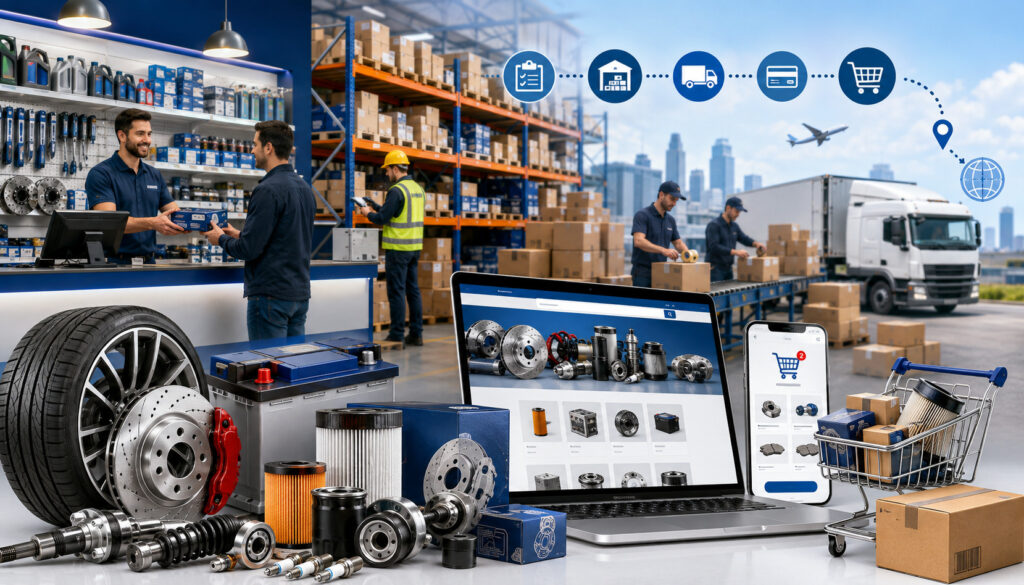
Parts businesses connect manufacturers, warehouses, repair facilities, vehicle owners, restorers, and specialty markets. Their success depends on supplying the correct component quickly while managing thousands of possible vehicle and part combinations.
Auto Parts Retail and Distribution
Auto parts retail includes physical stores, wholesale distribution, recycled-parts operations, specialty-component businesses, accessories retailers, tire suppliers, and business-to-business delivery networks. Customers may include individual vehicle owners, repair shops, collision centers, dealers, fleets, and other resellers.
Revenue usually comes from product markups, delivery fees, wholesale accounts, accessories, warranties, and related services. A distributor may operate on lower margins than a specialty retailer but process a higher volume of orders.
Inventory management is the main operational challenge. Stocking too little causes lost sales and repair delays, while stocking too much ties up cash in products that may become obsolete. Accurate demand forecasting, reorder points, supplier performance, returns, and inventory turnover therefore matter.
Fitment accuracy is equally important. A component may vary by engine, trim, production configuration, drivetrain, body style, or installed equipment. Incorrect parts create return costs, technician delays, damaged packaging, and dissatisfied customers.
Competitive businesses often combine local availability with rapid sourcing. They may stock fast-moving products while obtaining less common components from regional warehouses or specialist suppliers.
Automotive Ecommerce
Automotive ecommerce businesses sell parts, accessories, tires, tools, detailing products, service packages, and other vehicle-related items through websites or marketplaces. They can reach a broader market than a physical store, but they face significant catalog and fulfillment complexity.
The website must help buyers find compatible products using vehicle details, part numbers, dimensions, technical specifications, or guided search. Poor compatibility information can produce high return rates even when the product itself is not defective.
Revenue may come from product margins, marketplace commissions, shipping, subscriptions, promoted listings, installation referrals, or business-account pricing. Major costs include inventory, warehousing, shipping, packaging, returns, customer support, payment processing, fraud screening, marketplace fees, and digital advertising.
High-value orders and unusual purchasing patterns may require additional verification. Businesses also need clear policies for opened electrical components, installed products, core returns, hazardous materials, oversized items, and warranty claims.
Growth opportunities include private-label products, specialist catalogs, business-to-business accounts, installation partnerships, and improved search tools. However, adding more products without accurate data can increase support costs faster than sales.
Rental, Leasing, Subscription, and Fleet-Service Models
These mobility business models generate revenue from access to vehicles rather than immediate ownership. They can create recurring or repeat income, but they also expose the operator to depreciation, maintenance, insurance, utilization, and asset-financing risk.
Car Rental Businesses
Car rental businesses provide vehicles for daily, weekly, monthly, airport, neighborhood, replacement, luxury, commercial, or specialty use. Customers may include travelers, local residents, businesses, insurers, repair customers, and drivers needing temporary transportation.
Revenue comes from rental charges, mileage fees, optional protection, fuel charges, accessories, delivery, late returns, and other permitted services. The most important operating measure is utilization: a vehicle only generates rental revenue when it is available, reserved, and in service.
Major expenses include fleet acquisition, financing, depreciation, maintenance, insurance, cleaning, parking, registration, damage repair, reservation technology, and vehicle recovery. The company must balance having enough vehicles to serve demand against owning vehicles that may sit idle.
Damage documentation is essential. Inspection photos, mileage, fuel level, existing condition, customer authorization, and return records help reduce disputes. Pricing must also account for seasonality, vehicle class, reservation length, location, and replacement cost.
A rental operator can grow through business accounts, repair-shop partnerships, specialized vehicles, additional locations, or stronger fleet-utilization systems.
Vehicle Leasing Businesses
Vehicle leasing provides a customer with the right to use a vehicle for a defined term and payment schedule. Consumer leases and commercial leases may differ in purpose, tax treatment, mileage patterns, risk allocation, and contract structure.
The lessor generally earns from periodic payments, fees, financing economics, and the eventual sale or redeployment of the returned vehicle. Pricing depends heavily on the vehicle’s expected residual value, meaning its anticipated value when the lease ends.
Contracts may establish mileage limits, maintenance responsibilities, wear standards, insurance requirements, early-termination conditions, and purchase options. Businesses must estimate depreciation carefully because an incorrect residual assumption can reduce the value recovered at return.
Leasing differs from financing because payments do not normally build ownership unless the agreement includes and the customer uses a purchase option. It differs from short-term rental mainly in duration and contractual structure.
Vehicle Subscription Services
A vehicle subscription business charges a recurring fee for access to a vehicle or vehicle category. The fee may combine use of the vehicle with maintenance, registration, roadside assistance, and insurance-related services, depending on the program structure.
Subscriptions are designed to offer more flexibility than a traditional lease. Customers may be able to change vehicles, select shorter commitments, or avoid managing several separate ownership expenses.
That convenience creates operating complexity. The provider must coordinate fleet purchasing, financing, maintenance, cleaning, storage, vehicle swaps, insurance, customer screening, availability, and remarketing. Pricing must cover not only depreciation but also periods when a vehicle is being serviced or waiting for its next subscriber.
Cancellation terms, mileage limits, damage responsibility, availability promises, and included services must be clearly defined. A subscription that appears simple to the customer may require sophisticated fleet and pricing systems behind the scenes.
Growth depends on maintaining strong utilization while preserving enough flexibility to meet customer expectations. Expanding faster than the available fleet can damage service quality.
Fleet Management and Commercial Vehicle Services
Fleet management businesses help organizations acquire, maintain, monitor, operate, and replace work vehicles. Services may include preventive maintenance, fuel management, telematics, registration support, compliance records, route optimization, driver reporting, repair coordination, tire programs, and lifecycle planning.
Revenue is commonly generated through monthly management fees, per-vehicle charges, maintenance contracts, software subscriptions, consulting, markups, or shared-savings arrangements. This creates stronger recurring-revenue potential than many consumer automotive services.
Customers value vehicle uptime, cost visibility, accurate reporting, quick repair authorization, and predictable service levels. A delayed commercial vehicle can interrupt deliveries, field work, customer appointments, or employee productivity.
The provider must establish clear service-level expectations, approval limits, emergency procedures, reporting schedules, and payment terms. Integrations with repair networks, fuel systems, telematics platforms, and accounting tools may be necessary.
The model can scale by adding vehicles to existing accounts, serving additional industries, or offering more services. However, rapid growth without reliable repair capacity and customer support can lead to missed commitments and billing disputes.
Car Wash, Detailing, Towing, and Roadside Models
These automotive business types focus on appearance, convenience, recovery, and urgent support. They can serve broad local markets, but their economics depend heavily on location, routing, equipment reliability, response time, and repeat usage.
Car Wash and Detailing Businesses
Car-wash models include automatic tunnels, rollover systems, self-service bays, hand-wash operations, mobile detailing, premium studios, and fleet-cleaning services. Detailing businesses may add paint correction, interior restoration, protective films, ceramic coatings, headlight restoration, and odor treatment.
Revenue can come from individual washes, detailing packages, upgrades, fleet agreements, gift cards, and recurring memberships. Memberships can improve revenue predictability, although pricing must account for how often members use the service.
Fixed-site washes are highly location-dependent. Traffic flow, visibility, property access, competition, water availability, drainage, utilities, equipment maintenance, and weather can affect performance. Mobile detailers avoid major property costs but must manage travel, weather, vehicle setup, and access to water or power.
Quality control and customer expectations are important. Damage claims, inconsistent cleaning, long queues, equipment outages, and overselling premium services can weaken retention.
Growth may come from memberships, multiple sites, mobile fleet work, higher-value protective treatments, or improved throughput rather than simply lowering prices.
Towing and Roadside Assistance
Towing and roadside businesses provide vehicle transport, accident recovery, jump-starts, tire changes, lockout assistance, fuel delivery, parking enforcement, and contracted roadside services. Customers may include individual drivers, repair shops, property managers, insurers, fleets, and public agencies.
Revenue may be earned per call, per mile, through storage, through contracts, or through priority-service agreements. Demand can occur at any time, so many operations require dispatch coverage outside normal business hours.
The model is equipment-intensive. Tow trucks, recovery equipment, safety gear, communications systems, insurance, maintenance, fuel, storage property, and trained drivers represent substantial costs. Incorrect loading or recovery procedures can cause injury or vehicle damage.
Dispatch efficiency affects both customer experience and profitability. Long travel distances, traffic, weather, and unclear location information can reduce the number of calls each truck completes.
Growth opportunities include additional trucks, contracted accounts, heavy recovery, secure storage, fleet support, and wider service coverage. Expansion should be paced carefully because every new vehicle adds financing, staffing, insurance, and maintenance obligations.
Automotive Financing, Technology, Charging, and Marketplace Models
Some of the most scalable automotive industry models do not repair or own vehicles directly. They support transactions, data, customer communication, charging, software, and connections between buyers and sellers.
Automotive Financing and Related Services
Automotive financing may involve dealer-arranged loans, direct lending, leasing, loan referrals, warranties, service contracts, payment-protection products, or insurance-related referrals. Revenue can come from interest, referral compensation, administrative income, commissions, or product margins where permitted.
These activities require careful compliance because they involve consumer information, disclosures, advertising, pricing, eligibility, and contractual obligations. Licensing may apply to lending, insurance-related products, service contracts, or brokering activities.
Dealership financing can make vehicle purchasing more convenient, but customers should be able to understand the vehicle price, amount financed, term, rate, payment schedule, optional products, and total obligation. Businesses must avoid presenting optional services as mandatory.
Sensitive financial and identity information also requires protection. Applicable data safeguards for automobile dealers may require covered operations to maintain an information-security program and oversee service providers that handle customer data.
Financial products should support the vehicle transaction without obscuring its true cost or creating pressure to purchase unnecessary additions.
Automotive Software and Technology Businesses
Automotive software businesses serve dealerships, repair shops, parts sellers, fleets, rental operators, marketplaces, and vehicle owners. Products may include dealership-management systems, shop-management platforms, diagnostic tools, telematics, digital inspections, scheduling, inventory control, customer communication, payments, and reporting.
The common revenue model is a recurring software subscription. Additional income may come from setup, support, integrations, transaction fees, data services, training, or premium modules.
Software can scale without purchasing more physical inventory, but customer acquisition and support can be expensive. Automotive businesses may depend on the software for daily operations, so outages, inaccurate data, failed integrations, and slow support can have immediate consequences.
Data security, access controls, backups, privacy, and reliable integrations are therefore central operating requirements. Vendors also need onboarding systems that help employees adopt the product correctly.
Owners researching automotive technology and operating systems should evaluate whether a tool reduces real work or merely adds another disconnected system.
Electric-Vehicle Service and Charging Models
Electric-vehicle business opportunities include charger ownership, network operation, installation, maintenance, fleet charging, site management, battery diagnostics, thermal-system repair, electrical troubleshooting, and specialized technician training.
A charging-site owner may earn through energy charges, session fees, parking fees, memberships, retail traffic, fleet contracts, or property partnerships. An installation contractor earns from site design, equipment installation, electrical upgrades, permitting support, commissioning, and maintenance.
The economics depend on charger utilization, power costs, demand charges, equipment financing, site rent, maintenance, payment systems, and network fees. A charger in a weak location may remain underused even when overall vehicle adoption is growing.
Technical planning must consider available electrical capacity, charging speed, connector support, networking, accessibility, signage, safety, and future expansion. Official charging infrastructure planning guidance emphasizes procurement, installation, permitting, networking, interoperability, and operational considerations.
Specialized repair facilities must also invest in high-voltage safety procedures, insulated tools, battery-handling knowledge, diagnostic information, and technician training.
Automotive Marketplaces and Lead-Generation Platforms
Automotive marketplaces connect buyers, sellers, dealers, repair providers, parts suppliers, mobile mechanics, detailers, transport services, and other industry participants. The platform may facilitate discovery without owning the vehicle, part, or service being advertised.
Revenue can come from listing fees, subscriptions, advertising, lead charges, commissions, transaction fees, premium placement, financing referrals, or software services. Platform-based automotive revenue models can scale efficiently once they attract enough buyers and sellers.
The difficult stage is building trust and useful supply at the same time. Buyers will not use a marketplace with limited inventory, while sellers will not pay for listings that produce weak leads. This is the marketplace network-effect challenge.
Lead quality matters as much as lead volume. Duplicate requests, false information, unqualified buyers, fraudulent listings, and slow seller responses reduce value.
Successful platforms invest in verification, moderation, reviews, search quality, accurate listings, secure messaging, fraud prevention, dispute procedures, and measurable seller results. Expansion should protect trust rather than simply increasing listing volume.
Common Automotive Revenue Models
Automotive revenue models can be grouped according to how and when the customer pays. Understanding the category helps an owner evaluate cash flow, capacity, capital requirements, and risk.
Transactional revenue is earned from individual sales or services. Examples include vehicles, parts, repairs, towing calls, detailing packages, and charger sessions. It is easy to understand but may fluctuate with demand.
Recurring revenue comes from subscriptions, memberships, leases, fleet agreements, maintenance plans, software subscriptions, and service contracts. It can make revenue more predictable, but the business must continue delivering value throughout the contract.
Commission-based revenue is earned for arranging or referring a transaction. Examples include financing referrals, insurance-related referrals, marketplace commissions, and lead-generation fees. Licensing, disclosure, and contractual requirements may apply.
Asset-heavy revenue depends on expensive vehicles, facilities, equipment, or inventory. Dealerships, rental fleets, leasing businesses, car washes, and towing operations fit this category. These models may create strong barriers to entry but expose the operator to financing, depreciation, and utilization risk.
Platform-based revenue comes from connecting participants rather than owning the underlying product. Marketplaces, software platforms, booking services, and lead-generation businesses may earn subscriptions, listing fees, advertising, or transaction charges.
Typical automotive revenue sources include:
- One-time vehicle and product sales
- Technician labor charges
- Diagnostic and inspection fees
- Parts markups
- Rental and mileage charges
- Leasing payments
- Memberships and subscriptions
- Fleet-service contracts
- Service contracts and warranties
- Franchise fees and royalties
- Commissions and referral income
- Marketplace listings and advertising
- Software subscriptions
- Charging sessions and network fees
Businesses often benefit from combining complementary sources. A repair shop may add fleet maintenance, while a detailing operation may add memberships. However, each additional source should fit the existing staff, systems, customer needs, and operating capacity.
For repair and service businesses, secure invoicing and automotive payment processing workflows can influence authorization records, cash flow, chargebacks, reconciliation, and customer convenience.
Automotive Business Models Compared
The following table compares several major models. Startup intensity is relative rather than a universal cost estimate because property, equipment, inventory, labor, and licensing vary considerably.
| Business model | Primary customers | Main revenue sources | Startup intensity | Recurring-revenue potential | Major operational challenge |
| New-vehicle dealership | Vehicle buyers and owners | Vehicle sales, financing, service, parts | Very high | Medium to high | Inventory and manufacturer requirements |
| Used-vehicle dealership | Value-focused vehicle buyers | Vehicle margins, financing, contracts | High | Medium | Sourcing and aged inventory |
| Independent repair shop | Individual drivers and fleets | Labor, diagnostics, parts | Medium to high | High | Technician capacity and workflow |
| Mobile mechanic | Drivers and small fleets | Labor, call-out fees, parts | Low to medium | Medium | Travel time and service limitations |
| Parts ecommerce | Consumers and repair businesses | Product margins, shipping, subscriptions | Medium | Medium | Fitment, fulfillment, and returns |
| Car rental | Travelers, residents, and businesses | Rental charges and related fees | Very high | Medium | Fleet utilization and depreciation |
| Vehicle subscription | Drivers seeking flexible access | Recurring subscription fees | Very high | Very high | Pricing and fleet availability |
| Car wash or detailing | Drivers and fleet operators | Washes, packages, memberships | Low to very high | High | Location, throughput, or routing |
| Fleet services | Commercial vehicle operators | Contracts and per-vehicle fees | Medium | Very high | Service-level performance |
| Automotive software | Dealers, shops, and fleets | Subscriptions and integrations | Medium | Very high | Product adoption and support |
| Towing and roadside | Drivers, insurers, and property managers | Call fees, mileage, contracts | High | Medium | Dispatch, safety, and equipment |
| Charging services | Drivers, fleets, and property owners | Session fees, contracts, installation | High to very high | Medium to high | Utilization and infrastructure |
No row represents an automatically superior opportunity. High recurring-revenue potential may come with demanding service obligations, while lower startup intensity may limit capacity. Owners should compare business models using realistic local assumptions rather than broad labels such as “profitable automotive businesses.”
Major Cost Structures and Risks
Automotive businesses must control both fixed and variable costs. Fixed costs continue even when sales slow, while variable costs increase as transactions or service volume rises.
Common expenses include:
- Vehicle and parts inventory
- Property, rent, and facility improvements
- Tools, lifts, diagnostic systems, and machinery
- Technician, driver, sales, and administrative wages
- Insurance and risk-management costs
- Licensing, permits, taxes, and professional support
- Inventory and operating software
- Advertising and customer acquisition
- Utilities, water, electricity, and waste disposal
- Vehicle financing and fleet maintenance
- Payment processing, refunds, and chargebacks
- Shipping, damaged goods, returns, and warranties
- Training, protective equipment, and compliance systems
Inventory depreciation is a major risk for dealerships, rental fleets, leasing operations, and parts sellers. The longer an asset remains unused or unsold, the more financing and carrying costs it may create.
Service businesses face capacity risk. Revenue depends on having qualified employees, available bays, accurate scheduling, needed parts, and approved work. A technician shortage or extended equipment failure can reduce output even when customer demand remains strong.
Fraud and disputes affect online parts sales, rentals, vehicle transactions, financing, and card-not-present payments. Businesses need documented authorizations, accurate descriptions, secure payment systems, identity checks appropriate to the risk, and clear refund policies.
Liability is another central concern. Repairs, towing, vehicle storage, test drives, rentals, charging installations, and roadside work can involve property damage or personal injury. Insurance should match the actual services provided rather than a generic business category.
Technology changes can also alter demand. New powertrains, connected vehicles, software-controlled components, driver-assistance systems, and digital purchasing processes may require additional training and equipment. Regular automotive business benchmarking can help operators compare capacity, costs, margins, and customer behavior over time.
How to Choose an Automotive Business Model
No automotive business model is automatically the most profitable or suitable for every entrepreneur. The correct choice depends on experience, available resources, local conditions, operational ability, and tolerance for financial risk.
Use the following framework before committing capital:
- Assess your experience and technical knowledge: Determine whether the business requires mechanical expertise, sales ability, fleet operations knowledge, software development, property management, or regulated financial experience. Identify which skills must be hired rather than supplied by the owner.
- Calculate available startup and working capital: Separate the launch budget from the money required to operate during slow periods. Include deposits, inventory, payroll, insurance, licensing, software, marketing, repairs, and unexpected delays.
- Define the target customer: Decide whether the business will serve individual drivers, commercial fleets, dealerships, insurers, repair facilities, enthusiasts, or other businesses. Each group expects different pricing, response times, payment terms, and documentation.
- Validate local demand: Review vehicle ownership patterns, fleet activity, competitors, property access, service gaps, traffic, customer reviews, and supplier availability. Avoid assuming that broad automotive demand guarantees demand for a specific service.
- Compare revenue predictability: Transactional models may produce higher individual sales but fluctuate more. Contracts, memberships, software subscriptions, and fleet accounts may provide stability but require continuing performance.
- Review inventory and asset requirements: Estimate how much cash will be tied up in vehicles, parts, equipment, service trucks, or property. Consider depreciation, storage, maintenance, financing, and resale risk.
- Plan staffing and capacity: Identify the roles required at launch and at each growth stage. Consider recruitment difficulty, training time, compensation, scheduling, supervision, and dependence on one highly skilled employee.
- Verify licensing, insurance, and compliance: Requirements may apply to dealerships, repairs, towing, rentals, vehicle storage, lending, franchises, environmental activities, electrical work, employment, and data protection. Obtain professional advice for the specific operation.
- Map the technology stack: Determine how the business will manage customers, appointments, inventory, estimates, payments, accounting, vehicles, dispatch, reporting, and security. Avoid systems that cannot exchange essential information.
- Analyze competitors realistically: Compare services, availability, reviews, pricing structure, location, convenience, and customer experience. Look for underserved needs rather than assuming every competitor is poorly managed.
- Evaluate scalability: Determine what must be added to double capacity. A software platform might add servers and support staff, while a repair shop may need property, lifts, technicians, parking, and parts systems.
- Match the model to your risk tolerance: Consider whether you can manage debt, depreciation, employee liability, uncertain utilization, warranties, customer disputes, and regulatory obligations.
A practical decision should include a conservative financial model, an operating plan, supplier discussions, insurance estimates, and conversations with experienced professionals. Avoid choosing an opportunity merely because it appears fashionable or because another operator reports strong results.
Frequently Asked Questions
What are the main automotive business models?
The main models include new- and used-vehicle dealerships, direct vehicle sales, repair shops, specialized repair, mobile mechanics, parts retail, wholesale distribution, ecommerce, rentals, leasing, subscriptions, fleet management, car washes, detailing, towing, roadside assistance, financing services, software, charging infrastructure, and online marketplaces.
Many operators combine several models, such as a dealership with service, parts, financing, and used-car departments.
Which automotive businesses use recurring revenue?
Recurring revenue appears in vehicle leasing, subscriptions, fleet management, maintenance plans, car-wash memberships, software subscriptions, roadside contracts, commercial detailing, service agreements, and some charging programs.
Recurring billing can make revenue more predictable, but it creates an ongoing obligation to provide reliable service. Cancellation terms, service limits, payment authorization, and customer support should be clearly documented.
What is the difference between a dealership and a direct-sales model?
A traditional franchised dealership is independently operated under an agreement with a vehicle manufacturer. It usually handles local sales, trade-ins, financing, service, parts, and warranty work.
A direct-sales model gives the manufacturer or centralized seller greater control over pricing and customer relationships. However, it still needs physical systems for delivery, registration, test drives, support, repairs, and warranty service.
How do independent repair shops make money?
Independent repair shops commonly earn from labor, diagnostics, inspections, maintenance, parts markups, sublet-work coordination, shop supplies, and fleet accounts. Revenue depends on approved work and available capacity.
Strong performance requires accurate estimates, productive technicians, efficient bays, timely parts, quality control, clear customer communication, and repeat visits. High vehicle count alone does not guarantee healthy margins or cash flow.
What automotive businesses require the least inventory?
Mobile mechanics, detailing services, consulting, lead-generation platforms, software providers, vehicle inspectors, and certain roadside services may operate with less resale inventory than dealerships or parts stores.
However, they still need tools, equipment, service vehicles, software, insurance, supplies, or technical staff. Lower inventory does not necessarily mean lower risk, because labor availability, travel time, customer acquisition, and liability may become more important.
Are automotive franchises better than independent businesses?
Neither structure is universally better. A franchise may provide training, brand recognition, standardized processes, supplier relationships, and marketing support.
An independent operator has more freedom over pricing, suppliers, services, branding, and expansion. Franchise fees, royalties, purchasing restrictions, territory rules, renewal terms, and mandatory improvements should be compared with the actual value of the support being provided.
How do vehicle subscription models work?
Customers pay a recurring fee for access to a vehicle, often with several ownership-related services bundled into the payment. The provider manages vehicle acquisition, depreciation, maintenance, insurance arrangements, registration, cleaning, storage, and remarketing.
Customers may receive more flexibility than with a traditional lease, but mileage, cancellation, damage, vehicle availability, and swap rules can still apply.
What are the biggest risks in an automotive business?
Major risks include inventory depreciation, debt, supply disruptions, technician shortages, vehicle damage, incorrect repairs, workplace injuries, fraud, chargebacks, warranty claims, data breaches, changing technology, economic weakness, and regulatory violations.
The importance of each risk depends on the model. A rental company is highly exposed to fleet utilization, while a repair shop may be more exposed to labor capacity and liability.
How can automotive businesses improve customer retention?
Retention improves when businesses communicate clearly, meet promised timelines, document work, provide accurate estimates, resolve concerns promptly, and make repeat service convenient.
Maintenance reminders, service histories, memberships, digital inspections, fleet reports, and follow-up messages can support repeat activity. Retention strategies should be based on genuine customer value rather than constant discounts that weaken margins.
What should entrepreneurs consider before starting an automotive business?
They should evaluate their experience, target customers, local demand, startup capital, working capital, property needs, staffing, suppliers, insurance, licensing, software, payment systems, competition, and risk tolerance.
A realistic plan should explain how customers will be acquired, how work will be delivered, when payment will be collected, and how the business will handle slow demand, complaints, equipment failure, and unexpected expenses.
How is technology changing automotive business models?
Technology is changing vehicle purchasing, diagnostics, scheduling, inventory control, customer communication, payments, fleet monitoring, charging, and maintenance.
Connected vehicles and software-controlled components create new services but also require training, secure data practices, integrations, and technical support. Businesses should adopt technology that improves a specific workflow rather than adding tools without clear operational value.
Conclusion
Automotive business models differ in their customers, revenue sources, capital requirements, technical demands, inventory exposure, staffing needs, risk levels, and growth potential. Dealerships and rental companies rely heavily on vehicles and financing, while repair shops depend more on technician productivity, parts access, and customer trust.
Software, marketplaces, and subscriptions may offer recurring revenue but require reliable technology, support, and continuing customer value.
The right choice depends on local demand, relevant experience, available capital, operating ability, customer expectations, and long-term goals. Entrepreneurs should compare the complete business system rather than focusing only on sales volume or apparent margins.
A strong automotive business model clearly explains how customers are acquired, how value is delivered, how revenue is collected, what resources are required, and how major risks will be controlled.
Careful validation, conservative planning, appropriate professional guidance, and disciplined execution are more important than selecting the category that appears most popular.