Email Marketing Tips for Automotive Businesses
Email marketing tips for automotive businesses work best when you treat every message like a helpful “next step” in a customer relationship—not a random promotion.
The automotive customer journey is long, emotional, and full of decision points: researching options, comparing payments, scheduling test drives, delaying decisions, buying, servicing, trading in, and eventually purchasing again.
Email is one of the few channels that can support every one of those moments with the right timing, personalization, and value.
At the same time, inboxes have become stricter. Major mailbox providers now enforce stronger sender rules (especially for high-volume senders), making authentication, unsubscribe functionality, and list hygiene non-negotiable.
For example, Gmail introduced bulk-sender requirements starting February 2024, including authentication and easier unsubscribing. If you ignore deliverability basics, even the best creative campaigns won’t reach the inbox.
This guide shares practical, updated email marketing tips for automotive businesses—covering strategy, segmentation, creative, automation, compliance, measurement, and future trends. The goal is simple: increase leads, appointments, repeat service visits, and long-term loyalty while staying on the right side of inbox rules and privacy changes.
Build an Automotive Email Strategy Around the Customer Lifecycle
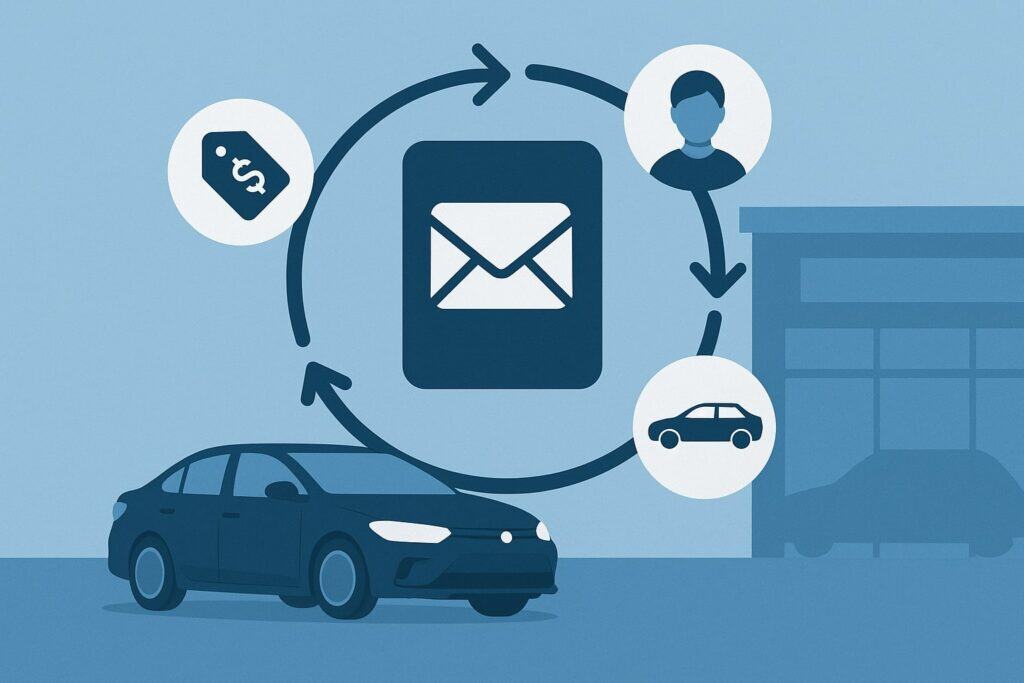
Email marketing tips for automotive businesses become far more effective when your strategy is organized by lifecycle stages instead of “monthly newsletters.”
A lifecycle approach means you send fewer irrelevant emails and more timely emails—messages that match what a person actually needs right now. That relevance is what drives opens, clicks, replies, calls, and appointments.
Start by mapping your customer lifecycle into clear stages: new lead, active shopper, appointment scheduled, no-show, sold, first service visit, ongoing service, lapsed service, and trade-in window.
Each stage should have a purpose, a primary call-to-action, and success metrics. For a new lead, the purpose is trust and next-step momentum (schedule a test drive, request a quote, confirm preferences). For service customers, the purpose is retention and convenience (schedule maintenance, seasonal inspections, recall support, service specials with clear terms).
When you build around lifecycle stages, you also naturally improve deliverability because your engagement increases and complaint risk drops. Inbox providers increasingly reward senders who generate wanted interactions and punish senders who create spam complaints.
A lifecycle approach also reduces your reliance on constant discounting. Instead of “$X off” every week, you can share ownership tips, service reminders, and vehicle education that keeps customers connected even when they aren’t ready to buy today.
Lead-to-Sale Messaging That Doesn’t Feel Pushy
Email marketing tips for automotive businesses should include a lead nurture plan that respects attention spans. Most leads are not ready the moment they submit a form. Your job is to help them choose confidently and reduce friction.
Use a sequence that feels like a guided conversation: confirm what they asked for, share 2–3 options that match their needs, offer a simple comparison, then invite them to a short next step.
A strong lead-to-sale sequence usually mixes value with action. Value looks like: “How to choose between trims,” “What impacts monthly payments,” “What to bring to a test drive,” “How trade-in estimates work,” or “How to decide between new and pre-owned.”
Action looks like: “Pick a time,” “Reply with must-have features,” “Confirm your budget range,” or “Send your preferred colors.”
Make your calls-to-action specific and low-pressure. Instead of “Buy now,” try “See it in person,” “Check availability,” or “Get a payment range.” Use personalization based on what you know: the vehicle category they viewed, their preferred price band, their desired features, or their location.
These email marketing tips for automotive businesses are especially powerful when paired with human-sounding copy that reads like one person helping another—not a billboard.
Sale-to-Service Messaging That Keeps Customers for Years
Email marketing tips for automotive businesses often focus heavily on sales, but service retention is where long-term profit is protected. A buyer who never returns for service becomes a “one-time win.” Email is ideal for preventing that because it can deliver reminders, education, and incentives at exactly the right intervals.
Build a post-sale onboarding series that makes ownership easy: welcome message, “how to schedule service,” “what your first maintenance milestone is,” “how to use key features,” and “who to contact for questions.” Then transition into an ongoing service cadence: seasonal checkups, mileage-based reminders, warranty tips, tire and brake education, and recall alerts.
Customers often delay service because they forget, feel unsure, or think it will take too long. Your emails should reduce those barriers by offering clear time estimates, online scheduling links, pickup/drop-off options, and service advisor contact details.
The best email marketing tips for automotive businesses treat service emails as customer success, not promotions. Make the customer feel taken care of, and they’ll return—often without needing a major discount.
Grow a High-Quality List the Right Way (And Keep It Clean)
Email marketing tips for automotive businesses must start with list quality, because list quality affects everything: deliverability, response rates, and revenue per send. A smaller list of engaged subscribers can outperform a huge list full of old, purchased, or unverified addresses.
Focus on permission-based growth. Collect emails at every legitimate touchpoint: lead forms, service scheduling, Wi-Fi sign-in (with permission), event registrations, trade-in valuations, and post-visit surveys.
Make it obvious what they’re signing up for. If they think they’re getting “my quote” but you add them to a daily promo list, complaints rise and inbox placement drops. Clean expectations reduce spam complaints and improve lifetime engagement.
Then commit to hygiene. Remove hard bounces immediately, suppress chronic non-openers carefully, and run periodic re-engagement campaigns. This is not just a performance best practice—it aligns with how mailbox providers judge your sending behavior.
Many sender rule updates emphasize reducing unwanted mail and honoring unsubscribes quickly. Healthy lists also make your segmentation more accurate, which is one of the most reliable email marketing tips for automotive businesses for increasing conversions without increasing send volume.
Ethical Lead Capture That Improves Engagement
Email marketing tips for automotive businesses work best when the subscriber feels they chose you. Use clear opt-in language: “Send me service reminders and special offers” or “Email me availability updates.”
If you use checkboxes, avoid pre-checking them. If you use online scheduling, include a preference center option (service reminders, new inventory alerts, event invites).
Another high-performing tactic is progressive profiling—collecting a little more information over time rather than asking for everything up front. Ask for one preference in the welcome email (“SUV or sedan?”), another later (“budget range?”), and another after engagement (“trade-in timeline?”).
This improves personalization and keeps forms short. It also makes your emails feel more relevant—one of the simplest email marketing tips for automotive businesses that scales well.
Finally, protect trust with frequency control. Let subscribers choose weekly updates vs. only major updates. A preference center reduces unsubscribes while keeping your list compliant and engaged.
List Hygiene, Re-Engagement, and Sunset Policies
Email marketing tips for automotive businesses should include a clear plan for inactive subscribers. “Inactive” is not just “didn’t open,” especially because open-rate tracking has become less reliable due to privacy protections that can inflate or obscure opens.
Instead, define inactivity using multiple signals: no clicks, no replies, no appointment scheduling, no website visits from email, and no form submissions over a set period.
Run a re-engagement series every quarter or twice a year. Offer a simple value proposition: “Still want service reminders?” or “Want updates on vehicles like X?”
Provide a one-click choice. If they don’t engage, sunset them—either pause sends or reduce frequency drastically. This improves deliverability, reduces complaint risk, and increases performance metrics that matter.
A strong sunset policy is one of the most underrated email marketing tips for automotive businesses because it protects your sender reputation. When you send to people who no longer want your emails, you increase spam complaints and reduce engagement—two signals mailbox providers actively watch.
Deliverability and Compliance: The Non-Negotiables in 2025 and Beyond
Email marketing tips for automotive businesses must include deliverability fundamentals because inbox rules have tightened and enforcement has increased. If your emails land in spam or get rejected, your strategy fails before it begins. Deliverability is not just “tech stuff”—it is revenue protection.
Mailbox providers increasingly require authentication (SPF, DKIM, and often DMARC) and user-friendly unsubscribes for bulk senders. Gmail’s sender guidelines for high-volume senders (5,000+ emails/day) include authentication and making it easy to unsubscribe.
Industry coverage also summarizes these requirements as focused on authentication, spam-complaint rates, and unsubscribe expectations, with enforcement getting stricter over time. Some industry updates note that additional providers have joined similar enforcement trends for large senders.
Even if you don’t send massive volume, these standards are becoming the “normal” baseline for good inbox placement. If you run multi-location operations, seasonal blasts, or large service databases, you can easily cross volume thresholds during busy periods—so it’s smarter to be compliant year-round.
Authentication Basics: SPF, DKIM, and DMARC (Explained Simply)
Email marketing tips for automotive businesses should explain authentication in practical terms: it proves you are who you say you are. SPF authorizes which servers can send for your domain. DKIM cryptographically signs your messages. DMARC tells receiving inboxes what to do when SPF/DKIM fail and provides reporting signals.
The business impact is simple: authenticated email is more trusted, more deliverable, and less likely to be spoofed. It also helps protect your customers from phishing that uses your brand name.
If you use an email service provider, you still need proper domain alignment and correct DNS records. Requirements and guidance around these protocols have become more prominent as mailbox providers fight spam and fraud.
If you’re unsure whether you’re compliant, start by checking: is every “From” domain authenticated? Are you using a custom sending domain? Are your marketing, transactional, and service emails all aligned?
These deliverability checks are foundational email marketing tips for automotive businesses that prevent painful revenue losses.
One-Click Unsubscribe and Complaint Rate Control
Email marketing tips for automotive businesses must treat unsubscribes as a feature, not a threat. Making it easy to leave reduces spam complaints. Many modern bulk-sender requirements explicitly emphasize easy unsubscribing, and the direction across providers is clear: user control is mandatory.
Implement List-Unsubscribe headers properly (often including a one-click unsubscribe option for marketing mail). Make sure the unsubscribes process fast. Use a visible unsubscribe link, not tiny gray text. Provide a preference center so subscribers can reduce frequency instead of fully leaving.
Also, monitor complaint rates and engagement. Even “good” lists can spike complaints if you increase send volume suddenly, send irrelevant blasts, or email people who never asked. Reduce complaint rates by segmenting, limiting frequency, and avoiding misleading subject lines.
These are practical email marketing tips for automotive businesses because they protect deliverability while improving customer experience.
Privacy Changes and the Decline of Reliable Open Rates
Email marketing tips for automotive businesses in 2025 must adapt to privacy-driven measurement issues. Apple’s Mail Privacy Protection (MPP) can preload tracking pixels and distort open-rate data, making opens less trustworthy as a success metric.
Many marketers now treat clicks, replies, conversions, and downstream actions as more meaningful indicators of intent.
This doesn’t mean email is weaker—it means measurement must be smarter. Track actions like: click-to-schedule, coupon downloads, trade-in form completions, finance application starts, inventory views, and service booking confirmations. Use UTM parameters, call tracking where appropriate, and CRM attribution for pipeline impact.
The best email marketing tips for automotive businesses now recommend shifting reporting conversations away from “open rate bragging” and toward revenue metrics and appointment metrics. This aligns your program with business outcomes, not vanity numbers.
Segmentation and Personalization That Actually Moves Revenue
Email marketing tips for automotive businesses should treat segmentation as the engine of performance. If every subscriber gets the same email, you’re basically doing digital direct mail without the targeting advantage.
Segmentation lets you tailor content based on intent, ownership stage, and preferences—so your emails feel helpful instead of noisy.
Start with simple segments that are easy to maintain: new leads vs. customers, sales vs. service interest, vehicle category interest, and last engagement date.
Then add business-value layers: estimated trade-in window, service due date, lease-end timing, and high-intent website behavior (viewed pricing page, started application, viewed specific VIN multiple times).
Personalization should go beyond the first name. Use dynamic modules: show relevant inventory categories, service offers matched to season, and educational tips based on ownership stage.
These email marketing tips for automotive businesses consistently outperform “one-size-fits-all” blasts because they reduce cognitive load and increase relevance.
Practical Data Fields That Make Emails More Relevant
Email marketing tips for automotive businesses become powerful when your data is clean. You don’t need “big data”—you need a few reliable fields that update correctly. Prioritize: last service date, next recommended service (or mileage interval), purchase date, vehicle make/model/year, preferred store location, and primary interest (new vs. pre-owned vs. service).
For leads, track: desired vehicle type, budget range, and timeline (“this week,” “this month,” “just browsing”). Even if those are self-reported, they help shape messaging. A “this week” lead should get fewer emails, faster follow-up, and more direct scheduling options. A “just browsing” lead should get more educational content and gentle check-ins.
If your CRM supports it, track behavior-based signals: clicked finance info, downloaded brochure, visited trade-in page. Then trigger emails that match that behavior. This is one of the most actionable email marketing tips for automotive businesses because it creates the feeling of a personal concierge experience.
Dynamic Content and AI Personalization Without Being Creepy
Email marketing tips for automotive businesses should warn against over-personalization that feels invasive. “We saw you look at this VIN at 2:14 AM” is creepy. But “Still interested in compact SUVs? Here are three options” is helpful.
Use AI carefully: subject line testing, content suggestions, send-time optimization, and summarizing long service explanations into clear bullet points. Keep a human review process so your tone stays consistent and your offers stay accurate.
As inbox providers introduce more AI-driven previews and inbox organization, clear branding and consistent value will matter more. Some email industry guidance notes new inbox experiences and previews that could influence how messages are displayed and scanned. That makes clarity and relevance even more critical.
Content That Works: Sales, Service, and Loyalty Email Ideas
Email marketing tips for automotive businesses must include content planning, because “we’ll just send promotions” eventually trains your list to ignore you unless there’s a discount. High-performing programs balance offers with value. Value builds trust; offers close actions.
Create content pillars: (1) ownership education, (2) service and maintenance support, (3) inventory and availability updates, (4) community and brand trust, and (5) financing guidance. Then rotate them across your calendar. This keeps your list engaged and reduces fatigue.
When you do send promotions, make them easy to understand. Include clear terms, deadlines, and the next step (schedule, call, reply, reserve). Confusing offers drive clicks down and complaints up.
These email marketing tips for automotive businesses are especially effective when you design content with mobile readers in mind—short paragraphs, bold subheads, and one clear call-to-action.
Service Reminder Emails That Drive Appointments
Email marketing tips for automotive businesses often produce the quickest wins in service. Service reminder emails can be automated, personalized, and timed to mileage/seasonal patterns. Use subject lines that emphasize convenience: “Time to schedule your oil change?” or “Quick tire check before the season changes.”
In the body, reduce friction: show available booking options, estimated appointment length, and any benefits like shuttle or pickup/drop-off. Add trust elements: technician certifications, genuine parts, warranty-friendly service, and transparent pricing policies when applicable.
You can also layer in smart upsells without being pushy: “If you’re coming in, consider a battery check” or “Brake inspection recommended at this mileage.” Customers appreciate proactive guidance when it’s framed as safety and reliability.
Service programs are frequently highlighted as critical retention levers in automotive marketing discussions. The key is execution: consistent timing, accurate personalization, and a simple scheduling path.
Inventory and Offer Emails That Don’t Feel Like Spam
Email marketing tips for automotive businesses can help you promote inventory without blasting the entire list. Send inventory updates only to shoppers who asked for them or showed relevant interest. Use dynamic blocks: “New arrivals in your preferred category” or “Options under your target monthly payment.”
Keep images lightweight and load fast. Provide 3–6 strong choices, not 30. Include one primary CTA: “Check availability” or “Book a quick walkaround.” Add a plain-text fallback link for users who block images.
Avoid deceptive urgency. If inventory is limited, explain why (“seasonal demand,” “popular trims”), but don’t use fake countdown timers. Honest messaging improves long-term trust and reduces spam complaints, which protects deliverability.
Automation Flows Every Automotive Business Should Have
Email marketing tips for automotive businesses should prioritize automations because automations compound results. A good automation runs every day, nurtures every lead, and supports every customer—without you manually building each send.
Start with the highest ROI flows: lead welcome/nurture, appointment confirmations and reminders, post-visit follow-up, service reminders, and reactivation for lapsed customers. Each automation should have a single objective and a small number of steps. Overly complex automations often break because data fields aren’t updated correctly.
A practical automation approach also protects your team’s time. Instead of “send more emails,” you send smarter emails. That improves engagement and reduces complaint risk—both important in the stricter deliverability environment described earlier.
Welcome and Lead Nurture Series (A Proven Structure)
Email marketing tips for automotive businesses often recommend a 4–7 email welcome series for new leads. A practical structure looks like this:
- Confirmation and next step (schedule a call or visit)
- Quick preference check (reply with must-haves)
- Helpful guide (how to compare options, trade-in basics)
- Social proof (reviews, process explanation)
- Offer or incentive (if appropriate)
- Reminder and easy scheduling link
Each email should be scannable, with short paragraphs and one CTA. If you can include a “reply to this email” prompt, you’ll often get higher-quality conversations than clicks. Replies are also a strong engagement signal.
This is one of the most reliable email marketing tips for automotive businesses because it converts more leads without relying on constant discounts.
Post-Service Follow-Up and Review Requests That Feel Human
Email marketing tips for automotive businesses should include post-service emails, because they increase repeat visits and protect your reputation. Send a thank-you email the same day or next day. Include: what was done, what to watch for, and the easiest way to book the next visit.
If you request reviews, make it specific: “How was your experience with the service team?” Keep the request short. If you can route unhappy customers to internal support first, you can often resolve issues before they become public complaints.
Also consider a “service education” follow-up: seasonal tips, maintenance reminders, and safety checklists. These messages build trust and make customers more likely to return.
Copywriting and Design Tips That Improve Clicks and Appointments
Email marketing tips for automotive businesses must include copy and design principles because even the best segmentation fails if the email is hard to read or sounds generic. Your audience is often reading on a phone between tasks. Respect that attention.
Use short paragraphs, clear subheads, and one primary CTA button. Write in plain language. Avoid jargon-heavy “marketing speak.” Make your sender name recognizable (not “noreply@”). A consistent sender identity improves trust.
Subject lines should be clear, not clever. Promise what the email delivers. Avoid excessive punctuation, gimmicky symbols, and misleading urgency. These patterns can reduce trust and increase spam complaints—riskier in today’s environment of stricter mailbox enforcement.
Subject Lines, Preview Text, and the 5-Second Scan Test
Email marketing tips for automotive businesses should treat subject line + preview text as a single unit. Many recipients decide in seconds. Use subject lines that highlight value or action: “Confirm your appointment,” “Ready for your next service?” “3 options that match what you asked for.”
Preview text should support the subject line, not repeat it. Use it to add clarity: “Pick a time in 2 clicks,” “See availability and pricing,” “Quick checklist inside.”
Then run the 5-second scan test: when you open the email, can you understand the point instantly? If not, simplify. Put the main CTA near the top. Keep supporting details below.
As inboxes evolve with new preview styles and categorization, clarity becomes even more important.
Mobile-First Layout and Accessibility Basics
Email marketing tips for automotive businesses should include accessibility because it improves results for everyone. Use readable font sizes, sufficient contrast, and descriptive button text (“Schedule service” instead of “Click here”). Keep your email width and image sizes optimized for mobile. Always include alt text for images.
Also, don’t build an email that requires images to understand the offer. Many users block images by default. Provide a text summary and a clear link.
Accessibility and mobile-first design also reduce frustration—less frustration means fewer unsubscribes and complaints, which helps deliverability.
Measurement and Optimization That Still Works in a Privacy-First Era
Email marketing tips for automotive businesses must evolve beyond open rates. With privacy protections affecting tracking, you need a measurement framework that focuses on actions and outcomes.
Track metrics in layers:
- Delivery health: bounce rate, spam complaint rate, inbox placement (if available)
- Engagement: clicks, replies, forward/share, time on landing page
- Conversion: appointments booked, calls generated, form submissions, quote requests
- Business impact: revenue influenced, service RO count, customer retention
Build dashboards that connect email activity to CRM outcomes. If you can’t attribute revenue perfectly, attribute progress: appointment set, appointment show, sold, service booked, service completed.
These email marketing tips for automotive businesses keep your program aligned with what leadership cares about: real results, not vanity.
A/B Testing That Improves Performance Without Risk
Email marketing tips for automotive businesses should include testing, but with discipline. Test one variable at a time: subject line, CTA text, offer framing, send time, or layout. Keep your test size statistically reasonable, and don’t over-test a small list.
Good early tests include:
- “Schedule service” vs. “Book a time”
- Short vs. slightly longer subject lines
- One offer vs. two offers
- Plain-text style vs. designed template
Then document learnings. Testing is only useful if you apply the results consistently.
Attribution: Connecting Email to Calls, Visits, and Sales
Email marketing tips for automotive businesses should include attribution methods that match how people actually buy. Many customers read an email, then call or visit later without clicking. Use multiple attribution signals: unique phone numbers for campaigns, “how did you hear about us” fields, tracked scheduling links, and CRM notes.
Also, consider “assist” attribution: email didn’t close the sale, but it reactivated a lead who later converted. Measure influence, not just last click. This is especially important as tracking becomes less granular.
Future Predictions: Where Automotive Email Marketing Is Headed Next
Email marketing tips for automotive businesses should include future-proofing because inboxes, privacy, and customer expectations are changing fast. The direction is consistent: more authentication enforcement, more user control, more privacy, and more AI-driven inbox experiences.
Expect authentication and compliance requirements to keep expanding and getting stricter—especially around bulk-sender behavior, spam complaints, and unsubscribe mechanisms. Even smaller senders may feel the ripple effects because mailbox providers tune filters globally.
Expect measurement to rely more on first-party actions: clicks, scheduling, replies, and CRM events. As open tracking becomes less trustworthy, teams that have clean data pipelines will outperform teams that don’t.
Expect more AI in the inbox: summarized previews, categorized messages, branded sender indicators, and smarter filtering. That will reward clear, honest, helpful emails and punish generic blasts.
The best email marketing tips for automotive businesses will stay the same at the core—relevance, trust, timing—but the technical and measurement standards will keep rising.
What to Do Now to Stay Ahead
Email marketing tips for automotive businesses that prepare you for the future include: tightening list hygiene, improving data quality, building lifecycle automations, and making deliverability compliance a permanent checklist item.
If your program is built on relevance and trust, future inbox changes become less scary—because your subscribers actually want what you send.
FAQs
Q.1: How often should automotive businesses send marketing emails?
Answer: Email marketing tips for automotive businesses typically recommend starting with consistency over volume. A common mistake is sending too often when you have promotions and going silent when you don’t.
That pattern trains subscribers to expect only discounts and can increase unsubscribes or spam complaints during heavy weeks. A better approach is a steady cadence: one helpful message per week or every two weeks for broad audiences, plus targeted automations triggered by behavior (like service reminders, appointment confirmations, and lead follow-ups).
Frequency should also vary by segment. Active shoppers may tolerate more frequent updates because their intent is high—especially if emails are personalized and relevant. Service customers usually prefer fewer promotional emails but appreciate timely reminders.
If you aren’t sure, create a preference center and let subscribers choose. This improves engagement and supports deliverability, since mailbox providers increasingly reward wanted mail and punish unwanted mail signals.
The best rule: increase frequency only when relevance is high, and always make it easy to opt down without fully unsubscribing.
Q.2: What emails drive the most revenue for automotive businesses?
Answer: Email marketing tips for automotive businesses often point to lifecycle automations as the biggest revenue drivers because they trigger at moments of highest intent. Lead nurture sequences increase appointment setting and showroom visits.
Service reminders increase RO volume and retention. Post-service follow-ups improve return rates and referrals. Reactivation campaigns bring back lapsed service customers or dormant leads.
Promotional inventory emails can perform well too, but only when targeted. Sending “new inventory” blasts to your entire list usually underperforms because most recipients aren’t shopping right now.
Instead, segment by interest and behavior, then send a smaller number of highly relevant options with an easy next step (availability check, appointment, call).
In a privacy-first era where open rates are less reliable, revenue-driving emails are the ones that generate measurable actions—clicks to schedule, replies, form submissions, and calls.
Q.3: How can automotive businesses avoid the spam folder?
Answer: Email marketing tips for automotive businesses to avoid spam start with three pillars: authentication, list hygiene, and relevance.
Authenticate your sending domain with SPF and DKIM, and implement DMARC if appropriate—especially if you send at scale. Gmail and other mailbox providers have made authentication and easy unsubscribing more central to bulk-sender requirements.
Next, keep your list clean: remove hard bounces, reduce sending to unengaged addresses, and stop emailing people who never opted in. Then improve relevance through segmentation and lifecycle messaging. A relevant email that gets clicks and replies is far less likely to be flagged as spam.
Also, avoid spam-trigger behaviors: misleading subject lines, excessive ALL CAPS, heavy image-only emails, and sudden large spikes in volume. Make unsubscribing easy, and honor it quickly. When recipients can leave cleanly, they’re less likely to hit “spam,” which protects your sender reputation.
Q.4: What should automotive businesses measure if open rates aren’t reliable?
Answer: Email marketing tips for automotive businesses in 2025 recommend treating open rates as directional at best—especially because privacy protections can distort opens. Instead, focus on a measurement stack that ties to business outcomes.
Track click-through rate by segment, click-to-schedule conversions, call clicks, replies, form submissions, and appointment confirmations. Then connect those actions to downstream metrics: appointments shown, vehicles sold, service repair orders completed, and customer retention.
Use UTMs and CRM attribution where possible. If full attribution is hard, measure “influence” by tracking how many engaged subscribers convert later compared to non-engaged subscribers. Over time, this reveals which email types actually move revenue.
These email marketing tips for automotive businesses help you make better decisions than chasing open-rate spikes that may not reflect real intent.
Conclusion
Email marketing tips for automotive businesses succeed when you combine strong fundamentals with modern execution: lifecycle strategy, clean data, thoughtful segmentation, helpful content, and reliable automation.
In today’s stricter inbox environment, deliverability and compliance are not optional—authentication, unsubscribe best practices, and list hygiene directly affect whether your messages are delivered.
The biggest shift in recent years is that “more email” doesn’t equal “more results.” Better email equals more results. Better means relevance, timing, and trust. It also means measurement that focuses on actions—appointments, calls, clicks, and customer retention—rather than relying on open rates that privacy changes can distort.