
How to Implement Lean Six Sigma in an Auto Repair Shop (Step-by-Step Guide)
Running an auto repair business today means balancing speed, quality, and customer trust—while labor is tight, parts are unpredictable, and customers expect constant updates. That’s why many operators are looking for practical ways to implement Lean Six Sigma in an auto repair shop without turning their business into a “corporate experiment.”
This guide breaks down Lean Six Sigma for auto repair shops into steps you can apply on the shop floor. You’ll learn how Lean Six Sigma in automotive service businesses helps reduce wasted motion, shorten cycle times, and stabilize quality—without forcing techs into paperwork all day.
We’ll also cover applying Lean Six Sigma in a car repair shop using real workflows like write-up → dispatch → diagnose → parts → repair → QC → delivery, and we’ll translate Six Sigma strategies for automotive service centers into tools you can use this month.
Most shops don’t lose money because they lack cars. They lose it because work doesn’t flow.
Common inefficiencies include:
- Cars waiting on approvals while bays sit idle
- A tech walking across the shop six times for tools or parts
- Repeated diagnoses because the original concern wasn’t captured clearly
- Comebacks that break trust and eat future capacity
- “Hero culture” where only one person knows the best way to do something
Lean Six Sigma is a structured way to fix those issues permanently—by improving the process, not blaming people.
Why Lean Six Sigma Matters for Modern Auto Repair Shops

Lean Six Sigma isn’t about “working harder.” It’s about building a shop where the right work happens in the right order, with fewer interruptions and fewer defects.
Auto repair is a service business, but it behaves like a production system: cars enter, go through steps, and exit. When those steps aren’t designed well, the shop gets stuck with bottlenecks, rework, and uneven workloads.
The biggest reason Lean Six Sigma works in automotive service is that most shops have repeatable workflows—even when repairs vary.
Every ticket still requires intake, triage/dispatch, diagnosis, estimate, approval, parts handling, repair steps, quality checks, and delivery. Improving that system increases throughput without increasing chaos.
Lean Six Sigma also supports a more consistent customer experience. Customers don’t just want a fix—they want confidence. When you reduce variability in inspections, estimates, approvals, and QC, you reduce surprises. That results in fewer escalations, less discounting, and fewer “unhappy phone calls” that distract your service team.
The goal is simple:
- Move vehicles through the shop with fewer stalls
- Reduce rework and comebacks
- Improve service bay efficiency
- Make performance visible with auto repair shop KPIs
- Create a culture of continuous improvement in auto shops
Lean Six Sigma gives you a proven structure to do that—especially when you’re managing multiple techs, multiple advisors, or multiple locations.
What Is Lean Six Sigma?
Lean Six Sigma combines two complementary improvement methods: Lean (remove waste and improve flow) and Six Sigma (reduce variation and defects). In a shop environment, Lean helps you speed up and simplify the workflow, while Six Sigma helps you prevent mistakes and repeat failures.
Lean Principles Explained Simply
Lean focuses on waste—anything that consumes time, effort, or money without improving the customer outcome. In auto repair, customers pay for skilled diagnosis and correct repair, not for waiting, searching, redoing work, or miscommunication.
Lean identifies common “wastes” you can see every day:
- Waiting: vehicles waiting for estimates, approvals, parts, or an open bay
- Motion: techs walking to find tools, information, or parts
- Overprocessing: repeated inspections or redundant paperwork
- Defects: comebacks, misdiagnoses, broken clips, missing fasteners
- Inventory: too many parts “just in case,” or too many cars staged with no plan
- Transportation: moving cars multiple times because bays aren’t planned
- Underutilized talent: experienced techs doing low-skill tasks that could be delegated
Lean improvements often look “simple,” like relocating commonly used tools, creating a better dispatch rhythm, or standardizing inspection steps. But those changes stack up fast when they remove friction across 20–40 repair orders per day.
Lean is the foundation of automotive workflow optimization because it makes work predictable and reduces interruptions.
Six Sigma Fundamentals (Without the Jargon)
Six Sigma is about reducing defects and variation. A “defect” in an auto shop isn’t only a broken part—it’s any failure to meet the standard you promised.
Examples include:
- The customer concern wasn’t verified properly
- A part was ordered incorrectly
- Torque specs weren’t followed
- A post-repair road test wasn’t completed
- The estimate wasn’t aligned with the actual repair path
- The vehicle wasn’t ready when promised
Six Sigma teaches you to:
- Define what “good” looks like (standards)
- Measure performance (data)
- Analyze root causes (why defects happen)
- Improve the process (fix the system)
- Control the gains (make it stick)
This is where reduce rework in car repair shops becomes real. Instead of saying “be careful,” you redesign the workflow so mistakes are less likely.
How Lean and Six Sigma Work Together in a Shop
Lean improves speed and flow. Six Sigma improves quality and consistency. If you use only Lean, you might move cars faster—but risk more comebacks if quality controls aren’t strong. If you use only Six Sigma, you might create heavy documentation and slow the shop down.
Together, they create:
- Faster cycle times with fewer defects
- Standard operating procedures (SOPs) for auto repair that are usable—not burdensome
- Clear checkpoints that reduce comebacks without adding unnecessary steps
- Data-driven decisions about staffing, dispatch, and parts processes
Why It Applies to Small and Mid-Size Repair Shops
Lean Six Sigma isn’t “only for big companies.” In fact, small and mid-size shops often see faster improvements because they can implement changes without layers of approvals.
It works especially well when:
- You want to improve throughput without adding bays
- You have a mix of A/B/C tech skill levels and need consistent execution
- You’re dealing with parts delays and want better planning
- You’re growing to multi-location operations and need repeatable playbooks
Lean Six Sigma is practical process improvement in automotive service—not academic theory.
Common Problems in Auto Repair Shops (Where Lean Six Sigma Helps Most)
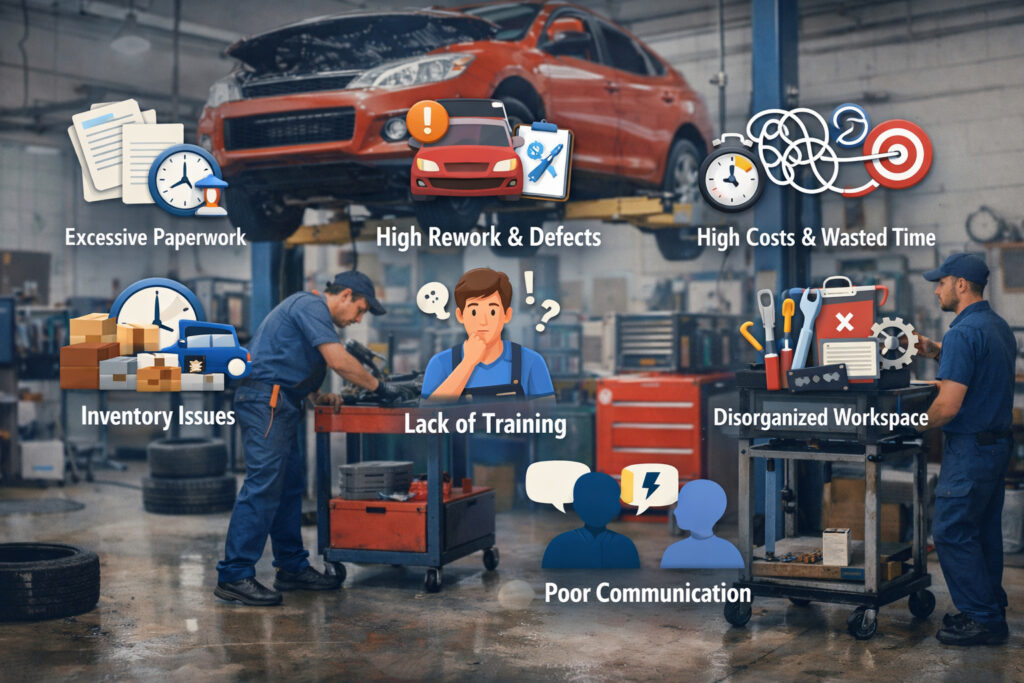
Most shops don’t have one giant problem. They have dozens of small inefficiencies that pile up until the day feels chaotic. Lean Six Sigma helps you identify the highest-impact issues and fix them systematically.
Service Bay Downtime (The Hidden Profit Leak)
Bay downtime is often misdiagnosed as a “tech problem,” but it’s usually a process problem. A bay can be empty even when the shop is busy because the work isn’t ready to start.
Common causes:
- Vehicles not staged with keys and RO ready
- Waiting on estimates or approvals
- Waiting on parts confirmation
- Techs finishing a job but not being dispatched quickly
- Bottleneck at diagnosis because only one tech can handle it
When downtime is visible, you can fix it. When it’s hidden, you end up pushing overtime, rushing, and reducing quality.
A simple way to spot downtime is to track:
- Bay utilization (how much bay time is productive)
- Queue time (how long cars wait between steps)
Even small improvements to dispatch, staging, and approvals can improve service bay efficiency dramatically—without adding staff.
Parts Delays and “Parts Chaos”
Parts are one of the biggest workflow disruptors in auto repair. The issue isn’t only availability—it’s process discipline.
Common “parts chaos” patterns:
- Parts ordered before diagnosis is confirmed
- Parts ordered without VIN/trim verification
- No clear “parts status” visibility (ordered, in transit, received, returned)
- No dedicated staging area, so parts get lost or mixed
- Techs leaving bays to chase parts updates
Lean Six Sigma targets parts delays by building a reliable parts workflow and a simple visual status system. That’s one of the fastest ways to reduce waiting and improve cycle time.
Rework and Comebacks (Defects That Kill Capacity)
Comebacks cost more than money. They consume bays, frustrate techs, and break trust with customers. A comeback also disrupts scheduling, which creates more waiting and chaos.
Common root causes include:
- Incomplete inspection or failure to verify concern
- Poor handoff between advisor and technician
- No standard quality check process
- Variation in repair methods between techs
- Inadequate documentation or missed specs
Six Sigma-style thinking focuses on defect prevention, not blame. The best shops don’t just “have good techs.” They have systems that consistently produce good outcomes.
Poor Workflow (Work Doesn’t Flow Through the Shop)
Workflow problems show up as:
- Cars moved multiple times because bays aren’t planned
- Techs switching jobs midstream due to approvals or parts
- Advisors constantly asking for updates because status isn’t visible
- Too many “priority” jobs and no clear dispatch rules
Lean tools like value stream mapping automotive workflows can expose where cars wait and where information breaks down. That’s the first step to fixing flow.
Inconsistent Customer Communication
Customers want clarity: what’s wrong, what it costs, and when it will be done. Communication problems usually come from process gaps:
- Advisors don’t have real-time status
- Tech notes are incomplete or inconsistent
- Approvals are requested without clear explanation
- Promises are made before parts and capacity are confirmed
Lean Six Sigma improves this by standardizing updates, building better handoffs, and making job status visible without constant interruptions.
The DMAIC Framework Applied to an Auto Repair Shop
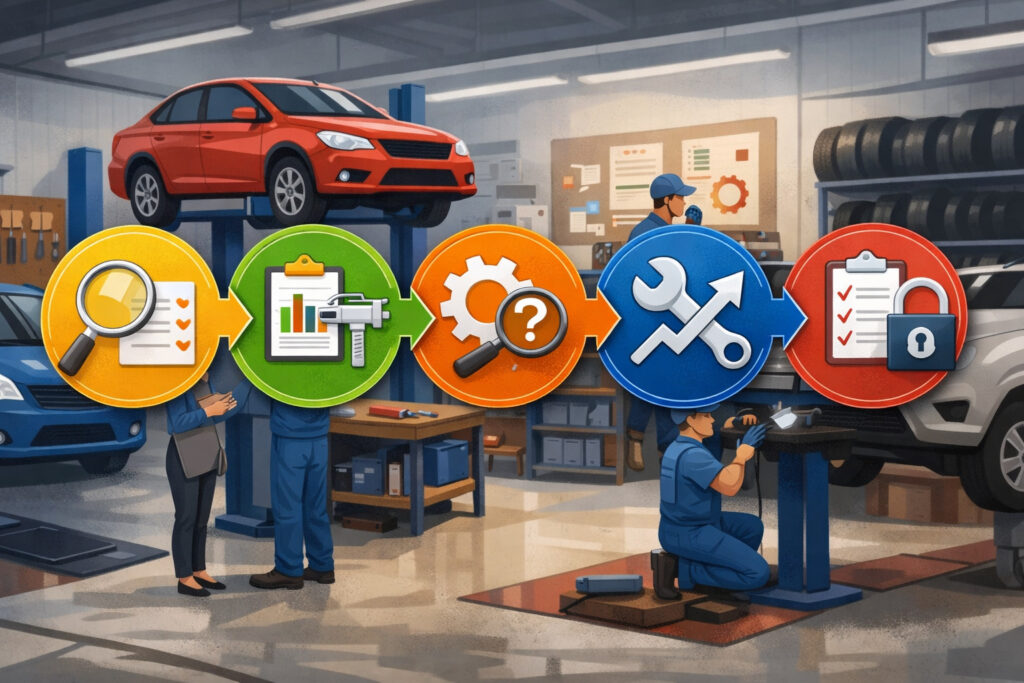
DMAIC is the core Six Sigma improvement cycle: Define, Measure, Analyze, Improve, Control. It’s not complicated when translated to a shop environment. Think of DMAIC as a disciplined way to run a “shop improvement repair order” the same way you’d run a complex diagnosis: symptom → measurement → root cause → fix → verify.
Define: Identify Key Shop Problems Worth Solving
In the Define phase, you choose one problem that matters and define it clearly. A vague problem like “we’re inefficient” won’t lead to action. A defined problem creates focus.
Good Define statements include:
- “Cycle time for brake jobs averages 1.8 days; target is same-day for 80% of brake ROs.”
- “Comeback rate on cooling system repairs is 4.5%; target is under 2%.”
- “Service bay utilization is 62%; target is 75% without increasing overtime.”
Define also includes:
- Who is impacted (techs, advisors, customers)
- What “done” looks like
- The scope (which service type, which shift, which location)
Practical tip: Start with one workflow that has a high volume or high pain. That’s where improvement creates the biggest return.
Measure: Track KPIs That Reflect Reality
Measure means collecting data on the current process. In a shop, you already have much of it in your shop management system—if you set it up and use it consistently.
Useful KPIs for DMAIC process in auto repair include:
- Labor hours per RO (billed vs. produced)
- Technician productivity and efficiency
- Cycle time (check-in to delivery)
- First-time fix rate / comeback rate
- Bay utilization
- Parts wait time
- Estimate approval time
- Vehicles touched per day (per bay, per tech)
A simple “measurement chart” you can do in text form:
- Cycle Time = Delivery Time – Check-in Time
- Queue Time = Start Repair Time – Approved Estimate Time
- Parts Delay Time = Parts Received Time – Parts Ordered Time
You don’t need perfect data to start. You need consistent data. Build measurement habits into the daily routine.
Analyze: Root Cause Analysis in Repair Shops (Real Examples)
Analyze is where you figure out why performance is what it is. This is where many shops get stuck because they jump to solutions too fast.
Use a structured approach like 5 Whys or a simple cause-and-effect breakdown.
Example: “Why is bay downtime high?”
- Bays sit empty waiting for vehicles to be staged
- Vehicles aren’t staged because dispatch is delayed
- Dispatch is delayed because advisors are waiting on estimates
- Estimates are delayed because diagnosis notes are inconsistent
- Diagnosis notes are inconsistent because there’s no standard inspection process
Now you’re not fixing “downtime.” You’re fixing the inspection and handoff process.
Another example: “Why are comebacks increasing?”
- Repairs not verified on a post-repair road test
- No checklist for torque/spec verification
- Parts quality differences across suppliers
- Variation in procedures between techs
- Inadequate documentation on multi-step repairs
Analyze is also where value stream mapping automotive workflows helps. You can map the steps and identify where the car waits and where information fails.
Improve: Workflow Adjustments and SOPs That Actually Get Used
Improve is where you implement changes—carefully and practically. The best improvements are:
- Simple enough to execute daily
- Clearly connected to the root cause
- Tested in a pilot before scaling
Examples of improvements in a shop:
- Create a standard digital inspection format with required fields
- Add a “parts verification” step before ordering (VIN/trim/notes)
- Implement dispatch rules (diagnosis first, then fast-moving jobs)
- Set standard time windows for customer updates
- Standardize quality control with a short checklist
This is where standard operating procedures (SOPs) for auto repair become a tool—not a burden. SOPs should be short, clear, and built around how techs already work.
Control: Ongoing Monitoring and Dashboards
Control is how you keep improvements from fading in 30 days. In shops, improvements often slip because:
- The shop gets busy
- New staff weren’t trained
- No one monitors the process
- Metrics aren’t reviewed consistently
Control includes:
- A simple dashboard (even a whiteboard)
- Weekly KPI review
- Process audits (quick checks)
- Coaching and refresher training
- A clear owner for the process (foreman, lead advisor, GM)
A practical control method is a weekly “process health check”:
- Are inspections completed with required fields?
- Are parts staged correctly?
- Are QC checklists used?
- Are comebacks reviewed with root cause notes?
Control is how you create continuous improvement in auto shops—without running another “program” every quarter.
Step-by-Step: Implement Lean Six Sigma in an Auto Repair Shop
If you’re serious about implementing Lean Six Sigma, treat it like a structured rollout—not a motivational speech. Below is a step-by-step method designed for real shops with real constraints.
Step 1: Get Leadership Buy-In and Set a Clear Target
Leadership buy-in means more than saying “we’re doing Lean now.” It means leadership commits to:
- Measuring performance consistently
- Giving teams time to improve processes
- Supporting standardization
- Not punishing people for surfacing problems
Pick one clear target tied to operational outcomes:
- Reduce cycle time on maintenance and brakes
- Improve service bay utilization
- Reduce rework and comebacks
- Improve estimate approval speed
- Stabilize parts flow and staging
Define a baseline and a target. Keep it realistic and measurable.
Step 2: Train Staff in the “Shop Version” of Lean Six Sigma
You don’t need everyone to get formal certifications. You need everyone to understand:
- What waste looks like
- Why standard work helps
- How to use data without blame
- How to escalate issues early
A practical training plan:
- 30 minutes: Lean wastes in the shop (with examples)
- 30 minutes: Six Sigma defects and comebacks
- 30 minutes: How your shop will measure KPIs
- 30 minutes: How to participate in improvements
Make it hands-on. Use your own workflow. Use your own examples. People support what they help build.
Step 3: Map Your Workflow (Value Stream Mapping Automotive)
Process mapping shows where cars and information actually flow—not where you think they flow. Do it as a team exercise with a foreman, an advisor, and a parts person.
Map these steps:
- Appointment scheduling
- Vehicle arrival and write-up
- Inspection/diagnosis
- Estimate creation
- Customer approval
- Parts ordering and receiving
- Repair execution
- Quality control and road test
- Final invoice and delivery
Under each step, document:
- Average time spent working
- Average time waiting
- Who owns it
- Common failure points
This reveals “hidden waiting,” which is often the biggest cause of long cycle times.
Step 4: Implement KPI Tracking (Simple, Visible, Consistent)
Choose a small set of auto repair shop KPIs and track them weekly. Avoid building a massive scorecard at the start.
A practical starter KPI set:
- Technician productivity (hours produced / hours available)
- Efficiency rate (hours billed / hours produced)
- Comeback rate (comebacks / total ROs)
- Average repair order (ARO)
- Bay utilization (productive bay time / total bay time)
- Cycle time (check-in to delivery)
Simple formula explanations (text-based):
- Productivity % = Produced Hours ÷ Available Hours × 100
- Efficiency % = Billed Hours ÷ Produced Hours × 100
- Comeback Rate % = Comebacks ÷ Total ROs × 100
Track trends, not perfection. Your goal is to see patterns and act on them.
Step 5: Choose a Pilot Project (Small, High-Impact)
A good pilot is:
- Limited scope (one service type, one shift, or one advisor)
- High volume (brakes, maintenance, inspections)
- Painful enough that the team cares
Pilot project example: Reduce cycle time for brake jobs.
- Baseline: average 1.6 days
- Target: same-day completion for 70%
- Key changes: parts pre-verify, standard inspection checklist, dispatch rule for brake jobs, QC checklist
Run the pilot for 2–4 weeks. Measure before and after. Keep notes on what worked and what didn’t.
Step 6: Scale Improvements and Standardize Across the Shop
Once the pilot works, scale it carefully:
- Create a short SOP for the improved workflow
- Train everyone using the SOP
- Update templates in your management system
- Assign ownership (foreman/advisor)
- Add control checks to weekly meetings
For multi-location operators, scaling means:
- A standardized playbook
- Shared KPI definitions
- Consistent training
- A cadence for cross-location learning
Scaling isn’t copying and pasting. It’s adapting a proven process while keeping the core standards consistent.
Key KPIs for Automotive Service Centers (What to Track and Why)
KPIs are only useful when they drive better decisions. The goal isn’t to “report numbers.” It’s to use shop productivity metrics to reduce waste, improve flow, and reduce rework.
Technician Productivity (Throughput Capacity)
Productivity reflects how much labor is produced compared to time available. Low productivity is rarely “lazy techs.” It’s usually interruptions, waiting, and poor dispatch.
What productivity reveals:
- Excess bay downtime
- Techs waiting on approvals or parts
- Bottlenecks in diagnosis or inspections
- Poor staging or tool availability
A practical action link:
- If productivity is low, map where time is lost and fix flow (Lean)
- If productivity varies widely by tech, standardize work and training
Efficiency Rate (Billing vs. Produced Hours)
Efficiency compares billed hours to produced hours. It reflects estimating accuracy, flat-rate performance, and process quality.
Efficiency can be harmed by:
- Poor estimating and missed labor lines
- Rework (produced hours that can’t be billed again)
- Under-quoting because of weak inspections
- Time lost due to unclear repair paths
Use efficiency to improve estimating discipline, inspection quality, and repair planning.
Comeback Rate (Quality and Defects)
Comeback rate is one of the most important measures of Six Sigma success in a shop. It directly relates to reduce rework in car repair shops and protects future capacity.
To use comeback rate effectively:
- Categorize comebacks (diagnosis error, parts failure, workmanship, communication)
- Track by repair type (brakes, suspension, cooling, electrical)
- Run root cause analysis in repair shops for repeated patterns
Comebacks are process signals. Treat them like quality audits, not blame sessions.
Average Repair Order (ARO) (Value and Inspection Quality)
ARO reflects how well your shop identifies needed work and communicates it clearly. ARO isn’t about upselling. It’s about complete, correct inspections and transparent recommendations.
ARO improves when:
- Inspections are standardized and documented
- Advisors present options clearly
- Deferred work is tracked and followed up
- Estimates are built consistently
Lean Six Sigma helps by standardizing inspection and estimate-building workflows.
Service Bay Utilization (How Well Bays Are Used)
Bay utilization matters because bays are fixed assets. Increasing utilization without increasing chaos is a major win.
Utilization drops when:
- Cars aren’t staged
- Work isn’t ready (parts/approval)
- Dispatch is inconsistent
- Techs move between jobs too often
To improve bay utilization:
- Implement staging rules
- Improve parts flow
- Create dispatch priorities
- Reduce interruptions (status visibility helps)
Cycle Time Reduction (Customer Experience and Flow)
Cycle time is a flow metric. It’s impacted by everything: scheduling, diagnosis, approvals, parts, workload balance, and QC.
Cycle time reduction usually comes from:
- Reducing waiting between steps
- Making approvals faster (better estimate presentation)
- Improving parts predictability
- Standardizing inspections and QC
- Better dispatch discipline
Cycle time is often where Lean Six Sigma delivers the most visible customer improvements.
Practical Lean Tools for Auto Shops
Tools don’t fix shops—people using tools fix shops. The best Lean tools for auto repair are simple, visible, and easy to sustain.
5S Method (Organize the Shop for Speed and Safety)
5S is the foundation of reducing motion waste and improving technician efficiency improvement. It stands for:
- Sort: remove what isn’t needed
- Set in order: place tools where they’re used
- Shine: clean and inspect regularly
- Standardize: consistent layout and labeling
- Sustain: weekly checks and ownership
Auto shop example: Tool and consumable organization.
- Create a “point-of-use” station for common consumables (gloves, brake cleaner, rags, zip ties)
- Label shelves for filters, bulbs, and common fasteners
- Assign weekly 5S ownership by bay or team
5S reduces walking, searching, and interruptions. It also reduces mistakes caused by clutter or missing tools.
Value Stream Mapping (Make Waiting Visible)
Value stream mapping automotive workflows is a practical way to visualize where time is lost. The point isn’t to create a perfect diagram—it’s to reveal waiting and handoff issues.
What to map:
- Steps in the repair order process
- Who owns each step
- Average work time vs. wait time
- Common failure points (missing info, parts issues, approvals delays)
Shop example: Mapping “diagnosis to approval.”
You might discover:
- Diagnosis notes wait 2 hours before estimate creation
- Estimate waits 3 hours before customer contact
- Customer approval waits overnight because no one followed up
- Parts aren’t ordered until the next morning
Once waiting is visible, you can redesign the workflow.
Standard Work Documentation (SOPs That Don’t Feel Like Bureaucracy)
Standard work means documenting the best-known method for a task so results are consistent. In shops, SOPs should be short and practical.
Good SOP traits:
- One page (or one screen)
- Clear steps and checkpoints
- Includes required documentation fields
- Specifies who owns each step
- Updated when improvements happen
Auto shop SOP examples:
- Digital inspection standards (required photos, notes, measurements)
- Parts verification checklist before ordering
- QC checklist for brakes, suspension, steering
- Customer update schedule for day-long jobs
This is how you stabilize quality across techs and shifts.
Kaizen Events (Short Improvement Sprints)
A Kaizen event is a focused improvement session, usually 2–4 hours, aimed at solving one problem. It’s effective because it produces action quickly.
Kaizen event examples:
- Reduce parts “search time” by reorganizing staging and labeling
- Fix dispatch bottleneck by redesigning job staging rules
- Improve estimate quality by standardizing labor line templates
- Reduce repeat questions by improving status visibility
Keep Kaizen practical:
- Identify the problem
- Map the current method
- Test a new method
- Assign owners
- Review results in one week
Root Cause Analysis (5 Whys) for Shop Defects
Root cause analysis in repair shops is essential for reducing comebacks and repeated inefficiencies. The 5 Whys method is simple:
- Identify the problem
- Ask “why” it happened
- Repeat until you reach a process-level cause you can fix
Example: “Customer returned with brake noise after repair.”
- Why? Hardware wasn’t replaced
- Why? Tech didn’t note the hardware condition
- Why? Inspection checklist doesn’t include hardware condition
- Why? Checklist wasn’t updated for brake jobs
- Why? No process owner reviews comebacks and updates SOPs
Fix: update brake SOP/checklist and add QC checkpoint. That’s Six Sigma in action.
Common Mistakes to Avoid When Applying Lean Six Sigma in a Car Repair Shop
Lean Six Sigma fails in shops for predictable reasons. Avoid these pitfalls to keep momentum and credibility.
Overcomplicating the Process
If your “Lean program” creates more paperwork than value, the team will resist it. Shop staff need practical tools, not presentations.
Signs you’re overcomplicating:
- Too many KPIs and nobody knows what they mean
- SOPs are long documents no one reads
- Meetings grow but problems don’t shrink
- Improvements aren’t tested before rollout
Fix: Keep it lean—one pilot, a few KPIs, short SOPs, visible results.
Lack of Employee Engagement
Techs and advisors won’t commit to changes they didn’t help design. Lean Six Sigma is not done to people—it’s done with them.
How to improve engagement:
- Ask “what slows you down daily?” and take it seriously
- Involve the team in mapping the workflow
- Let techs test improvements and give feedback
- Recognize process wins (not just sales wins)
Engagement is especially important in technician efficiency improvement because techs can see the waste firsthand.
Ignoring Data (Or Using Data as a Weapon)
Data should guide improvement, not punish people. If KPIs become blame tools, people will game the system or stop reporting accurately.
Better approach:
- Use KPIs to identify process constraints
- Ask “what’s causing this?” instead of “who caused this?”
- Focus on trends and categories (repair type, step delays)
- Share results openly so teams can help solve problems
Trying to Fix Everything at Once
Shops are busy. If you attempt to overhaul scheduling, dispatch, parts, inspections, and QC all at once, execution collapses.
Instead:
- Pick one high-impact workflow
- Run DMAIC
- Prove results
- Standardize and control
- Move to the next improvement
This is how continuous improvement in auto shops actually becomes sustainable.
Real-World Example Scenario: Reducing Turnaround Time and Rework
Here’s a realistic example of what Lean Six Sigma can look like in a mid-size shop with 8 bays, 6 techs, and 2 advisors.
The Problem (Before)
The shop owner noticed three issues:
- Brake and maintenance jobs often took 1–2 days
- Advisors were constantly chasing tech updates
- Comebacks on brake jobs increased (noise, vibration, repeat repairs)
Baseline metrics (collected over 3 weeks):
- Cycle time for brake jobs: 1.6 days average
- Bay utilization: 61%
- Comeback rate on brake jobs: 4.2%
Define and Measure
The team defined the pilot:
- Scope: brake jobs only
- Goal: same-day completion for 70% of brake jobs
- Secondary goal: reduce brake comebacks to under 2.5%
They measured where time was lost:
- Waiting for approval after estimate: 2–6 hours
- Parts issues: wrong hardware kits, missing sensors
- QC inconsistent: road tests skipped on “easy” jobs
Analyze (Root Causes)
Using 5 Whys and a workflow map, they identified:
- Inspections weren’t standardized (hardware condition not consistently documented)
- Advisors lacked a consistent estimate template (missed labor and parts lines)
- Parts ordering lacked verification (VIN/trim/kit checks)
- No consistent QC step before delivery
Improve (Changes Implemented)
They implemented four changes:
- Brake inspection checklist inside the digital inspection form
- Required photo of pad thickness and rotor condition
- Required hardware condition notes
- Estimate template for brake jobs
- Standard labor lines
- Standard parts list with options for sensors/hardware
- Parts verification step
- VIN + kit confirmation before ordering
- Dedicated parts staging bin per RO
- Brake QC checklist
- Torque verification checkbox
- Road test requirement for noise/vibration concerns
Control (How It Stuck)
- Weekly dashboard review of brake cycle time and comebacks
- Foreman spot-audited 5 brake ROs per week for checklist completion
- One advisor owned the estimate template updates based on comeback learnings
Results (After 4 Weeks)
They saw measurable changes without unrealistic claims:
- Brake cycle time dropped from 1.6 days to 0.9 days average
- Same-day completion increased from 35% to 68%
- Comeback rate dropped from 4.2% to 2.6%
- Advisors reported fewer interruptions because inspection notes were clearer
The biggest win wasn’t “profit.” It was regained capacity and fewer disruptions, which supports growth and customer trust.
60-Day Lean Six Sigma Implementation Plan (Week-by-Week)
This plan is designed for shop owners, service managers, and foremen who want fast, controlled progress. Each week includes actions that are realistic in a busy operation.
Weeks 1–2: Set the Foundation and Choose Your First Target
Week 1: Align leadership and define the problem
- Choose one improvement target (cycle time, comebacks, parts delays, bay utilization)
- Write a Define statement with baseline and goal
- Assign a project owner (service manager or foreman)
- Set a weekly 30-minute KPI review meeting
Week 2: Start measuring and build visibility
- Choose 5–6 KPIs (start simple)
- Confirm definitions (everyone measures the same way)
- Create a basic dashboard (whiteboard or spreadsheet)
- Collect baseline data for the chosen workflow
Output by end of Week 2:
- Clear target + baseline metrics + ownership
Weeks 3–4: Map the Workflow and Run Root Cause Analysis
Week 3: Map the current process
- Run a 60–90 minute process mapping session
- Identify waiting points and handoff breakdowns
- List the top 5 failure points
- Choose 1–2 root causes to address first
Week 4: Analyze and design improvements
- Use 5 Whys on the top failure points
- Decide on 2–4 improvements to test
- Draft simple SOP/checklists (one page)
- Prepare the pilot (scope, start date, who’s involved)
Output by end of Week 4:
- Process map + root causes + pilot plan
Weeks 5–6: Execute the Pilot and Adjust
Week 5: Run the pilot
- Start with a controlled service type or workflow
- Track pilot KPIs daily (quick check-in)
- Collect staff feedback on friction points
- Fix obvious issues fast (form fields, staging, labels)
Week 6: Improve based on real results
- Compare pilot performance to baseline
- Refine SOP/checklists to match reality
- Decide what to keep, modify, or drop
- Document the “new standard” clearly
Output by end of Week 6:
- Pilot results + improved SOP + confirmed workflow
Weeks 7–8: Scale and Control
Week 7: Expand rollout
- Train the rest of the team on the improved process
- Update templates in your shop system
- Implement visual controls (status boards, parts staging rules)
- Assign ongoing process ownership (foreman/advisor)
Week 8: Lock in Control
- Set weekly KPI review cadence (non-negotiable)
- Add spot audits (small sample checks)
- Add a comeback review routine with root cause notes
- Plan the next DMAIC project based on KPI trends
Output by end of Week 8:
- Standardized process + monitoring + next project queued
FAQs
Q1) Is Lean Six Sigma suitable for small auto repair shops?
Answer: Yes. Small shops often benefit faster because changes can be implemented quickly. You can apply Lean Six Sigma principles without formal departments by focusing on one workflow at a time and using a few key KPIs to guide decisions.
Q2) How much does it cost to implement Lean Six Sigma?
Answer: It depends on your approach. You can start with minimal cost by training internally, using simple dashboards, and running pilots. Costs increase if you hire consultants, purchase training programs, or invest in software—but you don’t need those to get meaningful operational improvements.
Q3) Do I need certification to apply Six Sigma?
Answer: No. Certification can help if you’re leading large multi-location initiatives, but most shops can apply DMAIC and Lean tools effectively without formal certification. What matters is consistent measurement, root cause discipline, and standardization.
Q4) How long does it take to see results?
Answer: Many shops see early improvements in 2–6 weeks when they run a focused pilot (such as brake jobs, inspections, or parts staging). Sustainable improvements require control routines that keep the process from slipping when the shop gets busy.
Q5) What KPIs should I track first?
Answer: Start with a small set that impacts throughput and quality:
- Technician productivity
- Efficiency rate
- Comeback rate
- Cycle time
- Bay utilization
These give a clear view of flow, capacity, and defects.
Q6) Can Lean Six Sigma reduce technician downtime?
Answer: Yes. The most common drivers of downtime are waiting (approvals, parts, staging, dispatch). Lean tools help reduce waste in auto repair shops by making work-ready status visible and improving handoffs so bays don’t sit idle.
Q7) How does DMAIC apply to car repair processes?
Answer: DMAIC is a structured way to improve a workflow:
- Define the specific issue (e.g., long cycle time on maintenance)
- Measure current performance (KPIs)
- Analyze root causes (5 Whys, process mapping)
- Improve with tested workflow changes and SOPs
- Control with dashboards, audits, and ownership
Q8) What’s the difference between productivity and efficiency in a shop?
Answer:
- Productivity focuses on produced hours versus available hours.
- Efficiency focuses on billed hours versus produced hours.
Both matter. Productivity reflects flow and interruptions; efficiency reflects estimating accuracy and billable capture.
Q9) What if my data is messy or inconsistent?
Answer: Start anyway. Pick a small number of metrics and define them clearly so your team tracks them consistently. As routines improve, data quality improves. Don’t let perfect data become a reason to avoid improvement.
Q10) Will SOPs slow my technicians down?
Answer: Bad SOPs slow people down. Good SOPs reduce confusion, prevent rework, and make results consistent. The best SOPs are short, visual, and tied to real failure points (like comebacks or parts errors).
Q11) How do I reduce rework in car repair shops without blaming techs?
Answer: Treat rework as a process defect. Track comeback categories, run root cause analysis, and improve inspection, documentation, parts verification, and QC checkpoints. The focus is system design—not punishment.
Q12) How can Lean Six Sigma improve customer communication?
Answer: By standardizing updates and making job status visible. When tech notes follow a standard format and the workflow includes defined update moments, advisors can communicate confidently without interrupting the shop floor.
Q13) What’s a good first Lean project for an auto shop?
Answer: Common high-impact starters include:
- Standardizing inspections and estimate creation
- Improving parts staging and verification
- Reducing cycle time for maintenance or brakes
- Implementing a QC process to reduce comebacks
Choose the one that causes the most daily disruption.
Q14) How do multi-location automotive service operators scale Lean Six Sigma?
Answer: Use shared KPI definitions, standardized SOP playbooks, and a consistent improvement cadence. Start with one location pilot, document the standard, then roll it out with training and controls across locations.
Q15) How do I keep improvements from fading after 60 days?
Answer: Use the Control phase: weekly KPI reviews, light process audits, and clear ownership. Improvements fade when no one monitors them and when new staff aren’t trained on the standard.
Conclusion
Lean Six Sigma works in auto repair because it matches the reality of the business: cars move through steps, handoffs happen constantly, and small defects become big costs.
When you implement Lean Six Sigma in an auto repair shop, you stop relying on heroics and start relying on a system—one that reduces waste, improves service bay efficiency, and reduces rework without turning the shop into a bureaucracy.
The key is focus. Don’t try to rebuild everything. Start with one workflow, apply DMAIC, measure the impact, standardize the better way, and build control routines. That’s how Lean Six Sigma for auto repair shops becomes part of how you operate—not just a project.