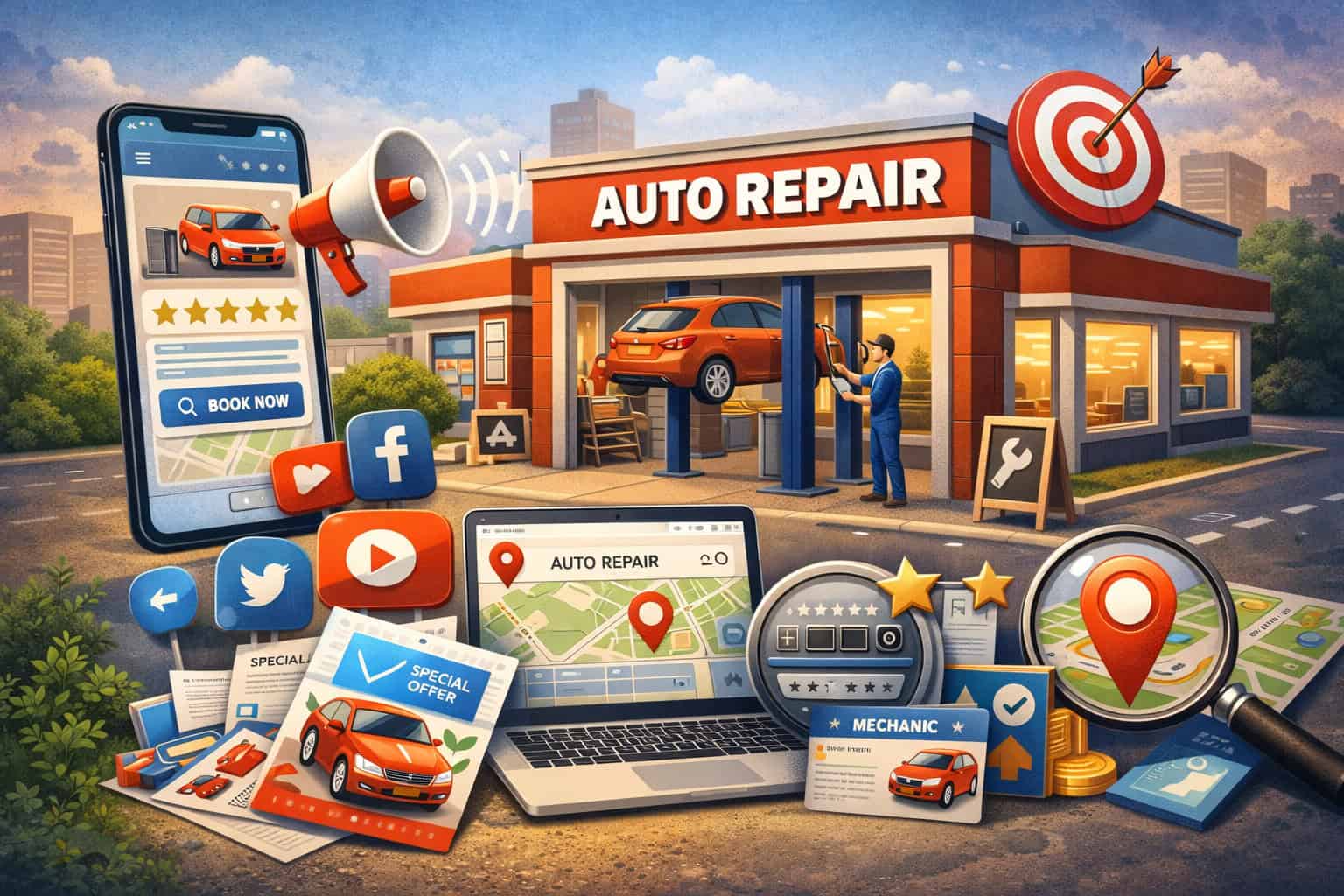
How to Market an Auto Repair Shop Locally (2026 Guide)
Marketing an auto repair shop locally is different from marketing almost any other local business because your customer’s intent is usually urgent, specific, and highly location-based. When someone searches for “brake repair near me” or “check engine light diagnosis,” they typically want a trustworthy shop close by, available soon, and transparent on price.
That’s why the goal isn’t just “more visibility.” The goal is to own local intent—on Maps, in reviews, in neighborhood conversations, and in the quick decisions people make when they’re stressed about their car.
To market an auto repair shop locally in 2026, you need a system that blends local search visibility, credibility signals, conversion-ready messaging, and repeat-customer retention. Local search is evolving fast with AI-generated results and new search experiences that pull data directly from business listings and third-party sources.
Google has been expanding AI-driven local experiences, including experiments where AI can contact auto shops to gather pricing and availability—meaning your public-facing info must be accurate and consistent everywhere.
This guide is built to help you market an auto repair shop locally with practical steps you can implement right away, without fluff.
You’ll see how to structure your online presence, how to win more calls, how to earn more reviews ethically, how to build neighborhood reputation offline, and how to future-proof your local visibility as “zero-click” and AI-driven search expand.
Build a Local Marketing Foundation That Makes Your Shop Easy to Choose
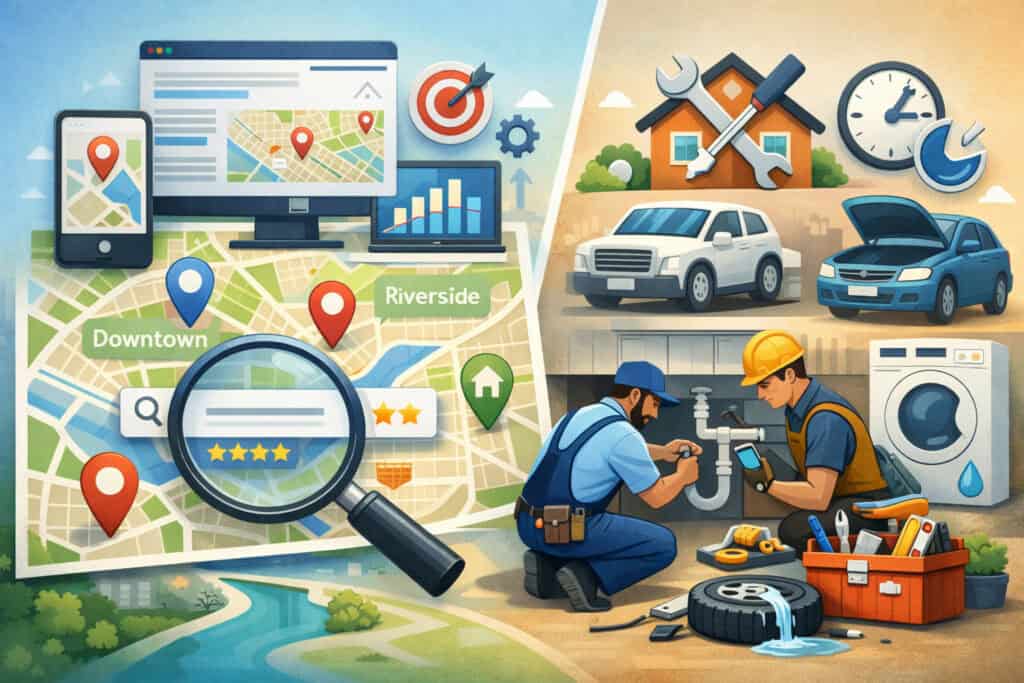
To market an auto repair shop locally, you need a foundation that answers three questions instantly: Where are you? Can you fix my problem? Can I trust you? If any of those are unclear, people keep scrolling. Your foundation includes your brand positioning, your service focus, your geographic focus, and the proof that you’ll do the job right.
Start by defining your “local promise” in one sentence. Examples: “Same-day diagnostics for busy commuters,” “Honest estimates for families in [Neighborhood],” or “Specialists in European vehicles with dealer-level tools.”
This isn’t a slogan—it’s a filter that shapes your website pages, your ads, your reviews strategy, and even your front-desk scripts. When you market an auto repair shop locally, clarity beats cleverness.
Next, lock down your service mix and your ideal customer. Many shops try to promote everything to everyone, which creates generic messaging that doesn’t rank well and doesn’t convert well.
Instead, build your marketing around high-intent services that people actively search for locally: brakes, AC, batteries, diagnostics, suspension, alignment, oil service, and fleet maintenance. Then add specialties like diesel, hybrids, European, or performance if that’s your edge.
Finally, ensure your basics are consistent everywhere: shop name, address, phone, hours, categories, and service descriptions. Search platforms treat consistency as a trust signal, and inconsistency creates friction for customers and algorithms.
Citation consistency (often called NAP consistency) is repeatedly emphasized as a local ranking factor and credibility driver. When you market an auto repair shop locally, this foundation is what turns “visibility” into booked appointments.
Set Up a Simple Local Offer Ladder That Converts Searchers Into Callers
A powerful way to market an auto repair shop locally is to build an “offer ladder” that matches how people actually choose a mechanic. Most customers aren’t ready to buy a major repair immediately. They want to reduce uncertainty first. Your offer ladder should start with low-risk entry points and move toward higher-value services.
Your first rung is a trust-building offer: free battery/charging check, complimentary visual inspection, discounted first-time oil service, or a diagnostics credit applied toward repair.
The second rung is your core service conversion: brakes, AC recharge, check engine diagnosis, alignment, etc. The third rung is retention: maintenance plans, seasonal inspections, reminders, and VIP scheduling.
This matters because local search behavior is often “near me + problem,” and the customer is comparing two or three shops quickly. If your listing and website explain what happens next—how they book, what the inspection includes, whether you text estimates, how long typical jobs take—you reduce anxiety and increase calls.
Google’s evolving local experiences also pull more business data directly into the search results, so the clearer your service details and policies are, the better you perform in “zero-click” environments.
If you want to market an auto repair shop locally and beat bigger competitors, don’t outspend them—out-clarify them.
Optimize Your Google Business Profile to Dominate Maps and “Near Me” Searches
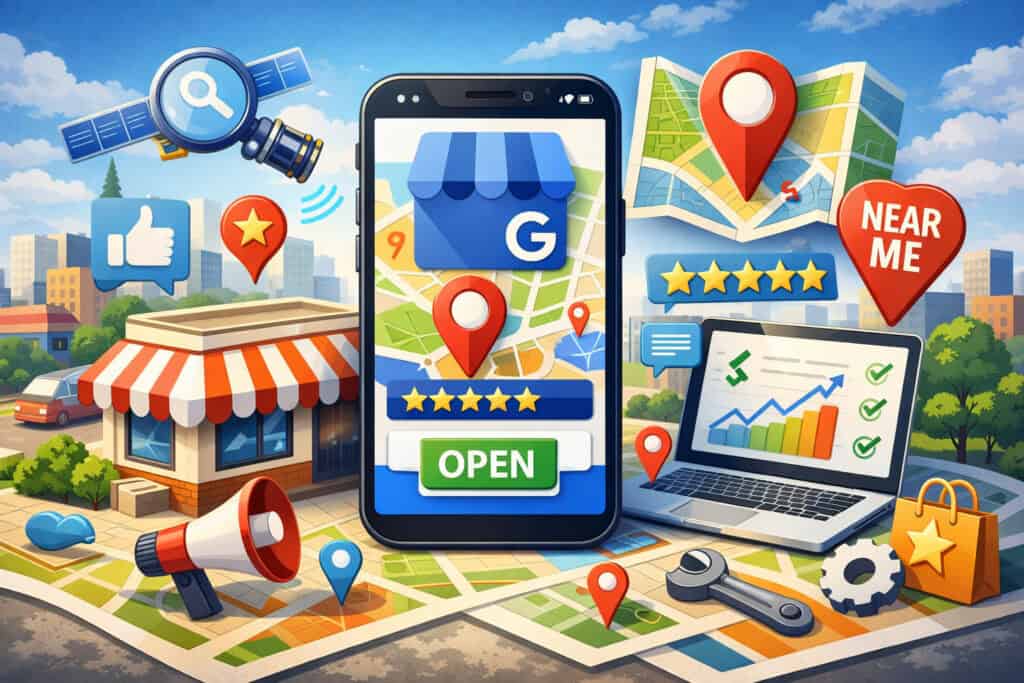
If you’re trying to market an auto repair shop locally, your Google Business Profile (GBP) is often your #1 lead source. Many customers will call directly from Maps without visiting your website. That’s why GBP optimization isn’t a one-time setup—it’s a weekly routine.
Complete every field: primary category, secondary categories, services, hours, special hours, attributes, description, appointment URL, products (yes, even service “products”), and photos. Post real images: your bays, waiting area, parking, signage, team, diagnostic tools, and before/after shots (where appropriate). Customers trust what they can see.
GBP is also becoming more dynamic with AI-assisted features, profile attributes, and increased anti-spam protections in the local ecosystem. Several 2025 updates and discussions highlight more automation and a stronger emphasis on accurate attributes and trust signals.
Most importantly: treat your GBP like a “mini-website.” When you market an auto repair shop locally, GBP should answer common questions: financing options, warranty terms, same-day availability, after-hours drop-off, towing partners, fleet accounts, and whether you service hybrids/EVs.
Use Reviews, Q&A, Messaging, and Posts to Turn Visibility Into Appointments
To market an auto repair shop locally, you need more than rankings—you need conversion signals. GBP gives you four conversion engines that many shops underuse:
- Reviews and responses: Ask every satisfied customer for a review at the moment they’re happiest—right after pickup, right after you explain the fix, or right after you save them money. Reply to every review with specific service references (without exposing private details). Reviews influence trust and can influence local visibility because they reinforce relevance and quality signals.
- Q&A strategy: Don’t wait for random questions. Seed your own Q&A by having staff or loyal customers ask common questions (“Do you offer same-day service?” “Do you work on European cars?”) and answer them clearly. This is “zero-click marketing” because the answers show right on the profile.
- Messaging and call handling: If messaging is enabled, set expectations: response times, what info you need (vehicle year/make/model, symptoms), and how you send estimates. Missed calls are lost revenue, so pair GBP optimization with call tracking and a missed-call text-back workflow.
- Posts and updates: Weekly posts—seasonal inspections, brake month, AC checks, winter battery checks—keep your profile fresh and help communicate relevance.
Local platforms are moving toward AI-led experiences that extract business facts from public sources, including listings. Google has even tested AI that contacts auto shops to gather info like pricing and scheduling, which makes your public data accuracy even more important.
When you market an auto repair shop locally, GBP is how you win the “right now” customer.
Build Local SEO Pages That Rank for Neighborhoods and High-Intent Repairs
To market an auto repair shop locally with SEO, your website must match real searches: service + location + urgency. That means creating dedicated service pages (brake repair, AC repair, diagnostics) and local location/neighborhood pages where it makes sense (not spammy doorway pages—use genuine local content).
A strong service page includes: symptoms, causes, your diagnostic process, expected time windows, ranges of cost factors (not fake “$99” bait), warranty information, FAQs, and calls to action. Add original photos from your shop. Include short paragraphs and scannable sections so the page is easy to read.
Also, strengthen local relevance using on-page local signals: nearby landmarks, common driving conditions in your area (stop-and-go commuting, winter salt, heat), and service scenarios that locals relate to. This helps both humans and search engines understand that you’re genuinely relevant to local intent.
Local SEO guides consistently emphasize NAP consistency, locally targeted keywords (“brake repair in [City]”), distinct service/location pages, review signals, and structured data (schema) to improve visibility.
If your goal is to market an auto repair shop locally, think “helpful landing pages,” not “SEO tricks.”
Use Citations, Structured Data, and Local Content to Earn Trust at Scale
Citations are mentions of your business details across directories, maps, and platforms. They act like consistency and legitimacy signals, especially when your name/address/phone match perfectly. Several modern local SEO resources continue to stress citation accuracy and quality over sheer quantity.
Here’s what to do when you market an auto repair shop locally using citations and structure:
- Audit your listings: fix old phone numbers, duplicate addresses, or outdated hours.
- Prioritize authoritative listings: major mapping apps, major review platforms, and industry-relevant directories.
- Add structured data (schema): LocalBusiness + AutoRepair can help search engines interpret your services, hours, and location.
Then create “local proof content” that earns links and shares:
- “State inspection checklist for local drivers”
- “Top causes of AC failure in hot summers”
- “What that dashboard light means and when to stop driving”
This content isn’t just for rankings. It’s for building reputation and trust so that when you market an auto repair shop locally, your shop becomes the obvious safe choice.
Local search is also increasingly shaped by AI summaries and “zero-click” layouts. Some local marketing commentary now explicitly mentions preparing listings and citations so AI systems can accurately reference your business.
Use Paid Local Ads for Immediate Leads Without Wasting Budget
Organic visibility takes time, but paid ads can generate calls this week. To market an auto repair shop locally with paid ads, use channels that match local intent and lead quality, not just clicks.
Two options typically matter most: Local Services Ads (LSAs) and search ads. LSAs are designed for service businesses and operate as pay-per-lead rather than pay-per-click, with prominent placement and trust indicators in some categories.
Google’s own help documentation highlights LSAs as a way to appear prominently and pay for leads related to your services. Many auto industry marketing resources specifically discuss LSAs for auto repair shops and how they can produce lower-cost leads compared to traditional click-based campaigns.
For traditional search ads, focus on “high-intent emergency” keywords (brakes, towing coordination, no-start, AC not cold) and protect your budget with negatives (DIY, free, manual pdf, salary, etc.). Send traffic to service pages built for conversions—never your homepage.
When you market an auto repair shop locally, you’re buying phone calls and appointments, not “traffic.”
Make Your Ads Match Real Local Decisions (Offers, Proof, and Speed)
Paid ads fail when they feel generic. Paid ads win when they reflect the exact local decision customers are making:
- Speed: same-day diagnostics, early-bird drop-off, appointment slots, quick estimates
- Proof: ratings, warranty, certifications, “locally trusted” social proof
- Clarity: what happens next, financing options, transparent inspection process
LSAs and local-focused ad products often show your rating, hours, and contact options right in the search results, which makes reviews and profile completeness part of ad performance—not just SEO.
Also, plan for a near-future shift: more leads will come from AI-led search experiences where the search engine tries to answer questions immediately or even contact shops on a user’s behalf. That pushes marketers to keep service info, pricing policies, and availability messaging consistent across GBP, your website, and directories.
If you want to market an auto repair shop locally and scale profitably, build ads on top of strong local credibility—not instead of it.
Create Local Partnerships and Community Presence That Competitors Can’t Copy
To market an auto repair shop locally beyond the internet, you need community gravity—relationships that keep referrals flowing even when ad costs rise. Local partnerships are hard for competitors to replicate because they’re built on trust and time, not spending.
Start with adjacent businesses that share your customer base but don’t compete: towing companies, car washes, tire shops (if you don’t sell tires), detailers, used car dealers, body shops, fleet operators, property managers, and local employers with commuting staff.
Create a simple referral agreement: a tracked referral card, a landing page, or a tagged phone extension. Keep it transparent and ethical.
Next, support your community in visible, practical ways: sponsor a youth team, host a “car care basics” clinic, run a winter safety inspection event, or partner with a local charity for a “donation drive + free inspection day.” People remember the shop that helped their neighbor.
This matters more in 2026 because digital spaces are getting crowded and “zero-click” search reduces website traffic. A strong offline reputation becomes a moat. Marketing trend discussions also highlight the importance of hyperlocal targeting and authenticity as competition increases.
When you market an auto repair shop locally, community presence becomes your long-term unfair advantage.
Turn Fleet, Rideshare, and Local Employer Deals Into Reliable Monthly Revenue
One of the smartest ways to market an auto repair shop locally is to reduce dependence on one-off emergency jobs by building repeatable service contracts. Fleets and local employers can become predictable monthly revenue if you package your offer correctly.
Targets include: delivery fleets, trades businesses (plumbers, electricians), landscaping companies, non-emergency medical transport, property maintenance teams, and rideshare drivers.
Your pitch should be operational, not promotional: “faster turnaround,” “text approvals,” “priority scheduling,” “maintenance tracking,” “after-hours drop-off,” and “clear invoicing.”
Create a dedicated fleet page on your site with a simple inquiry form and proof points (turnaround times, diagnostics capability, warranty). Offer a pilot: “first two vehicles get a discounted inspection and maintenance plan.” Once you have two or three fleet accounts, word spreads locally.
The bigger point: when you market an auto repair shop locally, the best growth often comes from relationships that reduce volatility. In a world where ad costs fluctuate and search layouts change, contractual local demand stabilizes your business.
Build a Referral and Retention Engine That Keeps Bays Full Year-Round
Retention is local marketing’s hidden profit lever. It’s cheaper to bring back a satisfied customer than to constantly win new ones. To market an auto repair shop locally for long-term growth, you need a retention system that feels helpful—not spammy.
Start with reminders people actually want: oil service intervals, seasonal inspections, brake checks, battery tests, and tire rotation schedules. Use text messages ethically and let customers choose frequency.
Make your reminders specific: “Your last service was [Month]. Based on your mileage, you’re due around [Month]. Want us to hold a spot next week?”
Then build a referral program that rewards behavior without feeling gimmicky. Examples:
- “$25 credit for you, $25 for a friend after their first completed service”
- “Free wiper blades after 3 referrals”
- “VIP priority scheduling after 5 referrals”
Referrals work best when you time the task: after a successful repair, after a great review, or after you solved a stressful breakdown. Your team should have a one-sentence script and a simple handout.
Auto service trend discussions increasingly emphasize multichannel strategies and retention as a way to grow market share in crowded local markets.
When you market an auto repair shop locally, retention turns marketing from an expense into compounding revenue.
Use Email and Text the Right Way (Service Updates, Education, and Re-Activation)
Most shops either ignore lifecycle messaging or overdo it. A balanced approach helps you market an auto repair shop locally while keeping trust high.
Create three message categories:
- Educational tips (monthly): short, seasonal, useful. “How to spot brake wear,” “What to do if your car overheats,” “Battery warning signs.” These messages reduce anxiety and position you as the expert.
- Service updates (as needed): recall checks, seasonal inspections, special hours, staffing updates, towing coordination changes. Clear and practical.
- Re-activation (quarterly): if someone hasn’t visited in 9–12 months, send a friendly note: “We haven’t seen you in a while—want a quick inspection before your next trip?” Add a small incentive if needed, but keep it simple.
As AI-led local search evolves, your owned customer list becomes more valuable because it’s insulated from algorithm changes. Even if “near me” layouts shift, your retention engine keeps volume stable.
Track What Works Locally: Calls, Bookings, Repair Orders, and Reputation
If you don’t measure, you guess. And guessing is expensive. To market an auto repair shop locally with confidence, you need a tracking setup that connects marketing to revenue.
Start with the basics:
- Call tracking by channel (GBP, ads, website, referrals)
- Appointment source captured at booking (“How did you hear about us?”)
- Repair order value by source (ads might bring more first-timers; referrals might bring higher trust)
- Review volume and rating trend over time
Then focus on two conversion choke points: missed calls and estimated approval rate. If you’re missing calls, you’re paying for leads you never convert. If your approval rate is low, your inspection process and estimate presentation need work (photos, explanations, financing options, phased repairs).
Also monitor listing accuracy and citations. Local SEO guidance continues to emphasize consistency and active management, especially as platforms increasingly surface business data directly in search experiences.
When you market an auto repair shop locally, metrics keep you focused on profit—not vanity traffic.
Future Prediction: Local Marketing Will Shift From “Rankings” to “Data Quality + Trust Signals”
Over the next 12–24 months, expect local visibility to rely even more on data quality (accurate services, availability, policies, and attributes) and trust signals (reviews, verification, responsiveness).
Search experiences are already moving toward AI-generated answers and features that reduce clicks, making the search results page itself the battleground.
You’ll also likely see:
- More lead flow through “pay-per-lead” and local-first ad units
- More importance placed on up-to-date photos, posts, and attributes
- More spam policing and verification in business listings
- More customers comparing shops based on review content (not just star rating)
That means the shops that win locally won’t just “do SEO.” They’ll maintain a living, verified public presence that makes decision-making easy for customers and easy for search engines to trust.
If your plan is to market an auto repair shop locally and stay resilient, treat your local data and reputation like a core business asset—because it is.
FAQs
Q.1: What is the fastest way to market an auto repair shop locally and get more calls?
Answer: The fastest way to market an auto repair shop locally is to combine Google Business Profile optimization with local-intent ads and review acceleration. GBP gives you immediate Maps visibility if your profile is complete, active, and trusted.
Then, local ads—especially lead-focused formats like Local Services Ads in supported categories—can place you at the top for high-intent searches while your organic visibility grows.
At the same time, you need a review system that’s consistent and ethical: ask at pickup, send a short link by text, and respond to all reviews. Those three moves work together because ads and listings often show ratings directly, and customers choose based on trust.
If you’re missing calls, add missed-call text-back and call tracking so paid leads don’t leak. This is how to market an auto repair shop locally for speed without wasting budget.
Q.2: How many reviews do I need to market an auto repair shop locally effectively?
Answer: There’s no perfect number, but you need “enough” reviews to remove doubt and “recent” reviews to show your shop is active now. People trust patterns: consistent rating, frequent mentions of specific services, and professional responses.
Your goal is steady review velocity—not a one-time spike. Local visibility strategies consistently highlight reviews as a major trust and relevance signal for local search.
A practical benchmark is: aim for a review request on every successful job, then track your conversion rate (how many requests become reviews). If you want to market an auto repair shop locally in a competitive area, the shops that win usually have both volume and freshness—because it reduces the perceived risk of choosing you.
Q.3: Should I use Google Local Services Ads to market an auto repair shop locally?
Answer: If Local Services Ads are available for your service category in your area, they can be a strong channel because they’re designed for service businesses and are often pay-per-lead rather than pay-per-click. Google’s own documentation describes LSAs as a way to appear prominently and pay for leads related to your services.
That said, LSAs don’t replace everything. They work best when your profile and operations are tight: fast response time, strong reviews, consistent hours, and a good intake process. Many auto marketing resources highlight that LSAs can generate cost-efficient leads for auto repair shops, but performance varies by market and responsiveness.
Q.4: How do I market an auto repair shop locally if I’m in a very competitive city?
Answer: In competitive markets, the winning formula is specialization + proof + neighborhood relevance. You market an auto repair shop locally by choosing a few services or vehicle types where you can clearly be “the best choice,” then building content, reviews, and offers around those.
Create dedicated pages for high-intent services and ensure your GBP is complete, active, and full of real photos. Add neighborhood signals (landmarks, common commuter problems) and publish FAQs that match what people search.
Also, diversify lead sources: referrals, fleet partnerships, employer relationships, and re-activation campaigns. Competition usually pushes ad costs up, so relationship-based channels become more valuable over time.
Trend discussions in auto service marketing emphasize multichannel approaches and retention to grow market share in crowded local markets.
Q.5: How will AI search change how to market an auto repair shop locally?
Answer: AI search is pushing local marketing toward “answers without clicks,” meaning customers may get pricing ranges, availability, or shop comparisons directly inside the search experience. Google has tested AI that can contact auto shops to gather information, which increases the importance of accurate public business data and responsiveness.
The future of how to market an auto repair shop locally will rely more on: clean listings, consistent citations, strong reviews, fast reply times, and clear service details. In other words, your marketing becomes less about “tricking algorithms” and more about becoming an easily verifiable, highly trusted local entity across the web.
Conclusion
To market an auto repair shop locally in 2026, focus on the actions that directly drive calls, bookings, and repeat business. Start with your Google Business Profile and treat it as your main storefront: complete it, refresh photos, post weekly updates, and build a review system that runs every day.
Then strengthen your website with service pages that match high-intent local searches and reinforce trust with clear policies and real-world proof.
Next, add paid local visibility carefully: use lead-focused local ad options where available, run tightly targeted search campaigns, and send clicks to conversion-ready pages.
Support all of that with offline community presence—partnerships, fleet accounts, local employer relationships—because those are resilient channels competitors can’t easily copy.
Finally, future-proof your strategy. AI-led search and “zero-click” results mean your data accuracy and trust signals matter more than ever. Keep listings consistent, manage citations, respond to reviews, and make it easy for both customers and search platforms to understand who you are, what you do, and how to book.