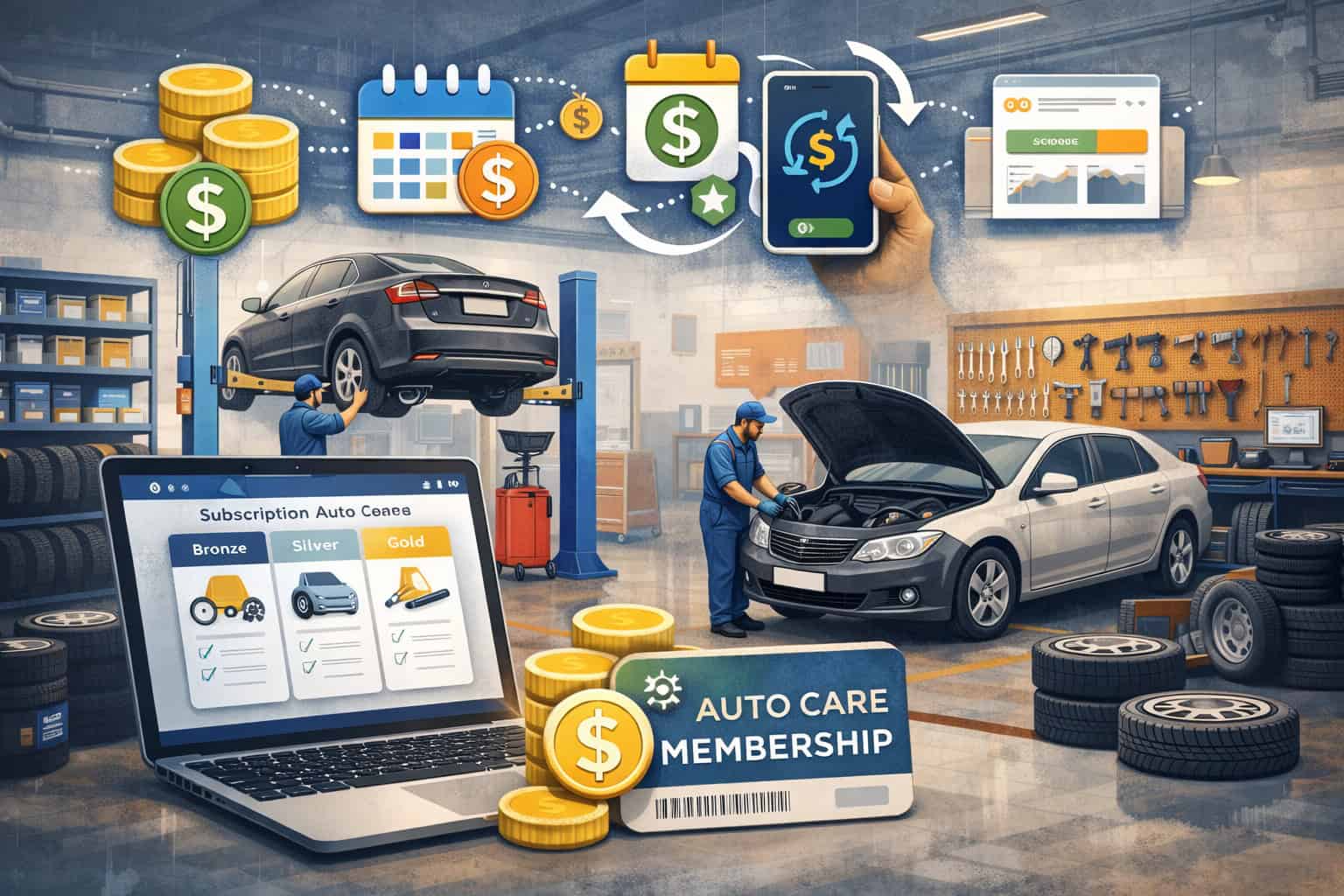
Subscription-Based Maintenance Models: A New Revenue Stream for Auto Repair Shops
Recurring revenue used to be a “nice to have” in automotive service. Today, it’s becoming a competitive advantage.
Subscription-Based Maintenance Models—including automotive maintenance subscription plans and a monthly vehicle maintenance subscription—help shops smooth out seasonal dips, stabilize cash flow, and deepen customer relationships without relying on constant couponing or chasing one-time jobs.
Independent shops, dealership service departments, and franchise operators all face the same structural challenge: the traditional repair model is reactive.
Cars break, customers show up when they have to, and the shop’s income swings with weather, holidays, back-to-school cycles, and the local economy. Even when demand is strong, last-minute schedule fills and “waiter” oil changes can create operational stress that hurts CSI, reviews, and technician morale.
At the same time, customer expectations are shifting. Many drivers want predictable costs, convenience, and fewer “surprise” expenses. They’re used to subscriptions in nearly every part of life—phones, streaming, software, even groceries.
A vehicle service subscription model translates that preference into a structured relationship where maintenance becomes planned, not postponed. When executed correctly, the shop benefits from predictable service income, and the customer benefits from clarity, reminders, and easier decision-making.
This article walks through how to design a car maintenance membership program that’s profitable, operationally manageable, and aligned with real-world service capacity—without hype, unrealistic ROI promises, or gimmicks. You’ll see plan structures, pricing logic, operational setup, risk controls, and a 60-day launch roadmap you can actually run.
Why Recurring Revenue Matters in Modern Auto Service

The auto repair industry has always been cyclical. Tire season, winter no-starts, summer A/C, pre-road-trip inspections, tax refund spikes—these patterns are predictable, but your income may not be. Recurring revenue for auto repair shops changes that dynamic by creating a baseline of contracted demand.
A well-designed membership program doesn’t replace repair work. It makes repair work more consistent. When customers come in regularly for maintenance, you find issues earlier, recommend services at the right intervals, and reduce the “I’ll wait until it’s worse” behavior that leads to angry phone calls and price shock.
Recurring models also help shops navigate the reality of modern customer acquisition. Ads and lead platforms are expensive. If you treat each visit as a one-time transaction, you’re constantly paying to replace churn. But if membership improves customer retention in auto repair, you reduce the need to “buy” the same customer over and over.
Most importantly, subscriptions create operational leverage:
- You can forecast oil change volume and align staffing
- You can plan parts inventory for common filters and fluids
- You can schedule work in advance instead of living on walk-ins
- You can build an automotive loyalty program with measurable engagement
The key is not chasing subscriptions as a “money hack.” It’s using them as a structured system for preventive maintenance packages and customer lifecycle management.
The Core Problem With One-Time Repair Revenue
One-time revenue is inherently unstable because it depends on unpredictable triggers: breakdowns, warning lights, and overdue maintenance that finally becomes urgent. That volatility creates specific business issues:
- Cash flow swings that make hiring, training, and tool purchases harder
- Pricing pressure because slow weeks push shops into discounting
- Low plan adherence because customers delay maintenance until it fails
- Customer churn after a single transaction (especially price-sensitive buyers)
- Capacity whiplash: slow Monday, slammed Thursday, technicians burned out
A subscription doesn’t eliminate these challenges automatically. But it does create a framework where you can pre-sell maintenance at a fair price, improve adherence through reminders and scheduling, and stabilize your base workload.
The shops that win with subscriptions are the ones that treat them like operations—not marketing.
What Are Subscription-Based Maintenance Models?

Subscription-based maintenance models are structured service offerings where customers pay a recurring monthly fee in exchange for a defined set of maintenance benefits. Think of it as a membership relationship: the customer commits to your shop, and you commit to delivering specific services, priority access, or pricing advantages.
In practice, a monthly vehicle maintenance subscription typically includes routine items like oil changes, inspections, tire rotations, and discounts on additional services. More advanced plans may include seasonal inspections, fluid top-offs, wiper replacement allowances, battery testing, alignment checks, or bundled diagnostic credits.
The difference between “good” and “bad” subscriptions usually comes down to clarity and constraints. If the plan is vague (“unlimited maintenance!”), you’re inviting abuse, conflict, and margin erosion. If the plan is specific (service limits, intervals, and exclusions), customers understand it and your team can deliver it consistently.
A vehicle service subscription model works best when it:
- Encourages preventive maintenance (not unlimited repairs)
- Creates predictable touchpoints (2–4+ visits per year)
- Uses simple rules your advisors can explain in 30 seconds
- Is easy to bill, track, and manage inside your existing workflow
How Subscription Plans Work in a Real Shop
Most subscription programs follow a similar operational loop:
- Customer joins online, in-store, or via a service advisor
- Payment method is stored and billed monthly (card or ACH)
- Plan benefits are tracked (visits, included services, discounts)
- Maintenance reminders drive scheduled appointments
- Upsell happens naturally during inspections, with trust intact
- Renewal and retention are managed through ongoing value delivery
To make this work, you need three building blocks:
- An auto repair recurring billing system (software + payment processor)
- A plan design that matches your service capacity and costs
- A staff process that makes membership part of the standard service flow
Subscription Plans vs. Extended Warranties and Service Contracts
Shops often confuse maintenance subscriptions with extended warranties or third-party service contracts. They are not the same product, and mixing them creates compliance and customer expectation problems.
Here’s the practical distinction:
- Maintenance subscription: covers routine services you control and schedule (oil change, rotation, inspection). The customer pays monthly for predictable upkeep and convenience.
- Extended warranty: typically covers repair failures (engine, transmission, electronics) and often involves claims, approvals, exclusions, and third-party administrators.
- Service contract: a broader term that can include repair coverage, but usually involves specific legal requirements and consumer contract rules depending on the state.
A subscription is simpler when positioned correctly: “This is a maintenance membership, not repair insurance.”
Examples in Automotive and Other Industries
Subscription logic is already normalized across the economy:
- Software (SaaS): recurring fee for ongoing access and updates
- Gyms: monthly membership for facility access and perks
- Car washes: unlimited or capped wash plans
- Dental plans: membership including cleanings and discounted procedures
Automotive has parallel examples:
- Dealer prepaid maintenance plans bundled into financing
- Tire and lube chain memberships
- Fleet service agreements with recurring billing
The opportunity for independents and service-focused dealerships is to offer the same predictability—without making promises you can’t operationally support.
Why Automotive Maintenance Subscription Plans Are Growing
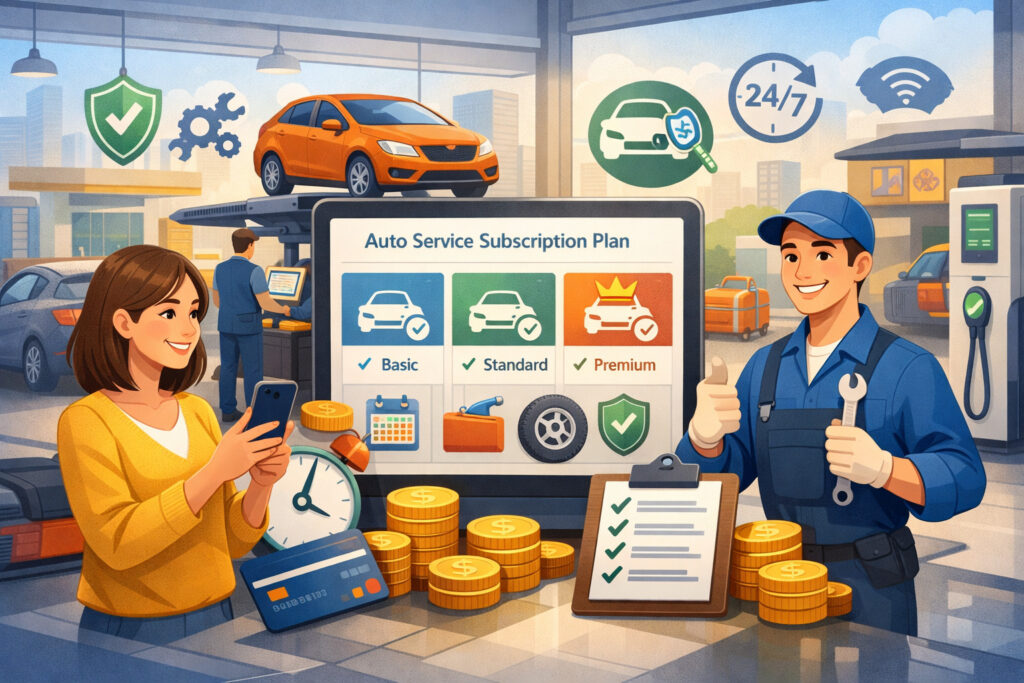
The growth of automotive maintenance subscription plans isn’t driven by one trend—it’s a convergence of customer behavior, cost pressure, and competitive differentiation. Shops adopting subscriptions aren’t just adding a product; they’re adapting to how people want to buy services now.
Drivers are dealing with higher overall cost-of-living. Even customers with good income often prefer predictable monthly budgeting over surprise $600 service visits.
A membership reframes maintenance as a manageable operating expense, not an occasional hit. That shift matters because deferred maintenance creates bigger repairs later—bad for customers and stressful for service advisors to explain.
Meanwhile, competition has intensified. Your customer isn’t choosing between two local shops anymore. They’re comparing you to dealer specials, chain discounts, mobile mechanics, and online marketplaces.
A well-structured vehicle service subscription model can stand out because it bundles convenience, priority, and relationship—things that aren’t easily compared on price alone.
Finally, the “membership economy” is real. Customers are more comfortable subscribing when the value is clear and cancellation is fair. But they’re also quicker to cancel if they feel they’re paying for nothing. That means subscriptions force shops to deliver consistent value—not just a one-time discount.
Customer Demand for Predictable Costs
Predictability is a selling point, but it must be real. Customers don’t want vague “savings.” They want:
- A known monthly charge
- Clear included services
- Easy scheduling
- Confidence that maintenance won’t be ignored
For many drivers, the plan reduces decision fatigue. Instead of debating whether to rotate tires or postpone an inspection, they simply follow the membership schedule.
The best subscription programs also reduce uncomfortable moments at the counter. When a customer already pays monthly, they’re less likely to feel “sold to” when you recommend needed work discovered during an inspection. They feel like they’re maintaining a system they’ve invested in.
Budget-Friendly Car Ownership and Deferred Maintenance
Deferred maintenance is one of the biggest silent killers of customer trust. A driver skips basic service, then gets hit with a larger repair, then blames the shop for “bad news.” Subscriptions help move the relationship upstream—into prevention.
A car maintenance membership program creates a habit. It increases visit frequency, which improves inspection consistency, which improves long-term outcomes. That pattern also supports better maintenance plan profitability, because you’re reducing no-shows, stabilizing workload, and building higher-lifetime-value accounts.
Increased Competition in Auto Repair
Competition pushes shops into discounting. Discounting trains customers to wait for the next coupon. A subscription shifts the conversation from “How cheap is the oil change?” to “How do we keep your vehicle on track all year?”
That’s strategic differentiation. Your marketing becomes less about a single transaction and more about an ongoing program:
- priority scheduling
- transparent benefits
- bundled preventive services
- relationship-based service history
This is why subscriptions often pair naturally with automotive loyalty programs, but with a stronger revenue backbone.
The Shift Toward Membership-Based Services
Customers already pay monthly for services they use periodically. The reason it works is trust and clarity. Automotive subscriptions grow when shops:
- position them as maintenance planning tools
- provide real reminders and easy booking
- deliver consistent experience across advisors
- avoid aggressive upsell tactics
Subscriptions don’t replace great service. They amplify it.
Types of Monthly Vehicle Maintenance Subscription Plans
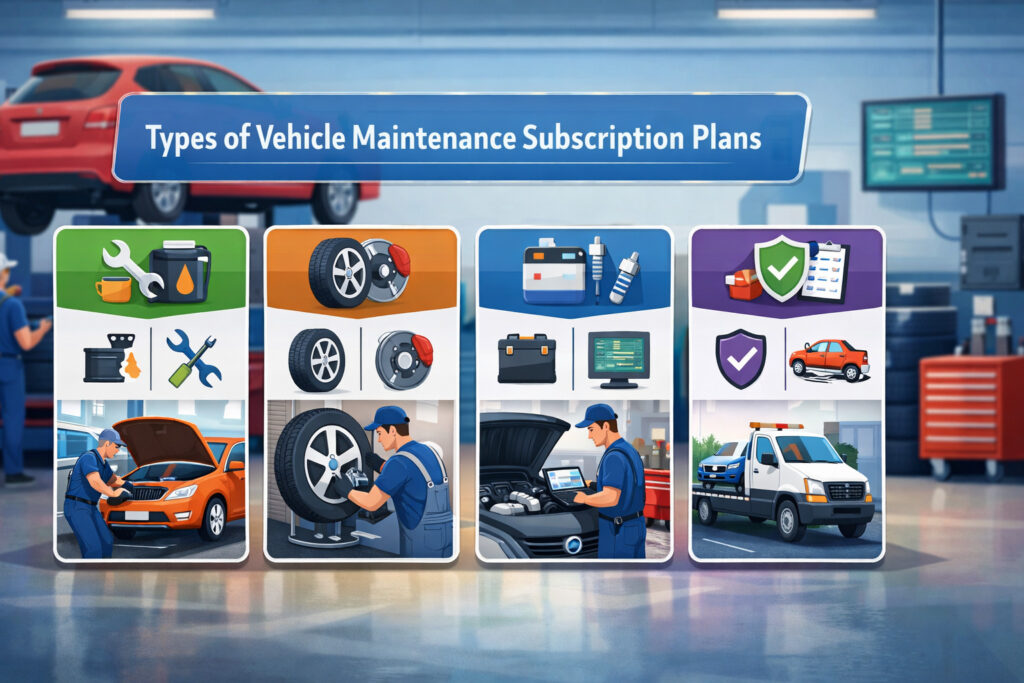
There isn’t one “correct” subscription model. The best design depends on your car count in the local market, vehicle mix, bay count, technician capacity, and whether you serve retail, fleet, or both. What matters is that your plan is easy to explain, profitable at realistic usage, and operationally trackable.
Most programs fall into five categories:
- Basic maintenance membership (oil changes + inspections)
- Multi-tier plans (Silver/Gold/Platinum)
- Fleet maintenance subscription programs
- EV-specific memberships
- Dealership service subscription model variations
Below are practical structures you can adapt.
Basic Oil-Change Membership
A basic plan is your entry-level offer. It’s designed to be simple, popular, and easy to deliver. It usually includes:
- Oil change at defined intervals (example: up to 2–4 per year depending on mileage)
- Tire rotation (with oil service or at set frequency)
- Multi-point inspection every visit
- Fluid top-offs (basic)
- Small discount on additional services
The goal is not to “win” on oil change pricing. The goal is to lock in the relationship and increase retention. A basic plan works best when it’s priced to cover realistic cost and includes clear service limits.
Operational tip: define oil type coverage. If you include “up to 5 quarts conventional,” you must have an upgrade price for synthetic, Euro oils, or extra capacity.
Tiered Plans With Membership Levels
Tiering is where subscriptions become a true revenue and retention system. Auto service membership tiers let you segment by customer needs and vehicle usage.
A common tier structure:
- Silver: core maintenance touchpoints (oil + rotation + inspections)
- Gold: adds seasonal inspections, alignment check, battery testing, deeper discounts
- Platinum: adds diagnostics credit, priority booking, concierge perks (where feasible)
Tiering works because different customers value different things. Commuters may value frequent oil changes. Busy parents may value priority scheduling. Enthusiasts may value inspections and discounts.
If you implement tiers, train advisors to recommend based on driving behavior, not “upsell.” For example:
- “Based on your 18,000 miles a year, Gold fits your intervals better.”
- “If you want priority scheduling during tire season, Platinum helps.”
Fleet Maintenance Subscription Programs
Fleet subscriptions are a different business. They can be powerful because fleet customers value uptime and predictable billing, but they also require disciplined service level definitions.
Fleet maintenance subscription programs typically include:
- scheduled PM services at mileage intervals
- inspections and reporting
- defined turnaround targets (only if you can meet them)
- consolidated invoicing with recurring billing and overage rules
Fleet plans should almost never be “unlimited.” They should be structured around:
- number of units
- expected monthly mileage
- service intervals and included labor time allowances
- parts billed separately or with markup rules
If you want fleet subscriptions, start with small local fleets (5–20 vehicles) and build your process before chasing large contracts.
EV-Specific Maintenance Plans
EVs need less routine maintenance, but they still need service. EV memberships should be designed around what matters:
- tire rotations (often more frequent due to torque and weight)
- brake inspections and fluid service (brake fluid intervals still apply)
- cabin air filters
- suspension and tire wear monitoring
- software/diagnostic checks (where applicable)
An EV subscription isn’t about oil. It’s about creating a service relationship in a segment where owners may assume “nothing is needed.” That makes education a key part of the plan.
Dealership-Branded Service Plans
A dealership service subscription model is often tied to retention and fixed ops performance. Dealership plans may integrate with:
- prepaid maintenance bundled into financing
- loyalty programs tied to OEM retention targets
- service lane capacity planning
Dealers can position subscriptions as an alternative to “one-and-done” express lane visits. The key is to avoid cannibalizing profitable menu items. Design the plan so that it increases visit frequency and drives inspection-based work ethically.
Pricing Strategy and Maintenance Plan Profitability
Pricing makes or breaks subscription programs. Underpricing is the fastest way to create chaos: overuse, advisor conflict, tech frustration, and margin collapse. Overpricing creates low adoption and cancellations. The right approach is a practical service plan pricing strategy based on your actual costs, usage assumptions, and capacity.
You’re not trying to guess perfect usage. You’re trying to price for a realistic average customer while building guardrails that prevent extreme outliers from destroying profitability.
A strong pricing model:
- includes only services with predictable cost behavior
- sets interval limits (per year or per mileage)
- creates an upgrade path for higher-cost vehicles
- separates “included maintenance” from “discounted repair”
How to Calculate Average Service Cost
Start by estimating your direct cost per included service. Use your own numbers, not industry averages.
For each included service, estimate:
- technician labor time (hours) × effective labor cost
- parts cost (filters, oil, shop supplies)
- disposal/environmental fees
- overhead allocation (optional, but helpful for realism)
Example (illustrative):
- Oil change direct cost: $22 oil + $6 filter + $18 labor + $3 supplies/fees = $49
- Tire rotation direct cost: $10 labor allocation = $10
- Inspection time allocation: $7 labor = $7
Now estimate realistic annual usage for the average member. For a typical driver:
- 3 oil services/year (depending on mileage and interval)
- 2 rotations/year
- 3 inspections/year (tied to visits)
Annual direct cost estimate:
- Oil: 3 × $49 = $147
- Rotation: 2 × $10 = $20
- Inspection: 3 × $7 = $21
- Total annual direct cost = $188
If you charge $24/month, annual revenue is $288. That leaves $100/year before overhead, payment costs, admin time, and occasional “perk” expenses. The point isn’t that $24/month is “right.” The point is that you must do the math with your own costs.
Break-Even Analysis With Simple Formulas
Use simple formulas your team can understand.
Annual break-even price = (Expected annual direct service cost + plan admin costs + payment costs) ÷ 12 months
If you estimate:
- Direct cost: $188/year
- Admin + tracking time allocation: $24/year
- Payment fees: $18/year
Total: $230/year ÷ 12 = $19.17/month break-even
You don’t price at break-even. You price above it to cover overhead and margin. Many shops target a buffer because usage varies and payment failures happen.
A practical approach:
- price base plans at 1.3× to 1.7× expected direct cost (not a guarantee—just a sanity check range)
- adjust for vehicle class (light trucks vs compact cars)
- build upgrade fees for synthetic or high-capacity oil systems
Margin Considerations and Avoiding Underpricing
Subscriptions have different margin dynamics than one-time services:
- You earn monthly whether they visit or not
- You incur costs when they redeem services
- High engagement is good (retention), but overuse is bad (margin)
To protect margin:
- limit included oil changes per year (or per 5,000–7,500 miles)
- define “rotation included only with oil service”
- include inspections, not repairs
- apply discounts to repair work rather than “free” repairs
Your goal is sustainable value, not aggressive giveaways.
Managing Risk Without Killing the Offer
Risk management should be built into plan design, not handled through arguments at the counter. Good guardrails include:
- Fair use language (maintenance schedule-based)
- Vehicle eligibility rules (exclude commercial abuse or salvage titles if needed)
- Service intervals clearly defined
- One membership per vehicle policy
- Non-transferability unless you choose otherwise
Also, consider a minimum commitment period (example: 3 months) to reduce churn from “join, use, cancel.” If you do this, make cancellation terms transparent and easy—just not exploitable.
Operational Setup: Systems, Billing, and Team Execution
The best plan design fails if you can’t bill it cleanly and track benefits accurately. Operational execution is where most subscription programs stumble. Shops get excited, sell memberships, then realize they don’t have a consistent process for redemption, cancellations, payment failures, and advisor scripting.
Operational setup should be treated like a mini launch of a new service line. You’re implementing:
- a recurring billing workflow
- a customer communication rhythm
- a tracking process tied to RO creation
- staff training and accountability
A subscription program is not just a marketing offer. It’s a recurring operations system.
Choosing Billing Software and Tracking Tools
Your billing system must do four things reliably:
- store payment methods securely
- charge automatically on schedule
- handle retries and dunning (failed payments)
- track membership status so advisors can verify benefits instantly
Shops typically solve this in one of three ways:
- an all-in-one shop management platform with membership add-ons
- a dedicated subscription billing platform integrated via API/Zapier-like tools
- a payment processor with recurring billing features plus manual tracking
The best choice depends on your current shop management system. What matters is minimizing manual work. If advisors have to “remember” benefits, mistakes will happen.
Operational requirement: create a single place in the workflow where membership status is verified (e.g., at check-in) and recorded on the RO.
Recurring Payment Processing and Reliability
Recurring payments have a different failure profile than one-time tickets. Cards expire, get replaced, or hit limits. You need a process for:
- automated reminders for expiring cards
- retry schedules for failed payments
- clear policy for benefit suspension if unpaid
- easy update methods (text link, portal, phone)
This is where your payment partner matters. A weak recurring billing system can quietly bleed revenue through failed charges and uncollected dues.
If your program grows, treat payment failure rate as a KPI. A 3–7% monthly failure rate is common in many subscription industries; reducing it improves predictable service income without selling more plans.
ACH vs Credit Card Billing
Both payment methods can work, and many shops offer both. Here’s the practical comparison:
| Billing Method | Pros | Cons | Best Fit |
|---|---|---|---|
| Credit Card | Easy adoption, fast setup, customer familiarity | Higher processing fees, card expiration, replacements | Retail customers, quick enrollments |
| ACH (Bank) | Lower fees, fewer expiration issues, stable long-term | Slightly more friction to enroll, customer trust hurdle | Long-term members, higher tiers, fleets |
If you want to maximize retention and reduce payment failures, offering ACH is worth considering—especially for fleet clients.
Contract Terms and Cancellation Policies
Your cancellation policy needs to be fair, simple, and consistent. The goal is not to “trap” customers. The goal is to prevent obvious abuse and reduce churn from impulse sign-ups.
Practical policy components:
- membership is tied to a specific vehicle (VIN)
- benefits apply only while account is current
- included services are based on interval rules
- cancellations require notice (e.g., 7 days) to avoid billing overlap
- optional minimum term (e.g., 3 months) if clearly disclosed
Avoid complex legal language. Use plain English. If your state has specific rules about service contracts, consult legal counsel—especially if you start bundling repair coverage.
Staff Training: Advisors and Technicians
Training should focus on consistency. Your team must understand:
- what’s included vs discounted
- how to explain it in under 45 seconds
- how to attach the membership to the vehicle profile/RO
- how to handle “Can I use it twice this month?” questions
Give advisors scripts that focus on outcomes:
- “This plan keeps you on schedule and spreads cost monthly.”
- “It includes your routine maintenance—repairs are still separate.”
- “You also get priority scheduling and a discount on additional work.”
Technicians need to understand that memberships aren’t “discount labor.” They’re a retention tool that increases steady work. If techs see memberships as a margin killer, they’ll resist. Show them how it stabilizes hours and reduces slow weeks.
Benefits for Auto Repair Shops
When subscriptions are designed and executed well, they create benefits beyond revenue. They can improve retention, stabilize operations, and build a customer base that views your shop as their default service partner. That’s the real value.
Recurring revenue is not magic. It’s a structural advantage that reduces dependence on unpredictable demand. It also improves your ability to plan staffing and inventory. Over time, it can reduce marketing spend per retained customer because the membership itself becomes the retention engine.
Subscriptions also change the way customers respond to recommendations. When customers feel they have a relationship (and a monthly investment), they’re more likely to approve needed maintenance and repairs discovered through inspections—especially when those recommendations align with a documented preventive plan.
Predictable Monthly Income That Supports Better Decisions
Predictable service income lets you make business decisions without guessing. Even if your membership revenue starts small, it creates a baseline you can build on.
Examples of how shops use predictable income:
- smoothing payroll during slow seasons
- funding ongoing training and certifications
- investing in equipment upgrades
- budgeting for marketing without panic discounting
The main advantage is stability. And stability improves service quality.
Improved Customer Retention and Reduced Churn
Subscriptions are retention systems. Customers who pay monthly are less likely to shop around for every service. That matters because customer acquisition is expensive and time-consuming.
Retention benefits often show up as:
- more repeat visits per year
- higher acceptance rates for maintenance recommendations
- more consistent RO history (better diagnostics and trust)
- fewer “price shoppers” dominating your schedule
This is one reason subscriptions pair well with inspection-based selling and strong documentation. You’re building a service history that makes future recommendations easier and more credible.
Higher Lifetime Value and More Ethical Upsell
A subscription relationship supports higher lifetime value (LTV) because the customer stays longer and visits more often. That doesn’t mean you upsell aggressively. It means you have more opportunities to serve them at the right time.
A member who comes in consistently is more likely to:
- replace tires before they’re dangerous
- address alignment issues before they destroy tread
- service fluids before they become failures
- approve brakes before rotors are damaged
That’s better for safety and for business. It’s also how you increase maintenance plan profitability without gimmicks.
Better Capacity Planning and Scheduling Control
Subscriptions can improve your schedule when you use them to shift demand:
- members get priority booking windows
- you encourage maintenance appointments midweek
- you pre-book next service at checkout
Over time, this reduces chaos and improves bay utilization.
Competitive Differentiation That Isn’t Just Price
A membership is a differentiator because it’s a relationship product. Competitors can match your oil change price. It’s harder to match your system, your reminders, and the way you take care of members.
Shops that market subscriptions effectively position them as:
- a maintenance management solution
- a convenience and priority access program
- a way to reduce surprise costs through planning
That’s more strategic than “$10 off.”
Benefits for Customers
Customer benefits must be real and repeatable. If the plan only benefits the shop, customers will cancel. If the plan promises savings that aren’t consistently felt, customers will churn after a few months. Successful subscriptions deliver value through predictability, convenience, and trust.
Customers don’t need complicated spreadsheets. They need a clear answer to: “Why should I pay monthly for this?”
The best answer is usually: because it makes maintenance easier to keep up with, reduces surprise, and gives priority access—especially when life is busy.
Cost Predictability Without the “Big Surprise” Visit
A maintenance subscription doesn’t eliminate repairs, but it reduces the likelihood of expensive surprises caused by neglect. Customers experience predictability through:
- a steady monthly cost
- included routine services at known intervals
- fewer “I didn’t budget for that” moments
This is especially appealing for:
- families managing multiple vehicles
- young drivers on tighter budgets
- commuters with high mileage
- customers who dislike financial unpredictability
The perception of long-term savings matters too—but be careful. Don’t promise “you’ll save X.” Instead, position it as budgeting and planning.
Convenience: Less Guessing, More Scheduling
Most customers don’t know what maintenance their vehicle needs. They also forget. Subscriptions reduce cognitive load:
- reminders drive scheduling
- included inspections create clarity
- priority access reduces wait frustration
Convenience becomes the retention hook. If members can book easily, get in faster, and feel cared for, they stay.
Priority Scheduling and VIP Experience
Priority scheduling is a powerful perk if you can deliver it without harming non-member service. Practical ways to offer it:
- reserve a small number of daily appointment slots for members
- offer earlier booking access for seasonal rushes
- provide a dedicated phone/text line for members
Don’t overpromise. The moment a customer pays for “priority” and still waits two weeks, trust drops fast.
Long-Term Savings Perception Through Prevention
The most honest way to discuss “savings” is through prevention:
- fewer breakdowns due to maintenance adherence
- better tire life through rotations and alignment checks
- fewer compounding issues from ignored inspections
Focus on outcomes: reliability, safety, and fewer unpleasant surprises—not guaranteed dollars.
Common Challenges and How to Avoid Them
Subscriptions can fail for predictable reasons. The good news is most problems can be prevented with clear plan rules, tracking discipline, and realistic service limits.
The most common failure pattern looks like this:
- shop launches a plan with vague “unlimited” language
- early adopters overuse it
- advisors argue at the counter about what’s included
- techs resent the plan
- cancellations rise and reputation suffers
Your goal is to build a plan that customers love and staff can deliver confidently.
Overpromising Services and Creating “Unlimited” Headaches
“Unlimited oil changes” sounds marketable, but it usually creates conflict. Customers define unlimited differently than shops do.
Replace “unlimited” with clear terms:
- “Up to X services per year”
- “One oil change every Y miles/months”
- “Rotation included with each oil service”
Also clarify what’s not included:
- repairs
- diagnostics beyond any included credit
- specialty fluids, Euro oil, oversized capacities (unless tiered)
Customers accept limits when they’re explained upfront.
Poor Plan Structure That Cannibalizes Profitable Work
A plan should not replace your best-selling menu items at a loss. If you include too much in the base tier, customers will migrate to the cheaper option and your average RO will drop.
Avoid cannibalization by:
- limiting included services to high-frequency preventive items
- keeping repair work discounted, not included
- building tiers that add value without adding unpredictable cost
Think of subscriptions as a retention engine, not a “cheap bundle.”
Lack of Tracking and Inconsistent Redemption
If advisors can’t instantly see membership status and remaining benefits, mistakes will happen:
- benefits given to non-members
- members denied benefits they paid for
- “he said/she said” conflicts
Solve tracking before launch:
- define where status lives (SMS/CRM/DMS)
- require membership verification at check-in
- build a simple redemption checklist on the RO
Tracking discipline protects customer trust and profitability.
High Cancellation Rates From Low Perceived Value
Customers cancel when:
- they don’t use the plan
- they forget they have it
- they can’t get appointments
- they feel it’s “not worth it”
Retention strategies:
- schedule the next service before they leave
- send maintenance reminders with booking links
- provide member-only perks that are easy to feel (priority slots, small discounts)
- do a 90-day “member check-in” message
If you want customers to stay, make sure they experience value early.
Payment Failures and Silent Revenue Loss
Payment failures can quietly destroy predictable income. A good recurring billing system should:
- automatically retry failed payments
- notify customers via email/text
- allow easy payment updates
- suspend benefits after a grace period
Treat failed payments like unpaid invoices: track them, follow up, and resolve quickly—without putting the burden on service advisors in the lane.
Comparison: Traditional Repair Model vs Subscription Model
A subscription program changes how revenue, scheduling, and customer relationships behave. It’s not better in every way, but it can be strategically better when managed well.
| Category | Traditional Model | Subscription-Based Maintenance |
|---|---|---|
| Revenue pattern | Spiky, seasonal | Smoother baseline + repair spikes |
| Customer behavior | Reactive, delayed maintenance | More proactive, scheduled maintenance |
| Marketing dependency | Higher (constant acquisition) | Lower over time (retention engine) |
| Scheduling | Walk-ins and rush cycles | Pre-booked visits, better forecasting |
| Upsell dynamics | Can feel transactional | Often feels like “maintenance planning” |
| Admin workload | Standard invoicing | Requires tracking + recurring billing |
| Risk | Less “overuse” risk | Requires guardrails and fair use rules |
| Customer retention | Depends on experience + price | Membership increases switching friction |
The key takeaway: subscriptions add operational complexity, but they can create stability and loyalty if you build the system correctly.
Pricing Model Examples and Plan Structures
Below are illustrative examples to show how shops structure membership tiers. These are not promises of profitability or required pricing—use them as templates to adapt based on your costs and market.
Example Tier Structure: Retail Customers
Silver (Entry Maintenance)
- Oil changes: up to 3/year (interval-based)
- Tire rotations: up to 2/year (with oil service)
- Multi-point inspection at each visit
- 5% discount on additional services
Gold (Preventive Plus)
- Oil changes: up to 4/year (interval-based)
- Rotations: up to 3/year
- Seasonal inspection (2/year)
- Battery/charging system test (1/year)
- 10% discount on additional services
- Priority booking window (limited daily slots)
Platinum (Priority + Planning)
- Oil changes: up to 4/year
- Rotations: up to 4/year
- Seasonal inspection (2/year)
- Diagnostic credit (example: $50/year applied to one visit)
- 15% discount on additional services
- Priority booking + member-only reminders
Pricing approach guidance:
- Set Silver to cover core costs with buffer
- Price Gold as the “best value” tier (most common selection)
- Price Platinum for customers who value convenience and priority
Example Add-On Pricing Rules (Avoid Margin Leaks)
- Synthetic oil upgrade: fixed surcharge per service
- Euro oil upgrade: higher surcharge
- Over-capacity oil systems: surcharge after X quarts
- Diesel or heavy-duty vehicles: separate tier or excluded
These rules prevent your base plan from being consumed by high-cost vehicles.
Example Fleet Subscription Structure (Small Local Fleet)
For a local fleet of 10 vehicles, structure around intervals:
- Monthly recurring base per vehicle includes:
- scheduled inspections
- PM service labor allowances at defined mileage intervals
- reporting and coordination
- Parts billed separately with agreed markup rules
- Overage labor billed at discounted fleet rate
The point is to create predictable billing and operational expectations—without turning your shop into an unlimited-service provider.
Real-World Scenario: A 5-Bay Shop Launching a Subscription Program
Let’s walk through an illustrative scenario to make this tangible.
Shop profile
- 5 service bays
- 6 technicians (mix of A/B level)
- 2 service advisors
- 220–280 ROs/month (seasonal swings)
- Strong Google reviews, but retention is inconsistent
- Oil changes and inspections are frequent, but customers often delay follow-ups
Goal
Build a subscription program that stabilizes monthly workload, improves retention, and increases inspection-driven preventive services—without discounting repairs aggressively.
Month 1: Plan Design and Capacity Check
The owner reviews oil change volume and realizes Mondays and Fridays are overloaded, while midweek has gaps. The shop designs two membership tiers first (Silver and Gold) to keep it simple.
Key design decisions:
- no “unlimited” language
- oil changes capped by interval and annual limit
- rotations included only with oil service
- priority scheduling limited to 2 slots/day for Gold members
- clear oil upgrade surcharges
They also define “membership eligible vehicles” as personal-use vehicles only, excluding commercial abuse.
Month 2: Pilot Launch With Existing Customers
Instead of blasting ads, the shop targets current loyal customers:
- customers with 2+ visits in the last year
- customers who declined maintenance due to budget
- families with multiple vehicles
Advisors present it as a convenience and budgeting tool. The shop signs up the first 40 members in 30 days—mostly Silver, some Gold.
Operational changes:
- membership status is checked at check-in
- next appointment is pre-booked
- a monthly reminder text is sent for upcoming interval maintenance
What Happens Next (Realistic Outcomes)
Within 60–90 days, the shop sees patterns—not miracles:
- member visits increase because scheduling is easier
- declined maintenance decreases (more trust, planned budgeting)
- midweek capacity fills more consistently
- payment failures occur and require a process (a few percent)
- one or two customers “test” the limits—staff handles it using clear rules
The shop doesn’t claim huge income. But they gain stability and retention, which supports long-term growth.
That’s the realistic value of subscriptions: operational improvement, not instant riches.
60-Day Launch Plan: Week-by-Week Rollout
A subscription program is a launch. Treat it like one. The goal in 60 days is not perfection—it’s a controlled rollout with a pilot group, clear tracking, and measurable KPIs.
Week 1: Define the Program and Guardrails
- Choose 1–2 plan tiers (don’t start with five)
- Define included services, limits, and exclusions
- Decide on vehicle eligibility rules
- Write plain-language terms and cancellation policy
- Define upgrade fees (synthetic, Euro, extra capacity)
Deliverable: one-page plan sheet + internal rules doc.
Week 2: Costing and Pricing Finalization
- Calculate direct costs for included services
- Build a simple break-even model
- Set pricing with buffer for usage variance
- Decide whether to offer ACH, card, or both
- Define how discounts apply on the RO
Deliverable: pricing sheet + advisor quote examples.
Week 3: Billing System Setup and Workflow Design
- Choose software/payment workflow
- Configure recurring billing schedules and notifications
- Set up failed payment retries and grace periods
- Create membership tracking fields (vehicle profile + customer profile)
- Build a redemption checklist for ROs
Deliverable: working billing flow + test memberships.
Week 4: Staff Training and Soft Launch Prep
- Train advisors on scripts and objections
- Train techs on how memberships affect workflow
- Role-play common questions:
- “Can I use it twice this month?”
- “What if I cancel?”
- “Does it cover repairs?”
- Create simple signage and a landing page (or printed enrollment form)
Deliverable: staff readiness + internal FAQ.
Week 5: Pilot Launch (Controlled Group)
- Offer membership to:
- repeat customers
- multi-vehicle households
- customers who regularly do maintenance
- Limit pilot to a manageable number (example: 25–75 members)
- Track issues daily:
- billing failures
- confusion points
- redemption mistakes
Deliverable: pilot performance dashboard.
Week 6: Optimize and Expand Marketing
- Adjust plan language based on pilot feedback
- Tighten any loopholes that caused confusion
- Create marketing assets:
- short explanation video
- email/text campaign to existing customers
- service advisor pitch card
- Begin asking for reviews from members who had smooth experiences
Deliverable: updated plan + full-customer rollout assets.
Week 7–8: Full Rollout and KPI Tracking
Launch to your broader customer base with disciplined messaging:
- focus on predictability and convenience
- show the plan as a maintenance management tool
- avoid aggressive “you’ll save so much” claims
Track KPIs weekly:
- new signups
- churn/cancellations
- payment failure rate
- member visit frequency
- member vs non-member ARO (average repair order)
- inspection completion rate
- service acceptance rate on recommended maintenance
Success isn’t just membership count. It’s whether the plan improves retention and operational stability.
Frequently Asked Questions (FAQs)
Q1) Are maintenance subscriptions profitable for small auto shops?
Answer: They can be, if priced correctly and designed with clear limits. Profitability comes from retention, steady visit frequency, and ethical inspection-driven maintenance—not from giving away unlimited services. The biggest risk is underpricing or including unpredictable-cost items.
Q2) How much should I charge for a monthly vehicle maintenance subscription?
Answer: Start with your direct service costs and realistic annual usage, then price above break-even with a buffer for variance and admin time. If you don’t know your direct costs, estimate conservatively and adjust after a pilot period. Avoid copying competitor pricing blindly.
Q3) What services should be included?
Answer: Include predictable preventive maintenance packages: oil service (with clear limits), rotations (often tied to oil service), inspections, and basic checks. Consider discounts on additional services rather than including repairs. Keep the plan simple enough to explain quickly.
Q4) How do I handle customers who overuse the plan?
Answer: Prevent overuse through plan structure: interval-based rules, annual caps, and plain-language fair use terms. If a customer pushes limits, your advisor can reference the written terms calmly and offer an upgrade tier if appropriate.
Q5) Is recurring billing secure?
Answer: Recurring billing can be secure when handled through reputable processors that store payment methods tokenized and follow industry security standards. From an operations perspective, your job is to choose a trusted provider and avoid storing sensitive data manually.
Q6) Can subscription plans work for fleet clients?
Answer: Yes, but fleet maintenance subscription programs require tighter service definitions, reporting, and billing rules. Avoid “unlimited.” Structure around vehicle count, expected mileage, intervals, and clear overage billing. Start small and build operational discipline.
7) What’s the difference between a service contract and a subscription plan?
A maintenance subscription is typically a membership for routine scheduled services you control. A service contract often implies repair coverage and may have different legal or regulatory requirements depending on your location. Position your program as maintenance, not repair insurance.
Q8) Should I offer one plan or multiple tiers?
Answer: Start with one or two tiers. Too many options slow down decision-making and confuse staff. Once you have 60–90 days of data, add tiers if needed based on customer behavior and profitability.
Q9) Will subscriptions reduce my average repair order?
Answer: They shouldn’t, if you avoid including high-value repair work for free. In many cases, member retention and higher visit frequency can increase total annual spend per customer, even if some routine services are bundled.
Q10) How do I market a car maintenance membership program without sounding gimmicky?
Answer: Market outcomes: predictable budgeting, maintenance adherence, priority scheduling, and convenience. Use real examples and clear benefits. Avoid exaggerated savings claims. Focus on trust and a better ownership experience.
Q11) What KPIs should I track to know if it’s working?
Answer: Track signups, churn, payment failure rate, member visit frequency, inspection completion, maintenance acceptance rate, and member vs non-member annual value. Also watch operational KPIs like bay utilization and appointment lead time.
Q12) Should I include diagnostics in the plan?
Answer: Be careful. You can include a small annual diagnostic credit applied to one visit, but avoid unlimited diagnostics. Diagnostics can vary widely in time and complexity. If you include it, cap it and define it clearly.
Q13) What if my shop management system doesn’t support memberships?
Answer: You can still launch with a separate recurring billing platform and a disciplined tracking method, but manual work increases. If you go this route, define one tracking process and train staff thoroughly to avoid redemption mistakes.
Q14) How do I reduce cancellations?
Answer: Deliver value early (first 30–60 days), make scheduling easy, communicate reminders, and ensure members can actually get appointments. Also maintain clarity: customers cancel when they don’t understand what they’re paying for.
Q15) Can a dealership service subscription model coexist with prepaid maintenance?
Answer: Yes, but you must avoid overlap confusion. Prepaid maintenance may cover specific factory services, while a subscription can add convenience perks, inspections, rotations, and discounts. The key is clear differentiation and advisor explanation.
Conclusion
Subscription-based maintenance models are a practical way to build stability in a business that’s traditionally reactive and seasonal. When designed with clear benefits, realistic limits, and solid tracking, automotive maintenance subscription plans can create predictable service income, improve customer retention, and support better capacity planning.
The goal isn’t to promise massive earnings. The goal is to create a system where maintenance happens on time, customers stay longer, and your shop stops living week to week.
A monthly vehicle maintenance subscription is most effective when it’s positioned as a maintenance planning relationship—simple, transparent, and easy to use.