Automotive Business Insurance Essentials
Insurance is easy to treat like paperwork. Many automotive operators buy a policy because a lender asks for it, a landlord requires it, or state rules leave no choice.
But that view misses the bigger point: the right insurance program can help protect the financial stability of the business when something goes wrong on the lot, in the shop, on a test drive, at the front counter, or online.
That matters because automotive operations deal with a layered mix of risk. A dealership may hold high-value inventory outdoors, allow employee and customer driving, and process large payments. A repair shop may have customer vehicles in its care every day, use expensive equipment, store parts and fluids, and rely on skilled technicians to keep work moving.
A body shop may face paint booth hazards, parts delays, and larger claims if a repair issue leads to additional damage. Even a small mobile mechanic business has exposures tied to tools, service vehicles, customer property, and liability.
Understanding Automotive Business Insurance Essentials helps owners and managers move from guessing to planning. It gives them a better way to think about what they are protecting, where losses are most likely to happen, and which types of coverage may fit the operation. It also creates a stronger foundation for budgeting, contracts, staffing, and day-to-day risk control.
In practical terms, automotive business insurance is not one policy. It is usually a package of coverages designed around the business model, property, vehicles, employees, and services offered.
Coverage needs can vary widely based on business size, building condition, inventory value, payroll, number of drivers, and local rules. That is why this topic is best understood as a strategy, not a checklist.
This guide explains the most important coverage types, the risks they address, common misunderstandings, and how dealerships, repair shops, and related businesses can build a smarter insurance approach.
It is written for owners, managers, and entrepreneurs who want useful guidance without unnecessary jargon. Because insurance details vary by carrier, policy form, and jurisdiction, business owners should always confirm decisions with qualified insurance and legal professionals before relying on any specific coverage interpretation.
What Automotive Business Insurance Is and Why It Matters
At its core, automotive business insurance is a group of policies designed to protect a business that sells, services, stores, transports, or works on vehicles.
That includes new and used car dealerships, buy-here-pay-here operations, service centers, independent repair shops, tire shops, detailers, collision centers, body shops, towing-related businesses, and mobile mechanics.
Some businesses need broad protection across multiple locations and departments. Others need a more focused plan built around one building, a few employees, and a narrow service line.
The reason insurance matters so much in automotive is simple: losses can be expensive, operations are hands-on, and liability can arise from many directions at once. A customer could slip in the showroom. A hailstorm could damage vehicles on the lot. A technician could back a customer’s car into another vehicle.
A fire could shut down a shop for weeks. A cyber incident could disrupt billing, appointments, and customer communications. One event may trigger property loss, income loss, legal costs, and reputational strain at the same time.
Automotive businesses also work with property that belongs to others. Dealerships carry inventory they own or finance. Repair facilities hold customer vehicles in their care, custody, or control. Mobile service operators bring tools and equipment onto customer sites. Those facts make coverage decisions more complex than they are for many ordinary retail businesses.
A strong insurance plan does more than pay covered claims. It can also support landlord compliance, lender requirements, contract obligations, hiring decisions, and continuity planning.
For example, a business that understands its limits and deductibles is often better prepared to make sensible decisions about savings reserves, security upgrades, and vendor agreements. Insurance, in other words, works best when it is part of a wider operating strategy.
The Difference Between “Having Insurance” and Having the Right Insurance
Many operators assume that once they buy a business owner’s policy or general liability policy, they are covered for the big risks in their business.
That assumption can create problems. Automotive exposures often require specialized coverage forms or endorsements because standard policies may not fully address customer vehicles, dealer inventory, employee driving, or repair-related risks.
For example, a business may have general liability insurance but no garagekeepers coverage. That could leave the owner surprised after a customer vehicle is damaged while parked overnight on the premises.
Another business may carry commercial property insurance on the building but undervalue the tools, diagnostic machines, lifts, and parts inventory needed to resume operations after a loss. A dealership may insure some business vehicles but overlook employee use of dealer plates or test-drive exposure.
The right insurance approach starts with accurate information about the operation. What vehicles are owned, borrowed, sold, repaired, moved, or stored? How many employees drive? Are keys secured? Is work subcontracted? Is inventory held outdoors? Are there after-hours drop-offs? Are customer payments processed remotely? Does the business rely on one paint booth, one alignment rack, or one service van to keep revenue flowing?
These details shape the answer more than the business name alone. Two auto repair shops can have very different risk profiles if one does routine maintenance and the other performs transmission rebuilds, ADAS calibration, welding, or mobile service.
Two dealerships can also differ sharply if one focuses on high-volume used vehicles and the other operates multiple rooftops with service, parts, and finance functions.
Why Insurance Needs Change as the Business Grows
Insurance planning is not a one-time event. Automotive businesses change constantly. They add employees, expand buildings, increase inventory, take on new service lines, adopt pickup-and-delivery options, begin using loaner vehicles, or move more customer interactions online. Each operational change can affect liability, property values, and policy structure.
Growth tends to expose weaknesses in older policies. Limits that looked adequate when the business opened may be too low after equipment costs rise or inventory expands. Payroll changes may affect workers’ compensation.
More service vehicles or more employee drivers can reshape commercial auto needs. A second location can introduce new lease obligations, new weather exposures, and new security concerns.
Business owners who review coverage only at renewal may miss important mid-year changes. A better habit is to reassess the insurance program whenever the operation adds a new revenue stream, acquires expensive equipment, changes physical locations, or materially increases vehicle count, payroll, or service complexity.
That is also where broader business controls matter. Operators who strengthen documentation, payment verification, and fraud controls may reduce some avoidable losses. Businesses that review their payments workflow alongside insurance planning often find useful overlap in areas like dispute handling, verification, and internal controls.
Educational resources on payment processing for automotive businesses and merchant account security for automotive businesses can complement an insurance review by helping owners think about operational and cyber-related exposure in practical terms.
The Main Risks Automotive Businesses Face Every Day
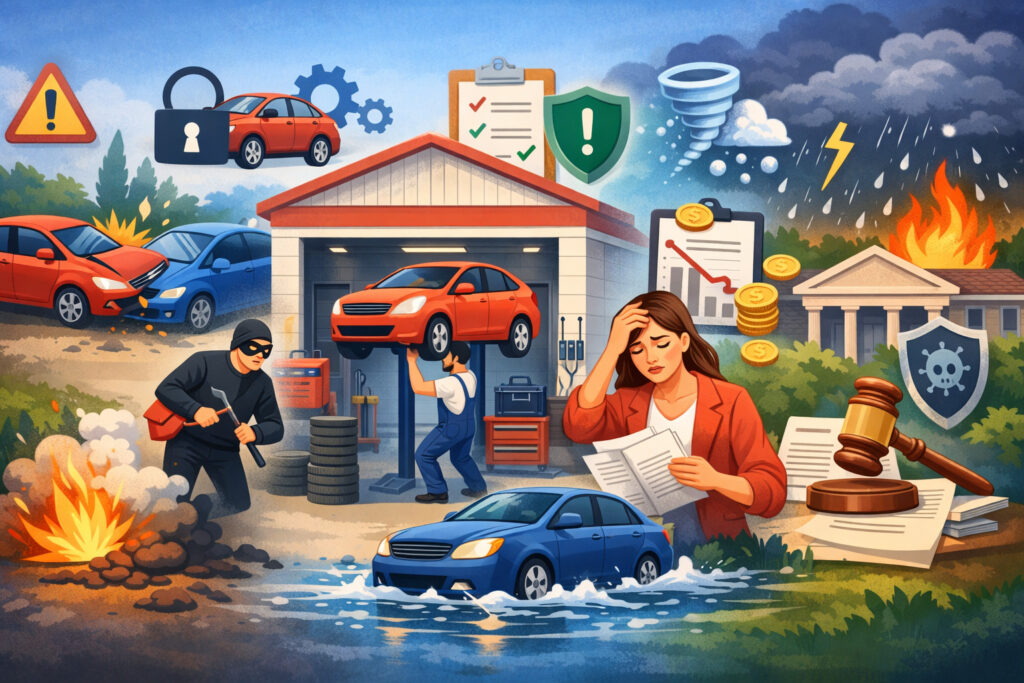
Automotive businesses live at the intersection of property risk, liability risk, and operational risk. Some threats are dramatic, like a fire or windstorm. Others are more ordinary but still costly, such as backing damage, dropped parts, a customer fall, a stolen key, or a payroll mistake that affects workers’ compensation calculations.
The goal of good insurance planning is not to assume the worst at every moment. It is to recognize where the most meaningful losses are likely to come from and build around those realities.
One of the biggest risk categories is damage involving customer vehicles. Repair shops, body shops, tire centers, and detail businesses often have customer property onsite from morning to evening and sometimes overnight.
Even careful businesses can face claims involving theft, vandalism, fire, weather damage, or employee mishandling. A simple parking-lot incident can turn into a larger dispute if the customer alleges diminished value, missed work, towing expense, or rental costs.
Another major category is premises and operations liability. Customers, vendors, and delivery drivers visit showrooms, service lanes, waiting rooms, and parts counters every day. Wet floors, uneven pavement, poor lighting, and cluttered workspaces can create injury claims.
Property damage claims can also arise if business operations affect someone else’s vehicle or property. For dealerships and repair facilities, this exposure often overlaps with specialized garage-related coverage considerations.
Then there is property risk to the business itself. Buildings, tools, scanners, lifts, air compressors, alignment systems, tire machines, paint booths, parts stock, computers, and furniture all represent real capital.
A fire, electrical issue, water loss, theft, or storm event can damage both fixed assets and the materials needed to keep the business running. If the business shuts down, lost income can become as painful as the physical damage.
Vehicle-related liability adds another layer. Dealerships may face test-drive exposure, lot movement exposure, and employee use of dealer vehicles. Repair facilities may have pickup and delivery, road testing, or parts runs. Mobile service businesses operate company vehicles as the core of their service model.
The more employees drive, and the more frequently vehicles are moved, the more important commercial auto planning becomes.
Physical Risks: Fire, Theft, Severe Weather, and Equipment Failure
Physical loss is one of the most obvious threats to an automotive operation because it can stop revenue quickly. Shops and dealerships commonly have large buildings, valuable contents, and concentrated vehicle exposure.
A single weather event can affect dozens or even hundreds of units at once. A localized fire can destroy not only the structure but also parts inventory, records, customer vehicles, and diagnostic tools that are hard to replace quickly.
Theft is another persistent concern. Dealers may face theft of vehicles, keys, catalytic converters, wheels, batteries, or electronics. Repair facilities may experience tool theft, parts theft, or break-ins that lead to secondary damage. Even a smaller loss can create a larger business interruption if critical equipment is stolen and replacements are delayed.
Severe weather deserves special attention because exposure differs by region, lot design, and storage practices. Hail, wind, flood, and falling objects can create broad losses. Outdoor inventory is especially vulnerable.
Indoor businesses are not immune either; roof leaks, water intrusion, and power failure can damage equipment and shut down service bays.
Equipment breakdown is often overlooked because owners assume property insurance automatically handles it. In reality, mechanical or electrical breakdown of essential systems may need separate treatment depending on the policy.
That matters for businesses that rely on compressors, lifts, paint equipment, HVAC systems, IT servers, or specialized machinery to function normally. When one critical machine fails, the income effect may be much larger than the repair bill itself.
Liability, Injury, and Cyber Risk in Automotive Operations
Liability claims can come from more than one direction. A customer injury on the premises may seem straightforward, but disputes can become more complicated when medical bills, lost wages, and attorney involvement enter the picture.
Repair-related allegations can also escalate if a customer claims faulty work contributed to additional damage or an accident. Even if the business believes it did nothing wrong, defense costs can matter.
Employee injuries are a separate but equally important category. Automotive work involves lifting, repetitive motion, exposure to chemicals, slip hazards, welding, cutting, and moving vehicles.
Technicians, porters, lot staff, parts workers, and drivers all face different injury patterns. Workers’ compensation helps address this risk, but prevention remains critical because claims can affect staffing, productivity, and future premiums.
Cyber risk now matters to many automotive businesses, including those that do not think of themselves as digital operations. Dealerships and repair facilities may store customer names, contact information, driver’s license details, financing documents, invoices, and card-related data.
Ransomware, phishing, account compromise, or payment fraud can disrupt scheduling, accounting, and customer service. The risk grows as businesses rely more on remote approvals, digital invoicing, cloud systems, and email-based communication.
Crime-related losses also deserve attention. Employee theft, forged checks, fraudulent refunds, social engineering, and stolen payment credentials can affect both dealerships and service businesses. Shops that process deposits, parts orders, and split payments need internal controls as much as insurance.
Businesses reviewing these exposures may benefit from related educational material on how to detect and prevent payment fraud in auto dealerships and automotive merchant account fees, since payment workflows and fraud controls often influence both operational risk and insurance conversations.
Core Coverage Types in Automotive Business Insurance Essentials
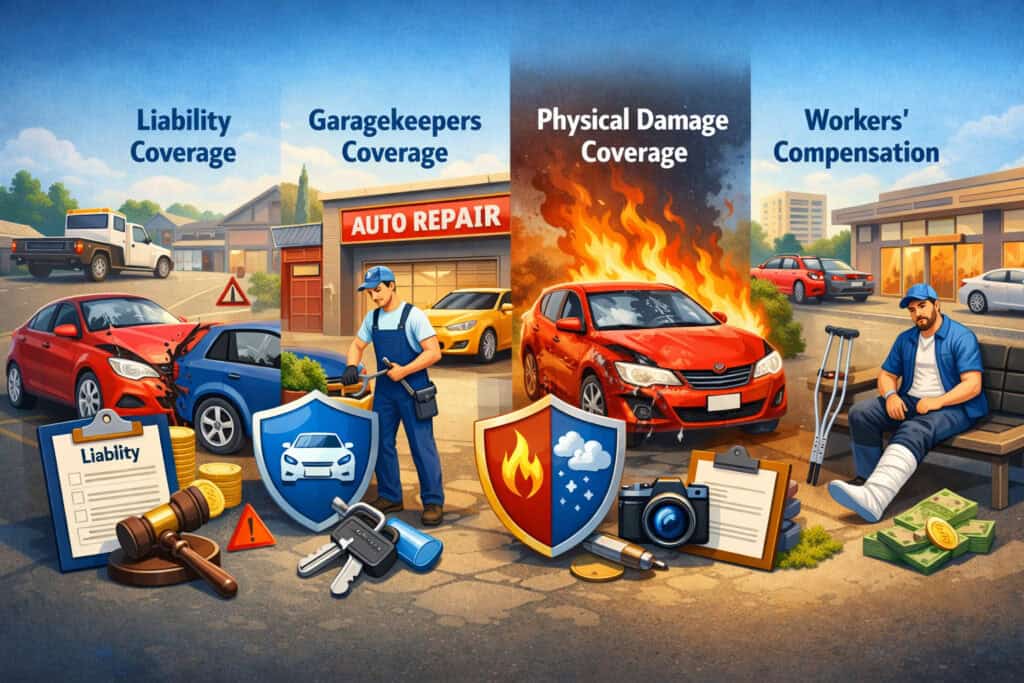
When people talk about automotive business insurance, they are often referring to a bundle of policies rather than one contract. The exact mix depends on the business model, but several coverage types show up again and again because they address the most common and most expensive loss categories.
Understanding what each one generally does can help owners ask better questions and avoid assumptions that create coverage gaps.
General liability insurance is often the starting point. It is designed to address certain third-party bodily injury and property damage claims arising from business operations.
If a customer slips in the lobby or the business is accused of damaging someone else’s property in a covered way, general liability may be relevant. But automotive operations frequently need more than this baseline because their risks involve vehicles, repair activity, and property in their care.
Garage liability insurance is a key concept for many automotive businesses. In broad terms, it addresses liability arising from garage operations, which may include premises and certain auto-related liability exposures tied to the business.
It is often central to garage liability insurance planning for dealerships, service shops, and related operations. However, it is not the same thing as garagekeepers’ coverage, which is a common source of confusion.
Garagekeepers coverage is designed to address damage to customer vehicles left in the business’s care, custody, or control, subject to policy terms and causes of loss. That distinction matters.
A shop may have garage liability insurance and still not have the protection it expects for customer cars parked onsite. This is one of the most important ideas in Automotive Business Insurance Essentials because misunderstanding it can leave a business exposed during a very common type of claim.
Commercial property insurance is also essential for many operators. It can help cover buildings, business personal property, tools, furniture, inventory, and other physical assets, depending on the policy structure. Workers’ compensation is equally important where employees are involved, helping address job-related injuries.
Commercial auto insurance may cover owned business vehicles used for service calls, transport, parts delivery, or operations. Dealer open lot coverage may be critical for businesses that hold vehicle inventory outdoors.
Below is a practical comparison of common coverage types and the role they often play.
| Coverage Type | What It Commonly Helps Address | Businesses That Often Need It | Common Misunderstanding |
| General liability | Certain third-party bodily injury and property damage claims | Most automotive businesses | It does not solve every vehicle-related exposure |
| Garage liability insurance | Liability arising from garage operations, including certain auto-related exposures | Dealers, repair shops, service centers | It is not the same as garagekeepers coverage |
| Garagekeepers coverage | Damage to customer vehicles in the business’s care, custody, or control | Repair shops, body shops, tire shops, detailers | Customer vehicles are not always automatically covered elsewhere |
| Commercial property insurance | Damage to buildings, tools, parts, furniture, equipment, and sometimes business contents | Shops, dealerships, service centers | Owners often undervalue tools and equipment |
| Workers’ compensation | Job-related employee injuries and related costs | Businesses with employees | It does not replace strong safety practices |
| Commercial auto insurance | Liability and physical damage involving owned business vehicles | Mobile mechanics, dealerships, shops with service vehicles | Personal auto policies are usually not enough for business use |
| Dealer open lot coverage | Damage to dealer inventory vehicles, often on outdoor lots | New and used dealerships | Standard property coverage may not be enough for vehicle inventory |
| Business interruption coverage | Income loss and certain ongoing expenses after a covered disruption | Most location-based operators | Owners focus on property damage but forget the lost revenue |
| Cyber or crime coverage | Data breaches, fraud events, social engineering, or certain theft-related losses | Businesses using digital systems and payments | Small operators often assume they are too small to be targeted |
Coverage for Property, Vehicles, and Operations
Commercial property insurance often looks straightforward until valuation questions begin. Is the building insured at a realistic replacement figure? Are tools scheduled or blanket-covered?
Are diagnostic devices, lifts, office systems, and waiting-room contents included? Is parts inventory counted correctly? Many businesses discover too late that they have insured the obvious items but not the full set of things required to reopen and operate normally.
Commercial auto insurance becomes critical once the business owns vehicles used for work. Service vans, parts runners, tow-related units, courtesy shuttles, or pickup-and-delivery vehicles all create exposure.
Some businesses also need to think carefully about non-owned and hired auto exposure if employees use personal vehicles for errands or the company rents vehicles occasionally.
In practical terms, commercial auto insurance for automotive businesses should be reviewed alongside employee driving rules, MVR screening, and vehicle-use policies.
Dealer open lot coverage deserves special mention for dealerships. Lot inventory can represent the largest concentration of value in the business, and it sits exposed to weather, theft, vandalism, and accidental damage.
New car stores, used car lots, and BHPH operations may all need some form of dealer inventory protection, but the right structure depends on volume, financing arrangements, and how vehicles are stored.
Business interruption coverage is another major piece of the puzzle. Property insurance may pay to repair a building after a covered fire, but that does not automatically solve payroll pressure, rent obligations, lost service revenue, or delays in reopening.
For operations with tight cash flow or specialized equipment, interruption can be more damaging than the physical loss itself.
Coverage for People, Errors, and Digital Threats
Workers’ compensation is often legally required where employees are involved, but it should also be viewed as a practical operating necessity. Automotive work is physical and sometimes hazardous.
A solid program supports claims handling after an injury, but it also encourages a better conversation about training, lift use, PPE, chemical handling, and ergonomics. For shops and service centers, business insurance for mechanics often starts here because technician injury exposure is part of normal operations.
Professional liability or errors-related coverage may matter in certain situations, especially where diagnosis, recommendations, or specialized service errors could create financial harm beyond ordinary premises liability.
Not every automotive business needs the same form of this protection, but it is worth discussing when the operation involves high-complexity repairs, reprogramming, calibration, specialized consulting, or documentation-heavy customer disputes.
Cyber insurance and crime coverage are increasingly relevant. Dealerships often hold financing and identity-related information. Repair facilities may store customer records and process card-not-present transactions for deposits or phone approvals.
A phishing attack, ransomware event, or fraudulent wire request can create legal, technical, and cash-flow consequences all at once. Cyber coverage does not replace strong security practices, but it can be an important part of the overall strategy.
Crime coverage may help address employee theft, forgery, cash theft, counterfeit payments, or social engineering losses depending on policy language and endorsements. Businesses that manage refunds, card disputes, deposits, ACH activity, or split-pay transactions should evaluate these risks carefully rather than assuming cyber coverage solves all fraud problems.
Car Dealership Insurance vs. Auto Repair Shop Insurance
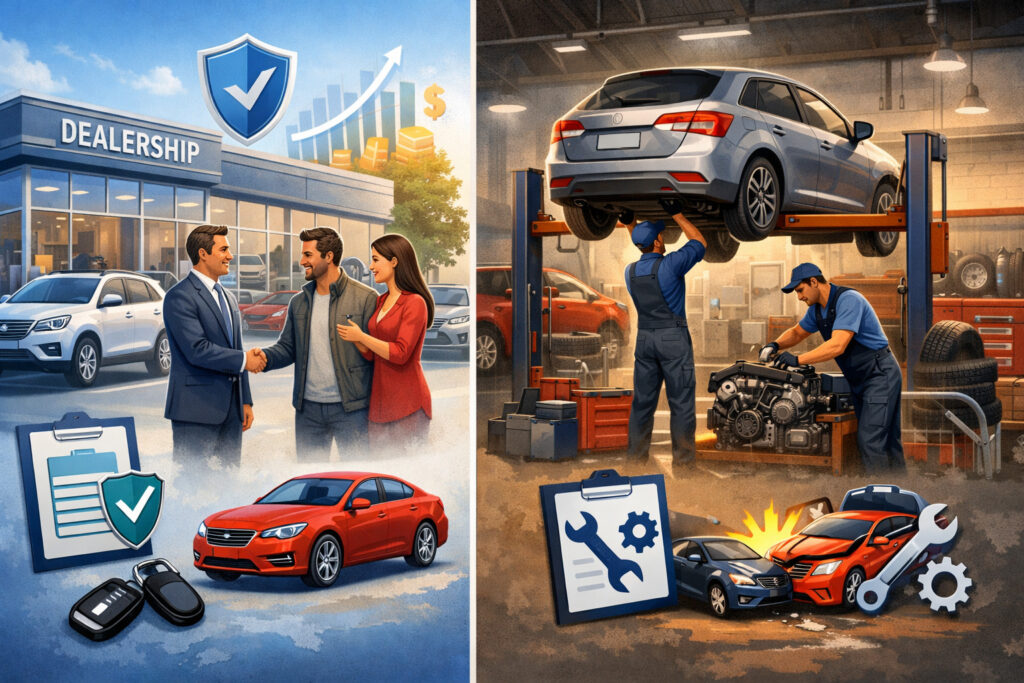
A dealership and a repair shop may both fall under the broad umbrella of automotive business insurance, but their risk profiles are not the same. That difference matters because buying a generic policy package without tailoring it to the actual operation is one of the fastest ways to create either wasted premium or dangerous gaps.
Car dealership insurance often centers on inventory exposure, lot operations, test drives, employee driving, customer foot traffic, financing-related documentation, and multi-department activity. A dealership may have sales, service, parts, detailing, and finance functions under one roof or across multiple buildings.
That creates a layered mix of property risk, garage-related liability, employee injury exposure, and cyber or crime concerns. Dealer open lot coverage is commonly important because inventory value can be substantial and exposed to outdoor hazards.
By contrast, auto repair shop insurance often places greater emphasis on customer vehicles in care, custody, or control, technician injury exposure, tool and equipment values, and repair-related liability.
The vehicle inventory may not belong to the shop, but the responsibility is still significant. Shops also tend to depend heavily on equipment and labor productivity. If a fire, compressor failure, or lift issue shuts down operations, the income effect can be immediate.
Both businesses need to think about customer injury claims, property damage, and employee safety. But the shape of the loss can be very different. A hail event might devastate a dealership’s lot inventory.
A shop fire might affect fewer vehicles but cause a deeper interruption to labor revenue and customer relationships. A dealership may worry more about lot theft or key control across many vehicles. A repair shop may worry more about garagekeepers exposure and the cost of resolving disputes tied to service work.
Why Dealerships Need a Different Insurance Conversation
Dealerships operate in a more public, inventory-heavy environment than many service-only businesses. There is often a steady stream of test drives, lot movement, trade-in evaluation, paperwork, and customer interaction.
Employees may regularly move vehicles across the property, between locations, or on roads. Some stores also provide loaners, pickups, or shuttle service. Each moving part changes the insurance conversation.
Inventory concentration is a major issue. New and used vehicles may be parked closely together, exposed to weather, theft, vandalism, and accidental damage.
If the store relies on floor plan financing, the business may face lender requirements that shape deductible choices, proof-of-insurance standards, and reporting expectations. A dealer with multiple rooftops may also need careful scheduling of locations, limits, and named insureds.
The sales process creates documentation and payment exposures as well. Identity theft, payment fraud, forged documents, and disputes over deposits or chargebacks can sit alongside the more obvious vehicle and premises risks.
While those concerns do not replace traditional insurance needs, they affect the broader risk picture. Businesses that handle larger card volumes or remote deposits may benefit from reviewing high-risk automotive merchant accounts or similar educational resources as part of a wider control strategy.
Why Repair Shops Need a More Care-Custody-Control Focus
Repair shops live inside a different operating rhythm. Vehicles come in for diagnosis, service, storage, and testing. Employees lift them, road test them, move them around the lot, and sometimes keep them overnight.
That means the business must think carefully about what happens if a customer vehicle is damaged before, during, or after work is performed.
Garagekeepers coverage becomes especially important in this context because the shop often controls the vehicle, even when it does not own it.
Shops also need to think about key management, after-hours drop-offs, lot security, storage practices, and whether road testing is routine. A basic assumption that “our regular liability policy covers it” can create expensive surprises.
Repair facilities also depend heavily on technicians and equipment. Revenue often stops when labor stops. That makes workers’ compensation, business interruption planning, and equipment-related valuation especially important.
Collision centers and body shops may also have paint booth hazards, environmental considerations, and more complex customer disputes over repair quality or completion timing.
Service centers that calibrate advanced systems, work on EV components, or handle sophisticated diagnostics should discuss whether their policy structure reflects those specialized activities.
How Business Model Changes Insurance Planning
One of the most practical ideas in Automotive Business Insurance Essentials is that coverage planning should follow the business model, not just the industry label.
“Automotive business insurance” is too broad to be useful unless it is connected to how the company actually makes money, where vehicles are stored, how employees work, and what customers expect.
A new car dealership may need stronger inventory, test-drive, cyber, and departmental coordination planning. A used car lot may focus more heavily on dealer insurance coverage for outdoor inventory, employee driving, and financing-related paperwork controls.
A buy-here-pay-here operation may have added concerns around collections, repossession interactions, and internal financial controls.
A general repair shop often prioritizes garagekeepers, garage liability, workers’ compensation, tool values, and business interruption. A tire shop may have lower repair complexity than a transmission or engine shop, but it still faces customer vehicle exposure, employee injury risk, and operational liability.
A body shop may need more attention on paint equipment, fire controls, parts storage, and work quality disputes. A detail shop may handle many customer vehicles and keys in a smaller footprint, making care-custody-control and theft-related issues particularly important.
Towing-related or roadside operations introduce another layer because vehicles are actively transported, recovered, or handled away from the main premises.
Mobile mechanics rely on service vehicles, portable tools, and customer-site work, which can change both property and liability considerations. A business that adds mobile service after starting as a fixed-location shop should not assume the old policy automatically adapts to the new exposure.
Common Insurance Priorities by Automotive Business Type
Below are broad examples of how business models can influence priorities:
- New car dealerships: Dealer open lot coverage, garage liability, employee driving controls, cyber insurance, crime coverage, property limits, and multi-department coordination.
- Used car lots: Inventory valuation, dealer insurance coverage, lot theft exposure, test-drive rules, commercial auto, and documentation controls.
- BHPH operations: Inventory protection, collections-related procedures, payment fraud controls, employee driving exposure, and strong documentation.
- General repair shops: Garagekeepers, garage liability insurance, workers’ compensation, tool and equipment values, road-test procedures, and interruption planning.
- Body shops and collision centers: Fire and paint-related controls, customer vehicle storage, parts inventory, professional or errors-related discussion, and longer interruption planning.
- Detail shops and car wash-adjacent service providers: Customer vehicle handling, key management, water-related property concerns, employee supervision, and lot security.
- Mobile mechanics: Commercial auto, inland or mobile equipment considerations, customer-site liability, employee driving screening, and theft prevention for tools.
- Towing-related operations: Commercial auto, on-hook or transported vehicle considerations where relevant, driver records, dispatch controls, and after-hours loss procedures.
The lesson is not that every business in each category needs the exact same package. It is that the business model should guide the questions. That is how owners move from buying generic coverage to building a risk-aware insurance plan.
When a Business Has More Than One Model Under One Roof
Many automotive businesses are hybrids. A dealership may also run a service department, detail operation, body shop, and parts counter. An independent shop may sell a few vehicles, offer towing, or provide fleet service contracts.
A mobile operator may keep customer vehicles overnight occasionally. These mixed models create insurance challenges because each added service can introduce a new exposure that the base policy was not designed to address fully.
This is where an annual renewal application is not enough by itself. Owners should map every revenue stream and every vehicle-handling scenario.
Who owns the vehicles? Who drives them? Where are they stored? What tools are required? Are keys retained overnight? Is subcontract work used? Are there contracts with fleets or lenders that impose insurance requirements? Those answers help a knowledgeable broker or underwriter shape the policy structure and endorsements more accurately.
Common Coverage Gaps and Misunderstandings
Insurance misunderstandings are common in every industry, but they are especially risky in automotive because the operation often involves expensive property, customer vehicles, and employees moving cars in ways that feel routine. What feels routine to the business may be exactly where the policy line gets tested.
One of the most frequent mistakes is assuming customer vehicles are automatically covered by whatever liability policy the business already has. In reality, damage to vehicles in the business’s care, custody, or control often raises a specialized coverage question.
That is why the distinction between garage liability and garagekeepers matters so much. The names sound similar, but they do different jobs.
Another common misunderstanding involves inventory. Dealers may insure buildings and business contents but fail to appreciate how separate or specialized inventory coverage works.
Repair shops may undervalue tools and equipment because the items were purchased over time rather than all at once. In a claim, replacement cost and downtime matter more than memory-based estimates from years ago.
Employee driving exposure is also easy to miss. Some owners focus on owned vehicles but overlook non-owned auto exposure when employees use personal vehicles for deposits, parts runs, or customer pickups.
Others assume that because a driver has personal insurance, the business has no exposure. That can be a costly assumption after an accident involving business errands.
Garage Liability vs. Garagekeepers: The Confusion That Causes Trouble
This is one of the biggest teaching points in Automotive Business Insurance Essentials. Garage liability insurance generally addresses liability arising from garage operations, including certain premises and auto-related liability exposures tied to the business.
Garagekeepers coverage, on the other hand, is generally aimed at damage to customer vehicles left in the business’s care, custody, or control.
Why does that matter? Imagine a repair shop has ten customer vehicles parked overnight behind the building. A fire spreads from an electrical issue in the shop and damages several of those vehicles.
The owner may think, “We have garage liability, so we’re covered.” But whether damage to those customer vehicles is covered may depend on garagekeepers or related policy terms, not general assumptions about the liability policy.
Or imagine a detail shop employee accidentally scratches a luxury SUV while moving it inside. Again, the coverage question may turn on whether the policy structure properly addresses customer vehicles in care, custody, or control. Businesses that do not understand this distinction are often underestimating their exposure.
Other Gaps That Quietly Develop Over Time
Some gaps appear not because the business bought the wrong policy on day one, but because the operation changed and the coverage never caught up. Examples include:
- Adding mobile service without revisiting commercial auto and equipment coverage
- Expanding lot inventory without updating limits
- Hiring more drivers without stronger screening and MVR review
- Beginning pickup-and-delivery service without addressing additional auto exposure
- Taking more digital payments without reviewing cyber and crime concerns
- Using subcontractors without tightening contracts and certificate tracking
- Storing more customer vehicles overnight than originally disclosed
- Remodeling the building without adjusting property values
These are practical business changes, not rare exceptions. That is why periodic review matters. Insurance should evolve with the operation, not lag behind it.
Policy Limits, Deductibles, Endorsements, and Exclusions
Buying insurance is not only about choosing coverage types. It is also about deciding how much protection is enough, what losses the business can absorb, and which policy details may narrow or expand real-world protection. Limits, deductibles, endorsements, and exclusions are where many “good enough” policies become either useful or disappointing.
Policy limits determine the maximum amount the insurer may pay under covered circumstances, subject to the policy. Low limits can reduce premiums, but they can also leave the business exposed during larger claims.
That is especially important for operations with concentrated inventory, high-value customer vehicles, busy public areas, or substantial payroll and revenue. A low premium may look attractive until a serious loss tests the plan.
Deductibles are another balancing tool. A higher deductible can lower premium, but only if the business can realistically absorb that out-of-pocket cost when a claim occurs.
For automotive operators, this should be discussed in cash-flow terms, not just insurance terms. If a shop cannot comfortably handle a large deductible during a slow month, the “savings” may not be worth the strain.
Endorsements matter because they adapt policies to the realities of the operation. An endorsement may add, limit, clarify, or exclude a certain type of exposure.
In automotive insurance, endorsements can be especially important when the business model includes mobile work, employee driving, lot inventory, customer transportation, hired or non-owned auto exposure, or specific property valuations.
Exclusions deserve careful review because they are often where expectations and policy language diverge. Flood, mechanical breakdown, wear and tear, employee dishonesty, pollution-related issues, or certain cyber losses may not be handled the way an owner assumes. That does not mean the policy is bad.
It means the owner should know where separate planning, endorsements, or specialized coverage may be needed.
Why the Cheapest Premium Is Not Always the Best Fit
Price matters. Automotive businesses have real cost pressure, and insurance is one line item among many. But the cheapest policy can become the most expensive option if it leaves the business short on limits, packed with exclusions, or missing the very coverage most likely to be needed.
A lower premium may reflect narrower definitions, higher deductibles, lower limits, or missing endorsements. It may also reflect underreported payroll, understated inventory values, or an incomplete picture of operations. That can create friction not only at claim time but also during audits, renewals, or lender reviews.
A better question is not “What is the lowest premium?” but “What is the best fit for the risk we actually carry?” That approach helps owners compare meaningful differences between quotes instead of treating all proposals as interchangeable.
How to Evaluate a Policy Beyond the Declarations Page
A declarations page is useful, but it is not the whole story. Owners should understand:
- Which locations are scheduled
- Which vehicles are included
- Whether customer vehicles are addressed appropriately
- How inventory is valued
- Which employees drive and under what conditions
- Whether interruption coverage reflects actual income needs
- What major exclusions apply
- Which endorsements materially change coverage
- Whether contracts, lenders, or landlords require specific wording or limits
The goal is not to become an insurance lawyer. It is to understand the major moving parts well enough to ask good questions and catch obvious mismatches before a loss occurs.
What Affects Premiums for Automotive Businesses
Insurance premiums are shaped by many factors, and automotive businesses often feel the effect of several at once. Carriers and underwriters want to understand not only the size of the operation but also how it is run. That means premium is influenced by exposure quality as much as exposure quantity.
Location matters because weather, crime, traffic patterns, litigation environment, and construction costs vary widely. A coastal or hail-prone area may increase property-related concerns.
A dense urban setting may raise theft, vandalism, or auto liability considerations. Even the immediate surroundings of the building can matter if the property has poor drainage, limited lighting, or heavy nearby traffic.
Claim history is another major factor. Prior losses do not always mean a business is careless, but they do shape underwriting. A pattern of backing claims, water losses, employee injuries, or theft incidents may signal the need for stronger controls. Businesses with clean records, good documentation, and visible safety practices may present better.
Payroll and employee count influence workers’ compensation and sometimes broader operational assessment. More technicians, more drivers, or more staff generally means more exposure. Driver records also matter. Poor MVRs, frequent turnover, or casual vehicle movement procedures can increase concerns for any business with auto exposure.
Property details count too. Building age, roof condition, wiring, fire suppression, alarm systems, fencing, lighting, key control, and camera coverage all help shape the underwriting picture. So do the number of vehicles onsite, average inventory value, service types offered, and whether the business stores cars overnight.
Operational Details That Can Raise or Lower Cost
Premium is often tied to the quality of day-to-day management. For example:
- Formal driver screening and MVR review can improve the business profile
- Better lot security can help reduce theft exposure
- Strong housekeeping can lower slip-and-fall and fire concerns
- Accurate payroll classification helps prevent workers’ compensation surprises
- Documented repair procedures and training may support better risk presentation
- Regular valuation updates can prevent underinsurance problems
Businesses that want to manage insurance costs over time should think beyond shopping quotes. Loss control, documentation, maintenance, and security are all part of long-term premium strategy.
Why Better Risk Management Can Influence Insurance Outcomes
Insurance is not just bought. It is also earned through how the operation presents itself. Carriers often look more favorably on businesses that can show they take risk seriously. That might include driver handbooks, key logs, incident reporting procedures, building maintenance records, camera systems, access controls, employee onboarding, and written safety practices.
This is where repair shop risk management and broader dealership controls connect directly to insurance outcomes. The same practices that reduce disputes, theft, and injury can also make the business easier to insure and easier to renew on favorable terms.
Businesses that want to tighten their back-office processes may also find value in operational resources like an automotive merchant services setup checklist, since better process control often supports both payment integrity and overall business discipline.
Real-World Scenarios That Show Why Coverage Structure Matters
Insurance conversations become much easier when they are tied to realistic scenarios. Owners and managers already think in terms of “what if this happens?” The key is to connect those events to the right coverage questions before the claim occurs.
- Scenario one: customer vehicle damage: A technician takes a repaired vehicle for a road test and is involved in an accident. The business now faces questions about liability, vehicle damage, documentation, and whether any employee conduct issues are involved. The right response depends on policy structure, driver authorization rules, and how the business handles road testing.
- Scenario two: overnight lot theft: Several vehicles are stolen from a dealer lot after keys are accessed during a break-in. This raises issues around dealer insurance coverage, key security, alarm systems, and perhaps crime or property-related concerns depending on the facts. A dealership that never examined its inventory exposure closely may discover that the policy arrangement was thinner than expected.
- Scenario three: employee injury: A technician suffers a back injury while moving heavy components. Workers’ compensation becomes central, but so do training, lift aids, staffing practices, and return-to-work planning. The insurance claim is only one part of the business impact.
- Scenario four: storm damage: Hail damages a large number of inventory vehicles on an outdoor lot. The loss may involve deductibles, valuation, and significant revenue disruption while the business sorts repairs, sales impact, and lender pressures. For a small dealer, that event can define the year.
- Scenario five: shop fire and interruption: A fire damages several bays, tools, customer vehicles, and parts inventory. The property claim matters, but so does the interruption to labor revenue, payroll obligations, and customer scheduling. If the shop relies on specialized equipment with long replacement lead times, the interruption can outlast the physical cleanup.
What These Scenarios Teach Business Owners
Each scenario reinforces a core lesson: no single policy answers every question. The way a business stores vehicles, documents activity, trains employees, and values property all affects claim outcomes. The insurance program needs to align with the operation, and the operation needs to support the insurance program.
This is why automotive business liability coverage should be viewed as one piece of a larger framework. Liability, property, auto, workers’ compensation, cyber, and interruption planning often intersect during real claims.
The Role of Documentation When Something Goes Wrong
Strong documentation helps before, during, and after a loss. Photos at intake, signed work authorizations, key logs, maintenance records, vehicle movement procedures, incident reports, surveillance footage retention, and repair notes can all make a difference.
Documentation does not guarantee coverage, but it can help establish facts, reduce disputes, and support the business’s position.
The same idea applies to employee policies. Written driving rules, road-test procedures, post-accident steps, security expectations, and claim reporting timelines make the operation more resilient. When a loss occurs, confusion creates cost. Procedures reduce confusion.
Insurance Should Work With Risk Management, Not Replace It
Insurance is essential, but it is not a substitute for running a disciplined business. The healthiest approach is to combine insurance with operational controls that reduce the frequency and severity of losses.
This is especially true in automotive operations, where many claims begin with small procedural failures rather than major reckless acts.
Contracts matter. Repair authorizations, storage disclosures, subcontractor agreements, vendor contracts, and customer communication policies all help set expectations.
They do not eliminate liability, but they can reduce misunderstandings and support better claim handling. Businesses using third-party drivers, detailers, tow vendors, or mobile technicians should review contracts and certificates regularly.
Staff training is equally important. Vehicle movement, lift use, chemical handling, key control, after-hours procedures, and incident reporting should not live only in a manager’s head. When employees know the standard, losses are easier to prevent and easier to investigate if they occur.
Payment controls also belong in the conversation. Fraud, chargebacks, fake refunds, account takeovers, and social engineering can cause real losses that traditional liability policies may not address well.
Insurance may help in some circumstances, but internal controls remain the front line. Segregation of duties, refund approval rules, bank verification, and secure handling of customer payment data all support a stronger business.
Practical Controls That Support Insurance Strategy
Useful operational controls often include:
- Key inventory logs and restricted key access
- Driver authorization lists and regular MVR review
- Intake photos for customer vehicles
- Signed estimates and change-order approvals
- Clear road-test and pickup-and-delivery procedures
- Building maintenance and fire-prevention routines
- Camera coverage for lots, service lanes, and key areas
- Employee safety training with refreshers
- Incident reporting forms completed immediately
- Strong password, MFA, and payment verification practices
These steps improve more than safety. They also support claims handling, underwriter confidence, and renewal discussions.
Why Business Owners Should Revisit Contracts and Procedures Regularly
Operational drift is real. Policies that worked when the business had eight employees may not fit when it has twenty-five. Informal habits that were manageable in one building may break down across multiple lots or mobile units.
Insurance review should therefore happen alongside contract and procedure review, especially after growth, staffing changes, or added service lines.
Common Mistakes Business Owners Make With Automotive Insurance
Many insurance mistakes are understandable. Owners are busy, policy language is dense, and renewal season often arrives during an already packed schedule. Still, certain errors show up repeatedly, and they can create serious financial exposure.
The first mistake is buying a generic policy not built for automotive operations. Automotive businesses often need specialized treatment for garage liability, garagekeepers, dealer inventory, or business vehicle use. A basic business package may be a starting point, but it is rarely the full answer.
The second mistake is failing to update coverage after growth. New service vans, more inventory, higher payroll, another location, after-hours drop-off, pickup-and-delivery, mobile service, ADAS work, or fleet contracts can all change risk materially. Yet many businesses wait until the next renewal to mention them, or forget entirely.
A third mistake is not reviewing exclusions and endorsements. Owners may look only at premium and high-level limits, assuming the rest is standard. But endorsements can expand or narrow important coverage, and exclusions can remove protection for risks the owner thought were included.
Another common mistake is treating insurance as separate from operations. Claims often begin with weak procedures: poor key control, incomplete intake notes, informal road-test practices, unvetted drivers, or missing incident documentation. Insurance works best when it is backed by process.
The Hidden Cost of Underreporting or Guessing
Some businesses unintentionally underreport payroll, values, vehicle counts, or operational details because they are moving fast or working from estimates. Others are tempted to keep numbers low to reduce premium. That approach can create long-term trouble, especially during audits, claim valuation, or renewal review.
Accurate reporting helps prevent coverage disputes and pricing surprises. It also allows the business to compare quotes more meaningfully, since underreported exposure can make one proposal look cheaper without truly being better.
Why Annual Review Is the Minimum, Not the Ideal
At a minimum, businesses should review insurance annually. In practice, they should also review after major operational changes. Adding a new location, launching mobile service, buying expensive equipment, changing building layout, increasing lot inventory, or hiring multiple drivers are all events worth discussing with an advisor promptly.
That is especially true for businesses trying to stay aligned with automotive insurance requirements business obligations tied to landlords, lenders, state rules, or customer contracts. Waiting too long can leave the business out of compliance as well as underinsured.
A Practical Checklist for Building or Reviewing an Automotive Business Insurance Plan
A strong insurance plan starts with clear information. Owners do not need to become insurance experts, but they do need to know what they own, what they do, what can go wrong, and what they could afford to absorb themselves. This checklist can help structure that review.
Insurance Review Checklist for Automotive Businesses
- List every business activity, not just the main one
- Identify all locations, owned and leased
- Count all owned business vehicles and all employees who drive
- Estimate the maximum number and value of customer vehicles onsite
- Estimate the maximum number and value of inventory vehicles onsite
- Update building, tool, equipment, and parts values realistically
- Review whether garage liability and garagekeepers are both needed
- Review commercial auto, including hired and non-owned exposure where relevant
- Confirm workers’ compensation classifications and payroll accuracy
- Review interruption exposure based on realistic downtime scenarios
- Ask whether cyber and crime coverage fit current payment and data practices
- Review key exclusions, deductibles, and endorsements
- Compare policy limits to current operations, not past operations
- Check landlord, lender, and contract insurance requirements
- Review security practices, driver screening, and incident documentation procedures
- Revisit the plan after expansion, new services, or major staffing changes
Questions to Ask an Insurance Advisor Before Renewal
Business owners can improve renewal conversations by asking focused questions:
- What are the three biggest uninsured or underinsured risks in our operation?
- Do our current policies address customer vehicles clearly enough?
- Are our inventory and property values realistic today?
- What loss scenarios would create the most out-of-pocket cost for us?
- Which exclusions should we pay the most attention to?
- Are our deductibles practical given our cash flow?
- Have our new services changed our risk profile?
- Are there endorsements we should consider based on how we operate now?
- Are we relying too much on assumptions about employee driving or subcontractors?
- What steps could improve both safety and insurability before next renewal?
These questions turn renewal from a price exercise into a risk exercise, which is where the real value lies.
FAQs
What is automotive business insurance?
Automotive business insurance is a combination of policies designed to protect businesses that sell, repair, store, transport, or work on vehicles. Depending on the operation, it may include general liability, garage liability, garagekeepers coverage, commercial property insurance, workers’ compensation, commercial auto insurance, business interruption coverage, and other protections tied to business-specific risks.
Is garage liability the same as garagekeepers coverage?
No. Garage liability and garagekeepers coverage are different. Garage liability generally addresses liability arising from garage operations, while garagekeepers coverage is usually designed for damage to customer vehicles that are in the business’s care, custody, or control. Many automotive businesses need to understand both because one does not automatically replace the other.
Do auto repair shops need commercial auto insurance?
Many do. If a repair shop owns service vehicles, parts delivery vehicles, shuttle vehicles, or uses vehicles as part of daily operations, commercial auto insurance may be important. Shops should also review whether hired and non-owned auto exposure applies when employees use personal vehicles for business errands or the business rents vehicles occasionally.
What risks does car dealership insurance usually address?
Car dealership insurance often focuses on risks such as lot inventory damage, theft, vandalism, severe weather, employee driving, test-drive incidents, customer injuries on the premises, cyber exposure, property damage, and business interruption. The exact mix depends on the dealership’s size, location, services offered, and how vehicles are stored or moved.
What risks does auto repair shop insurance usually address?
Auto repair shop insurance often addresses risks such as damage to customer vehicles, employee injuries, fire, theft, equipment damage, premises liability, road-test accidents, and interruption to normal business operations. Repair shops usually need coverage that reflects both customer vehicle exposure and the physical risks tied to tools, equipment, and day-to-day shop activity.
Why does business model matter when choosing automotive business insurance?
Business model matters because insurance needs are different for dealerships, repair shops, body shops, tire shops, detailers, mobile mechanics, and buy-here-pay-here operations. The right coverage depends on factors such as inventory value, number of employees, customer vehicle exposure, building size, services offered, employee driving, and whether the business stores vehicles onsite or operates in the field.
What are common insurance mistakes automotive business owners make?
Common mistakes include buying a generic policy that does not reflect actual operations, assuming customer vehicles are automatically covered, underinsuring inventory or equipment, overlooking employee-driving exposure, failing to update coverage after growth, and reviewing price without carefully checking exclusions, deductibles, endorsements, and policy limits.
What factors affect automotive business insurance premiums?
Premiums can be affected by location, claim history, payroll, driver records, number of vehicles, inventory value, building condition, security practices, service type, equipment exposure, and how the business handles risk management. A business with stronger safety controls, accurate reporting, and better documentation may present a more favorable risk profile than one with similar size but weaker procedures.
Is the cheapest automotive insurance policy always the best option?
Not necessarily. A lower premium may come with lower limits, higher deductibles, missing endorsements, or exclusions that create serious gaps. The better choice is usually the policy that fits the business’s actual risks, operations, property values, and vehicle exposure rather than the one with the lowest upfront cost.
How often should an automotive business review its insurance plan?
An automotive business should review its insurance plan at least once a year and also after major changes such as expanding locations, adding service vehicles, hiring more employees, increasing inventory, launching mobile services, or changing the type of work performed. Coverage should keep pace with how the operation actually works.
Conclusion
Understanding Automotive Business Insurance Essentials is about more than checking a box. It is about protecting the business from the kinds of losses that can interrupt operations, strain cash flow, damage customer trust, and slow long-term growth.
Whether the operation is a dealership, repair shop, body shop, tire center, detail business, mobile mechanic service, or a hybrid of several models, insurance works best when it reflects how the business actually runs.
That means looking closely at the big exposures: customer vehicle damage, employee injuries, lot and property losses, severe weather, theft, test-drive incidents, equipment breakdown, cyber events, customer injury claims, and business interruption.
It also means understanding the core building blocks of protection, including general liability, garage liability insurance, garagekeepers, commercial property, workers’ compensation, commercial auto insurance for automotive businesses, dealer insurance coverage where relevant, and interruption planning.
The strongest insurance strategy is rarely the cheapest or the simplest. It is the one that matches the business model, values property realistically, addresses customer vehicles clearly, accounts for employee driving and payroll, and works alongside strong operational controls.
Contracts, training, documentation, payment security, and disciplined procedures all support the insurance plan and help reduce avoidable losses.
For owners and managers, the practical next step is straightforward: review the operation as it exists today, not as it existed when the last policy was purchased. Revisit values, workflows, service lines, drivers, inventory, and security practices.
Then discuss those realities with qualified insurance and legal professionals who can help confirm what fits the business. That is how a company turns automotive business insurance from a routine expense into a smarter protection strategy.