New vs Used Automotive Businesses: Pros and Cons
Entrepreneurs are often drawn to automotive retail because the market is large, visible, and full of different ways to make money.
A store can sell vehicles, arrange financing, earn from service work, move aftermarket products, and build long-term customer relationships that go well beyond the first sale. On the surface, that makes the industry look straightforward: find inventory, attract buyers, and close deals.
The reality is much more complex. The New vs Used Automotive Businesses decision is not just about whether the vehicles have prior owners. It affects how you source inventory, how much capital you need, what kind of license structure you may deal with, how customers judge your business, how tightly operations are controlled, and where your profit actually comes from.
In many cases, the biggest difference is not on the sales floor at all. It is in the business model behind the scenes.
That is why many operators underestimate the gap between a new vehicle franchise model and an independent used-car model. A new vs used car dealership business comparison quickly shows that these are two very different operating environments.
One often comes with manufacturer relationships, image standards, and brand-driven expectations. The other usually offers more flexibility, but also requires stronger judgment in buying, reconditioning, pricing, and risk control.
Franchise operators may benefit from established consumer trust, warranty-backed inventory, and structured support, while independent operators often gain more control over sourcing, margins, and market positioning.
For entrepreneurs deciding where to start, or existing owners deciding where to grow, the right answer depends less on what sounds bigger and more on what fits your capital, experience, appetite for structure, and operational strengths.
Some businesses thrive under a manufacturer-backed system. Others do better when they can move quickly, buy creatively, and serve a wider range of price-sensitive customers.
This guide breaks down the real pros, cons, startup realities, and dealership business model differences between new and used automotive businesses. It is designed to help readers think like operators, not just shoppers, so they can make a more informed decision before committing time, money, and energy to one path.
What a New Automotive Business and a Used Automotive Business Actually Mean
Before comparing strategy, it helps to define the two models clearly. A new automotive business typically operates as a franchise dealership authorized to sell vehicles from one or more manufacturers.
That relationship often comes with formal brand standards, facility expectations, sales process requirements, and access to new vehicle inventory from the manufacturer. The dealership may also handle warranty repairs, recall work, certified pre-owned programs, and brand-specific financing or incentive programs.
A used automotive business usually works very differently. It often operates as an independent dealership that buys pre-owned inventory from auctions, trade-ins, wholesalers, fleets, rental channels, direct consumers, or other dealers.
Rather than following one brand’s standards, the operator decides what segments to stock, how to price vehicles, what reconditioning level to apply, and how to position the store in the market. This makes the used car business vs new car business decision less about vehicle age and more about control, structure, and operating style.
What defines a new vehicle dealership
A new vehicle dealership is usually built around a franchise agreement rather than pure retail freedom. That agreement can shape nearly every part of the business, including branding, signage, facility layout, inventory allocation, approved marketing standards, training, reporting, and service capabilities.
The operator may have access to new-unit supply, manufacturer-backed warranty programs, incentives, co-op advertising support, and branded consumer financing channels.
That support can be valuable, but it comes with tradeoffs. The dealership is not free to make every pricing, inventory, or presentation decision on its own. In many cases, it must meet strict expectations to maintain the franchise relationship.
That includes facility upgrades, customer satisfaction requirements, staffing standards, and compliance with brand programs. In a new car dealership vs used car dealership comparison, this is one of the clearest distinctions: a new dealership may look more established from the outside, but it often has less day-to-day freedom than people expect.
Manufacturer oversight, underwriting expectations, and dealership-specific payment workflows can also make the operating structure more formal and less flexible.
What defines a used automotive business
A used automotive business is usually defined by independence and flexibility. The owner chooses what to buy, where to buy it, how deeply to recondition it, how to price it, and what type of buyer to target. One store may focus on affordable commuter vehicles.
Another may specialize in trucks, luxury units, performance vehicles, older cash cars, subprime financing customers, or buy-here-pay-here contracts. That range is one reason starting a used car dealership appeals to many first-time operators.
But independence cuts both ways. Since there is no manufacturer standing behind the inventory, the store itself must create customer confidence. That means stronger attention to vehicle history, inspection quality, disclosures, title handling, pricing discipline, collections policies where relevant, and reputation management.
A used operation can often enter the market with lower capital and fewer facility burdens than a franchise store, but it must be more skilled at sourcing, merchandising, and risk control. A single poor buy or unresolved title problem can do real damage. Freedom is real, but so is the responsibility.
New vs Used Automotive Businesses: Core Business Model Differences
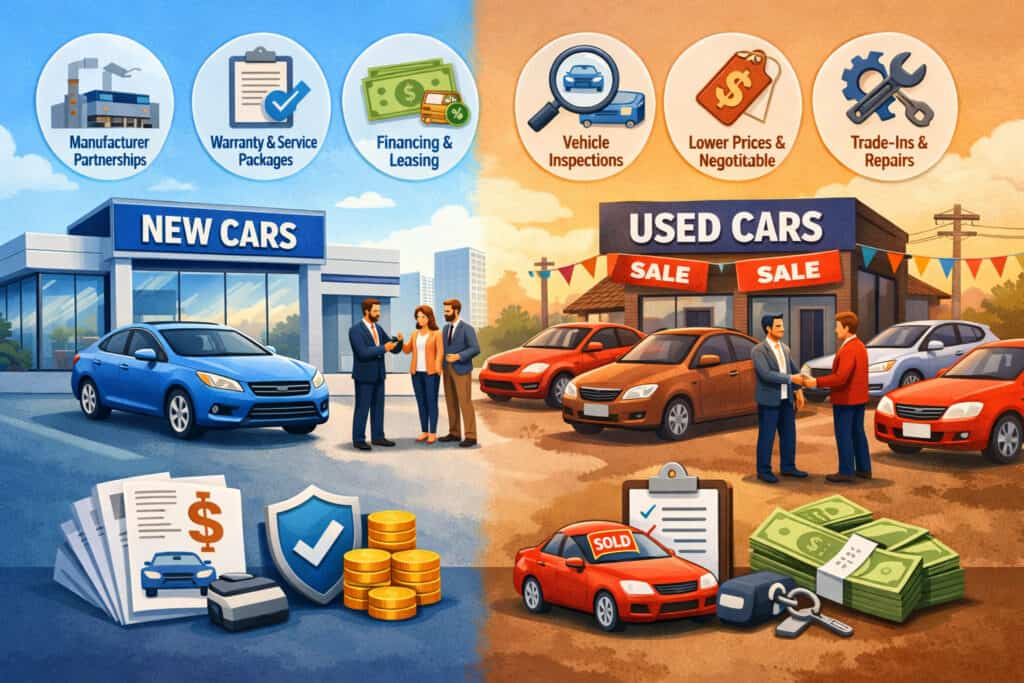
The strongest automotive business comparison starts with structure. New and used dealerships both sell vehicles, but the engine behind the business is different. The new model is usually relationship-driven from the top down.
It depends on manufacturer ties, franchise agreements, brand positioning, and a more formal operating environment. The used model is often market-driven from the ground up. It depends on buying skill, inventory turn, pricing discipline, and operational control.
Those differences affect nearly every part of the dealership. Inventory sourcing is one obvious example. A new dealer may receive allocations and follow manufacturer rules, while a used dealer is constantly searching for the right units through auctions, trade-ins, private purchases, and wholesale networks.
Branding is another. A new franchise benefits from a recognizable badge, but an independent store must build its own identity and trust. Financing also differs.
New dealerships may have stronger access to captive lending programs and manufacturer promotions, while used stores often rely on a wider mix of banks, finance companies, credit unions, subprime lenders, or in some cases internal financing structures.
The same applies to customer expectations. Buyers walking into a new store often expect a polished brand experience, warranty protection, advanced features, and structured financing offers.
Buyers at a used store may be more price-sensitive, more focused on payment flexibility, and more willing to compare condition, mileage, and value across brands. That changes how the sales process works, how disputes arise, and where profit opportunities appear.
Manufacturer relationships, branding, and operational control
In a new vs used automotive businesses discussion, the manufacturer relationship is one of the biggest dividing lines. A new dealer can benefit from national advertising support, brand awareness, OEM training, service program alignment, and a stronger built-in identity.
That can reduce the burden of introducing the store to the market. Customers already know the brand, and many will shop at the dealership because they have already decided they want that make.
At the same time, the manufacturer relationship limits independence. The dealership may not be free to source outside that brand’s new inventory stream, and it may need to follow image rules, facility upgrades, program participation standards, and other franchise obligations.
This can create stability, but it can also create fixed costs and strategic constraints. A used dealer usually has the opposite reality. There is less built-in visibility, but more operating freedom.
The owner can pivot faster, target underserved niches, test new vehicle categories, and adjust merchandising quickly when the market shifts. That flexibility is a major reason independent dealer content often emphasizes operational fit, payment workflows, cash flow discipline, and underwriting readiness over brand prestige alone.
Inventory sourcing, financing, and customer expectations
Inventory sourcing shapes risk and profit in both models. New dealers generally do not have to scour the market unit by unit for most of their new inventory, but they may face allocation limits, aging pressure, and dependence on what the manufacturer sends.
Used dealers have more freedom, but they also carry more sourcing risk. Every vehicle is a buying decision. Condition, title status, transport cost, reconditioning needs, and market demand all matter.
Financing also changes the sales environment. A new dealership often benefits from manufacturer-affiliated programs, promotional rates, or brand-backed lease and finance options. That can help close deals and support customer confidence.
Used dealers may work with a broader but less standardized lender mix. In some operations, financing becomes a major profit center; in others, it becomes a major risk area, especially when customer documentation, payment collection, chargeback exposure, or recurring billing processes are weak.
That is one reason dealership operators often review topics such as how payment processing works for auto dealers, especially when deposits, down payments, and mixed-tender transactions are part of the sales process. High-ticket auto transactions, variable funding timing, and dispute exposure can all change how a dealership manages cash flow and approvals.
Customer expectations follow the model. New-vehicle buyers usually expect transparency around factory options, warranty coverage, incentives, and a more formal delivery process.
Used-vehicle buyers often care more about total value, payment affordability, vehicle condition, and whether the store feels trustworthy. Neither customer is easier. They simply judge the business on different criteria.
Advantages of a New Car Dealership Business

The case for a new dealership is easy to understand. The model can offer built-in legitimacy, manufacturer alignment, branded service opportunities, and a more structured path to long-term scale. For the right operator, those advantages are significant.
A store tied to a recognized manufacturer may find it easier to attract walk-in traffic, recruit certain types of staff, and create a polished customer experience that matches buyer expectations.
That structure also supports consistency. Training programs, warranty procedures, service systems, and approved financing relationships can create a stronger operating foundation than many first-time entrepreneurs realize.
In some markets, the perceived trust gap between new and used is still meaningful. Customers often feel more comfortable buying from a franchise rooftop because they associate it with quality control, service support, and lower uncertainty.
This does not mean every franchise store is well run or every independent store is risky. It means the starting point for customer confidence can be different.
A new dealership also has more natural opportunities to create revenue beyond the front-end vehicle sale. Service work, manufacturer warranty reimbursement, recall work, parts sales, accessories, and customer retention programs can all strengthen the overall business. In many stores, those recurring departments matter as much as, or more than, the initial sale itself.
Brand recognition and manufacturer support
One of the biggest advantages in the new car dealership vs used car dealership debate is brand recognition. A new dealership does not have to explain what it sells at the most basic level. The manufacturer’s reputation already exists in the consumer’s mind.
That can reduce some marketing friction and give the store a head start with customers who are already comparing dealers within the same brand network.
Manufacturer support also matters operationally. Training materials, product knowledge systems, sales tools, co-op marketing programs, warranty processes, and branded finance channels can make the business easier to standardize.
This is especially important for owners who want a repeatable structure rather than a highly improvisational retail environment. Franchise support will not solve weak leadership, but it can provide an operating framework that independent stores have to build on their own.
Educational content for dealer payments and provider selection also highlights how a more structured environment often benefits from systems that reduce friction across sales, F&I, and service workflows.
Warranty-backed inventory and stronger trust signals
A new vehicle generally carries fewer questions about prior use, mechanical history, and hidden condition issues. That does not eliminate complaints or disputes, but it changes the nature of them.
Customers know the vehicle is new, and warranty protection can reduce fear around unexpected repair costs. From the dealership’s point of view, that lowers some of the uncertainty that comes with used inventory and makes the sales story cleaner.
Trust also tends to come more easily in certain markets. Many buyers view a franchise location as a safer place to spend a large amount of money, particularly when financing is involved.
That perception can improve close rates and reduce the amount of reputation-building required before the customer is comfortable moving forward. It can also help support stronger service retention after the sale because the customer expects the dealership to remain part of the ownership experience.
Disadvantages of a New Car Dealership Business
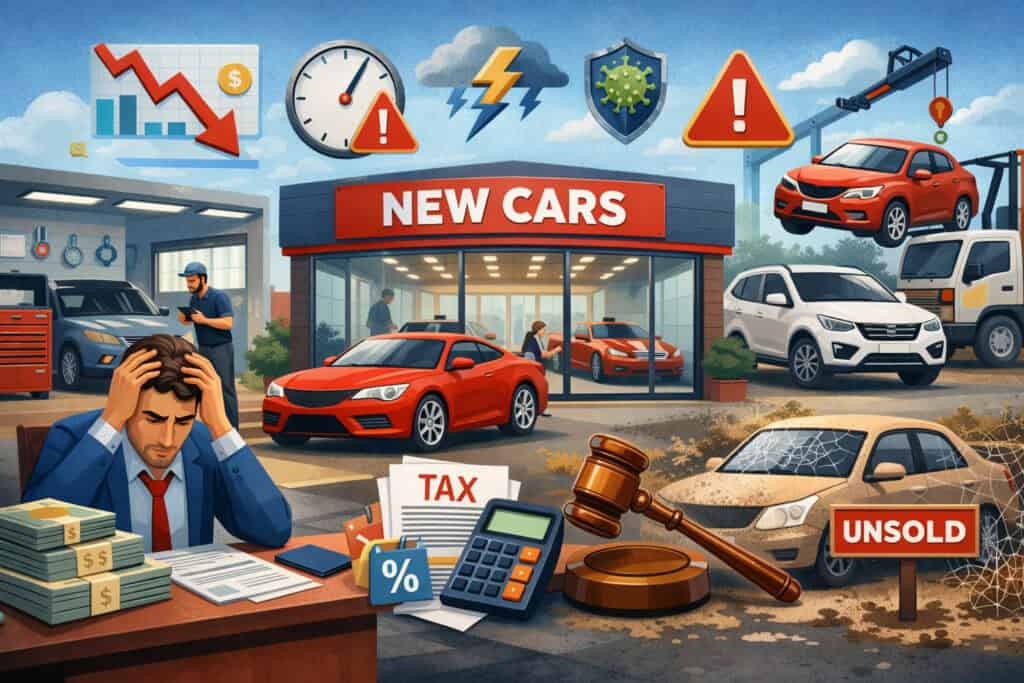
For all of its strengths, the new dealership model can be difficult to enter and demanding to maintain. Many entrepreneurs are drawn to the stability of a franchise environment without fully understanding the capital, compliance, and operational burdens that come with it.
The biggest misconception is that a recognizable brand automatically creates an easier business. In practice, it often creates a more expensive and tightly managed one.
Starting a new car dealership may involve high franchise barriers, real estate expectations, facility image requirements, brand-specific service equipment, and a larger staffing footprint than many independent operators are prepared for.
The owner may also face less flexibility in inventory decisions, pricing strategy, facility presentation, and long-term planning. This can be frustrating for entrepreneurs who value autonomy or want to pivot quickly when local demand changes.
New dealerships can also face inventory pressure that is less visible from the outside. Aging units, sales targets, incentive dependencies, and flooring obligations can create cash flow strain, especially if consumer demand softens or product mix does not line up with local preferences. A business can look strong from a branding standpoint and still be under real operational pressure.
Higher startup barriers and franchise restrictions
The biggest drawback of the new model is often the entry threshold. New vehicle dealership requirements may include franchise approval, brand review, significant working capital, property standards, service capacity, specialized tools, trained technicians, formal reporting systems, and higher insurance and compliance complexity. Even operators with industry experience can find the path demanding.
Franchise restrictions also reduce independence. The dealer may not be free to carry whatever new inventory it wants, modify branding as it sees fit, or make major facility or presentation decisions without approval.
Some operators appreciate this structure because it creates consistency. Others find it limiting because it makes adaptation slower and more expensive. That tradeoff matters. A business model that looks prestigious on paper can become frustrating when every operational change touches brand standards, investment requirements, or approval processes.
Provider selection, underwriting, and equipment decisions may also need to fit more formal operational requirements, which is why many dealers review merchant account approval and systems-fit issues before making commitments.
Inventory pressure, fixed costs, and lower flexibility
A new dealership often carries heavier fixed overhead than an independent used lot. The facility is usually larger, staffing is broader, and customer expectations around presentation, service, and technology are higher.
That means payroll, utilities, property costs, equipment, insurance, and process infrastructure can all be substantial even before considering inventory carrying costs.
Inventory pressure can add another layer. If a store has aging units, weak demand for certain trims, or a mismatch between allocations and local buyer preferences, gross profit can tighten quickly.
Discounts, incentive dependence, and carrying costs can erode what looked like a strong retail model. In other words, a new dealership may appear more stable, but it can also be less forgiving. When the business is large and structured, mistakes become expensive fast.
Advantages of a Used Car Business
The strongest case for the used side is flexibility. For many entrepreneurs, the used model offers a more realistic entry point and a more adaptable path to growth.
It usually requires less capital than a franchise store, gives the operator more control over what to buy and how to price it, and allows the business to serve a broader range of customer budgets. That is why starting a used car dealership remains one of the most common paths into automotive retail.
Used inventory also creates room for sharper buying and merchandising decisions. A skilled operator can create value by sourcing underpriced vehicles, improving presentation, reconditioning wisely, and targeting demand segments that larger stores overlook.
This means the owner can influence gross profit more directly than in some new-vehicle environments, where brand standards and factory programs shape much of the business.
Another advantage is market reach. A used store can carry multiple brands, multiple price bands, different mileage profiles, and different customer payment types.
That makes it easier to serve commuters, value shoppers, first-time buyers, work-truck customers, credit-challenged borrowers, and cash buyers from the same location. For entrepreneurs who like agility and hands-on control, that breadth can be very attractive.
Lower barriers to entry and greater inventory freedom
A used dealership is usually easier to launch than a franchise operation. The licensing process still matters, the capital requirement is still real, and compliance still matters, but the owner is typically not dealing with a manufacturer’s facility program, franchise approval, or OEM-driven image standards. That alone changes the startup equation.
Inventory freedom is just as important. The store can buy what fits its local market instead of what a franchise relationship dictates. One month that may mean affordable sedans. Another month it may mean trucks, SUVs, vans, niche imports, or high-turn work vehicles.
This freedom allows the business to react quickly when demand shifts. It also gives experienced buyers a chance to build margin through smart sourcing instead of waiting for factory support or promotional programs to carry the month.
Pricing control and the ability to serve broader customer segments
Used dealers often have more room to set their own pricing strategy. They can position for fast turns, high front-end gross, niche specialization, or payment-driven selling depending on the market they serve.
That does not guarantee higher profits, but it does create more levers. In a used auto dealership profits discussion, this matters because the operator can influence both the buy side and the retail side.
The customer base is also broader. Many buyers are not shopping by brand first. They are shopping by price, payment, utility, mileage, or credit profile. A used dealership can meet that demand with more flexibility than a new-only store.
The business can also layer in trade-ins, lender relationships, service contracts, recurring payment arrangements where appropriate, and more diverse transaction structures.
Independent dealer payment workflows often reflect exactly this mix: deposits, down payments, warranty products, split tenders, and high-ticket transactions that need careful tracking and dispute prevention.
That is one reason many operators study auto merchant services for independent dealers and automotive merchant account fees as part of building the store correctly from the beginning.
Disadvantages of a Used Car Business
The used model gives more freedom, but it also creates more uncertainty. Every vehicle is a judgment call, and every weak process tends to show up faster.
An operator can make money quickly with smart sourcing and strong discipline, but can also lose money quickly through poor buys, inconsistent reconditioning, title issues, missed disclosures, or a damaged reputation.
Used-car retail often requires sharper operational instincts than outsiders expect. Inventory quality is inconsistent by nature. Some vehicles are easy wins. Others come with hidden condition problems, higher-than-expected recon costs, or market resistance that kills in turn.
The store must also work harder to create trust because customers know used inventory varies from unit to unit. One mistake can affect reviews, referrals, lender confidence, and future deal flow.
There is also more complexity in some financing environments. If the store works with credit-challenged customers, deferred down payments, recurring payment setups, or in-house collections, the business must manage documentation, payment risk, and dispute exposure carefully. Flexibility helps close deals, but it can also create operational strain if controls are weak.
Reconditioning risk and variable inventory quality
The biggest operational headache in many used stores is the gap between what a vehicle looked like when it was bought and what it costs to make it retail-ready.
Reconditioning can destroy expected gross profit if the store underestimates repairs or moves too slowly. Cosmetic work, tires, brakes, sensors, mechanical fixes, detail, transport, title delays, and shop bottlenecks all add time and money.
Inventory quality is also uneven. Even with inspections, vehicle history reports, and buying experience, some issues only show up later. That means a used dealer carries more product-level uncertainty than a new dealer.
When that uncertainty reaches the customer, it can turn into complaints, bad reviews, refund pressure, or post-sale disputes. Because the dealership itself stands behind the sale more directly, reputation management becomes an everyday operating function rather than an occasional branding issue.
Reputation challenges, financing complexity, and collections pressure
Independent used dealers often live closer to the edge of reputation risk. Customers may arrive with more skepticism, and the store has to earn confidence through transparency, presentation, vehicle quality, paperwork accuracy, and follow-through.
Weak communication about condition, fees, financing, warranty terms, or return expectations can turn a normal transaction into a damaging public complaint.
Financing can also be more complex. Some used stores depend on multiple lenders with different approval standards. Others serve customers with thinner credit files or more fragile payment capacity.
In buy-here-pay-here or related recurring-payment environments, collections and payment compliance become central parts of the business. Even outside those models, dealers must understand payment authorization, fraud controls, refunds, chargeback prevention, and clear transaction records.
That is why educational resources on choosing the right auto merchant services provider and chargebacks in the auto industry are relevant to used-vehicle operators trying to avoid preventable losses. Poor documentation, unclear policies, or weak identity checks can increase disputes and hurt already-thin cash flow.
Startup Costs and Capital Requirements: New vs Used Car Dealership Business
One of the most important parts of any auto dealer startup comparison is capital. This is where many people abandon realistic planning and focus only on lot size or expected monthly sales. But startup success usually depends on whether the owner truly understands the cash demands behind the chosen model.
A new dealership generally requires more capital up front. There may be franchise fees, real estate costs, facility build-out or renovation expenses, signage, furniture, service equipment, technology systems, higher payroll needs, inventory financing arrangements, and working capital reserves.
Because the operation is usually larger and more standardized, the business often needs more cash before the first sale even happens.
A used dealership can often start smaller, but that does not mean it is cheap. The owner still needs licensing, location costs, insurance, dealer systems, initial inventory, transport, reconditioning capacity, detail work, title processing, and enough cash to withstand slow turns or surprise repairs.
The difference is that the operator often has more flexibility in how to stage the launch. A used lot can start with a narrower inventory band and expand as cash flow improves.
Typical startup cost profile
The table below provides a practical, non-brand-specific view of how these startup realities often differ.
| Category | New Automotive Business | Used Automotive Business |
| Franchise or brand entry | Often required and substantial | Usually not required |
| Facility expectations | High; image and service standards may apply | More flexible, depending on market and license rules |
| Initial inventory approach | Manufacturer allocation and floorplan structure | Auction, wholesale, trade-ins, private buys |
| Service department investment | Often important from day one | May be lighter at launch or outsourced |
| Staffing footprint | Usually larger and more specialized | Can begin leaner, then scale |
| Working capital needs | High due to fixed overhead and operating structure | Lower relative entry point, but still meaningful |
| Flexibility to start small | Limited | Higher |
| Ability to pivot inventory quickly | Lower | Higher |
This is why capital fit matters so much in the new vs used automotive businesses decision. Entrepreneurs sometimes choose the model that sounds more established, then discover they are underfunded for how that model actually operates.
Why working capital matters more than opening budget
The opening budget is only part of the picture. Working capital often determines whether the business survives the first inventory cycle, the first service bottleneck, or the first month where sales miss plan.
New dealers need reserves because fixed costs are heavy and brand expectations do not pause when traffic slows. Used dealers need reserves because reconditioning, title delays, lender timing, and aged units can tie up cash unexpectedly.
A healthy working capital plan should account for slower-than-expected turns, delayed funding, repair surprises, payroll, taxes, insurance, advertising, and customer issue resolution. Owners who budget only for the opening day often end up reactive by the second or third month.
That is when bad decisions start: overpaying for inventory, discounting too aggressively, skipping reconditioning, or accepting weak financing structures just to move a deal.
Profit Margins, Inventory Turn, and Revenue Mix
Many people enter automotive retail believing the main question is simple: which side makes more on each vehicle? That is the wrong starting point.
A better question is how each model creates gross profit, how quickly inventory turns, and how much of the business depends on other revenue sources. The answer is one of the most important dealership business model differences to understand.
New dealerships often work with tighter front-end margins on the vehicle itself, but that does not mean they are weak businesses. The model is usually designed to earn from a broader revenue mix: finance products, manufacturer incentives, warranty service, parts, accessories, trade-ins, and long-term service retention. Profit is spread across departments.
Used dealerships can often achieve stronger front-end gross on individual units if they buy well and manage recon carefully. However, that profit is less standardized and more dependent on sourcing discipline.
One great month can be followed by a weak month if buying quality slips or aged inventory builds up. Used stores may also earn from financing, warranty products, service work, or fees, but the consistency of that income depends heavily on the operator.
How gross profit behaves in new and used operations
In a new store, front-end vehicle profit may be tighter because competition is often brand-to-brand within the same market and customers can compare similarly equipped new units more easily.
That puts pressure on pricing and can make the dealership more dependent on F&I, trade-ins, service retention, and manufacturer programs to produce healthy overall results.
In a used store, front-end gross can be stronger because each vehicle is unique in mileage, condition, equipment, and acquisition cost. That uniqueness gives the dealer more room to create margin through buying skill and merchandising. But it also creates more volatility. A poor appraisal, a missed mechanical issue, or a stale unit can erase profit quickly.
Why service, finance, and payment workflows matter
Revenue does not stop at the sale price. Finance income, service contracts, GAP, accessories, service lane work, warranty repair, parts sales, and customer retention can materially change the profitability of either model.
New stores often have a built-in edge in service traffic because warranty work and manufacturer alignment bring customers back. Used stores can still build service revenue, but it usually takes more intentional process design and customer follow-up.
Payment workflows matter here too. Down payments, partial payments, deposits, service invoices, and recurring charges must all be managed cleanly. Inconsistent processing can create reconciliation problems, funding delays, and disputes that eat into gross.
That is why operators reviewing payment strategy often compare transaction structure, fraud controls, fee transparency, and dealership-specific workflows rather than looking only at the headline rate. Resources on merchant fee structure and dealership payment operations can help owners understand that payment systems affect profitability, not just convenience.
Customer Base, Compliance, and Operating Complexity
A new vs used car dealership business comparison is incomplete without looking at the customer and compliance side. These businesses may both sell cars, but they do not always serve the same buyer in the same way. Nor do they carry the same operational complexity.
New dealerships often attract customers who are researching specific brands, expecting a modern showroom experience, and comparing finance or lease offers. The sales process may be more structured, but the expectations are high. Customers often expect consistency, product expertise, warranty clarity, and a smooth handoff to service.
Used dealerships tend to serve a broader and more mixed audience. Some buyers are value-focused. Others are credit-focused, utility-focused, or payment-focused. That makes the customer base more diverse, which can be an advantage, but also requires stronger communication and process control.
The store must be ready to explain condition, history, pricing, financing, warranties, and disclosures in a way that reduces confusion and builds trust.
Compliance, disclosures, and deal structure
Compliance needs exist in both models, but the pressure points differ. New stores may deal with franchise obligations, manufacturer standards, service program rules, and more formal corporate-like oversight.
Used stores may face more transaction-level risk around disclosures, title handling, odometer records, condition representations, financing documentation, and collection practices where relevant.
Neither side gets a pass. Licensing, consumer disclosures, payment compliance, fraud prevention, privacy obligations, and recordkeeping matter across the board.
What changes is how often the store is relying on its own controls instead of a manufacturer-driven framework. In used retail, weak process discipline shows up quickly. In new retail, process failures can become expensive because the store’s cost structure is larger and more layered.
Customer trust and dispute management
Trust is not just a branding issue. It affects close rates, finance approvals, reviews, repeat business, and dispute frequency. New dealerships often start with stronger trust signals because the inventory is new, the environment is more standardized, and warranty support is expected.
Used dealerships must create trust more actively through photos, inspections, disclosures, test-drive experience, paperwork accuracy, and post-sale communication.
Dispute management matters in both models, especially around deposits, add-ons, refunds, payment authorizations, service work, and customer misunderstandings. High-ticket transactions need stronger documentation, not weaker.
Clear receipts, signed agreements, and consistent authorization steps matter because auto disputes can become costly quickly. Automotive payment guidance and chargeback education regularly emphasize that documentation, transparency, and transaction controls are central to protecting cash flow in dealership operations.
Risk Factors: Market Swings, Floorplan Pressure, Fraud, and Customer Disputes
Every dealership carries risk, but the risk profile differs by model. Understanding that profile is one of the most practical parts of the used car business vs new car business decision. Some risks are strategic, such as being overbuilt for the market. Others are transaction-specific, such as fraud, title errors, or chargebacks.
New dealerships are often more exposed to overhead pressure and inventory financing stress. If demand slows, fixed costs do not disappear. A large facility, bigger payroll, and inventory aging can create pressure fast. Depending on the business structure, the operator may also feel more strain from flooring arrangements and incentive dependence.
Used dealerships are often more exposed to product-level uncertainty. Buying mistakes, surprise recon costs, title issues, vehicle history complications, and reputation damage can all hit hard. Financing and collections risk may also be higher in operations serving challenged credit segments or using recurring-payment structures.
Market swings and inventory financing pressure
When the market changes, the new model can feel heavy. If inventory sits, carrying costs grow and pricing pressure increases. If the wrong mix is on the ground, the store may have limited flexibility in the short term. Because overhead is often high, the business may need volume to keep the model healthy.
Used stores can pivot faster, but that does not mean they are safer. When market values move sharply, units bought at yesterday’s numbers can become difficult to retail profitably. If inventory turns slow, reconditioning money and acquisition costs stay tied up. The difference is that the operator usually has more ability to adjust sourcing immediately.
Fraud, chargebacks, vehicle history issues, and dispute exposure
Fraud and disputes are real concerns in both models, especially where large card deposits, remote approvals, financing paperwork, or split-tender transactions are involved. Weak identity checks, incomplete documentation, unclear cancellation policies, or poor communication can increase chargeback risk.
Educational guidance for auto merchants repeatedly notes that underwriting, fraud controls, and transparent transaction records matter because automotive tickets are high-impact when something goes wrong.
Used operations also have more exposure to vehicle-history and condition-related disputes. Even with proper disclosures, customers may question previous damage, wear, repairs, or performance issues after delivery.
New stores face disputes too, but they are less likely to center on prior ownership history. That difference should influence how the business handles inspections, disclosures, paperwork, refunds, and customer follow-up.
Which Business Model Fits Different Types of Entrepreneurs?
There is no universal winner in the New vs Used Automotive Businesses comparison. The better model depends on who is running it, how much capital is available, how the operator thinks, and where the real strengths are.
The key is to match the model to the entrepreneur instead of chasing the one that sounds more prestigious or easier to sell.
A first-time operator with limited capital and strong buying instincts may be better suited to an independent used operation. An experienced dealer principal with access to capital, process discipline, and comfort with structured oversight may fit the new franchise model better. A family-run business may value a smaller, more controllable used lot.
An investor-led group may prefer the scale and brand positioning of a franchise platform. An operator focused on financing, collections, and recurring payments may see more opportunity in a used strategy than a traditional new-vehicle model.
Best fit for first-time dealers, experienced operators, and investors
First-time dealers often underestimate complexity more than opportunity. For them, a used model may be more practical because it allows a narrower launch, more gradual growth, and more control over pace. That said, it only works when the owner is disciplined about buying, recon, disclosures, and cash management.
Experienced operators may be better positioned to handle the heavier infrastructure of a new dealership. They are more likely to understand staffing layers, manufacturer expectations, service absorption, finance management, and inventory pressure.
Investors may go either direction, but they need to be honest about whether they are investing in a system-driven franchise or a talent-driven independent store. The latter often depends more on operator skill than spreadsheet assumptions suggest.
Real-world scenarios: when each model may be the better choice
A new dealership may be the better fit when the owner has strong capital access, long-term real estate commitment, management depth, and a desire to build a structured multi-department operation with service retention and brand support. It may also fit operators who prefer formal systems over improvisation.
A used dealership may be the better fit when the owner wants lower entry barriers, more sourcing freedom, faster pivots, and the ability to serve a wider range of price points and credit profiles. It often makes sense for hands-on entrepreneurs who are strong at appraisal, acquisition, merchandising, and local-market adaptation.
Common Mistakes People Make When Choosing Between New and Used
Many poor dealership decisions start with incomplete comparisons. People focus on vehicle margins without understanding total operating costs. They compare sales volume without comparing staffing needs, facility burden, reconditioning risk, or financing structure. They assume customer traffic will solve weak operations. It rarely does.
One common mistake is choosing the new model for image rather than fit. A franchise relationship can look attractive, but if the operator is undercapitalized or frustrated by restricted control, the business may become stressful quickly.
Another mistake is choosing the used model because it looks cheaper without respecting how difficult buying, recon, titles, and reputation management can be.
A third mistake is ignoring compliance and payments. Licensing, documentation, fraud prevention, refunds, dispute controls, and lender coordination are not side issues. They are part of the business core.
In dealership environments, fee structure, approval requirements, chargeback controls, and transaction workflows can materially affect cash flow and customer experience, especially when down payments, deposits, service contracts, or recurring obligations are involved.
The biggest decision errors to avoid
Here are some of the most common errors:
- Focusing only on front-end vehicle gross
- Underestimating recon, title, and carrying costs
- Ignoring working capital needs
- Choosing a model that does not match management style
- Assuming brand recognition replaces operational discipline
- Assuming flexibility replaces process discipline
- Failing to plan for payment disputes and documentation needs
- Treating compliance as a paperwork issue instead of a risk issue
These mistakes are common because they are easy to make from the outside. Automotive retail often looks simpler than it is.
Practical Checklist: How to Decide Whether New or Used Is the Better Path
If you are still weighing the new vs used car dealership business question, a practical checklist can be more useful than a broad theory discussion. The goal is not to find a perfect answer. It is to identify which model fits your resources, strengths, and growth goals with fewer blind spots.
Decision checklist for entrepreneurs and operators
Ask yourself the following:
- Do I have the capital for high fixed overhead, or do I need a leaner launch?
- Do I want structure and brand alignment, or flexibility and control?
- Am I better at managing systems, or at spotting inventory opportunities?
- Can I handle recon risk, title issues, and unit-level variability?
- Do I want a manufacturer relationship, or would that feel restrictive?
- How strong is my local market for lower-payment used inventory versus brand-specific new demand?
- Do I have service and finance capabilities, or will I need to build them gradually?
- How comfortable am I with compliance, dispute prevention, and payment workflow design?
- Do I want to scale through process standardization or through buying and merchandising skills?
- What kind of customer do I want to serve every day?
If most of your honest answers point toward flexibility, cash discipline, local-market adaptation, and hands-on inventory decisions, a used model may fit better. If they point toward structure, service depth, brand-driven retailing, and capital-backed scale, the new model may be more suitable.
Frequently Asked Questions
Is a used car dealership easier to start than a new car dealership?
In many cases, yes. An independent used dealership often has lower startup barriers, more flexible facility expectations, and no manufacturer franchise approval process. But easier to start does not mean easier to operate, since used stores still require strong buying judgment, reconditioning control, title discipline, and trust-building from day one.
Which model usually needs more startup capital?
A new dealership usually needs more capital because the operating structure is often larger and more formal. Franchise relationships, facility standards, staffing, service equipment, and working capital needs are typically heavier. A used dealership can often launch more leanly, but it still needs enough cash for inventory, reconditioning, insurance, compliance, and slow-turn scenarios.
Are profit margins higher in used vehicles than new vehicles?
They can be, but it depends on buying skill and cost control. Used inventory often allows more gross-profit opportunity per unit because each vehicle has a unique acquisition cost and retail position. New vehicles may have tighter front-end margins, but the total business can be strengthened by service, finance products, manufacturer programs, and customer retention.
Which business model offers more operational freedom?
Used automotive businesses usually offer more freedom. The owner has more control over inventory sourcing, pricing, brand identity, and niche strategy. New dealerships often operate within tighter franchise standards, which can bring support and stability but limit flexibility.
Is customer trust stronger with new dealerships?
In some markets, yes. Buyers often feel more comfortable with new inventory, factory warranties, and franchise environments. But strong used dealerships can build excellent trust through transparency, quality control, fair pricing, and consistent follow-up. Trust is easier to signal in the new model, but it can still be earned in either one.
Can a used dealership become more profitable than a new dealership?
Yes, it can. A well-run used store with disciplined buying, smart reconditioning, strong financing relationships, and solid reputation management can produce excellent returns. The model is simply less standardized and more dependent on operator skill.
What is the biggest hidden challenge in the new dealership model?
Many operators underestimate fixed-cost pressure. Large facilities, broader staffing, brand standards, and inventory financing obligations can create stress even when the store looks impressive on paper. The challenge is not just getting open, but staying financially healthy when volume softens or inventory ages.
What is the biggest hidden challenge in the used dealership model?
Many people underestimate how much risk sits inside each vehicle purchase. A store can lose money through reconditioning surprises, title delays, weak disclosures, stale inventory, or reputation damage. In used retail, one bad buy can create several downstream problems.
Conclusion
The New vs Used Automotive Businesses decision is really a decision about structure, risk, control, and fit. New dealerships often offer stronger brand recognition, manufacturer support, warranty-backed inventory, and more predictable customer trust signals. In return, they usually demand more capital, more infrastructure, more fixed overhead, and less freedom.
Used automotive businesses often offer lower entry barriers, broader inventory freedom, more pricing control, and more room for entrepreneurial agility. In return, they usually require sharper judgment in sourcing, reconditioning, disclosures, financing, reputation management, and cash flow control. The model can be highly rewarding, but it rarely tolerates weak process discipline.
The smartest way to compare a new vs used car dealership business is not to ask which one sounds better. Ask which one matches your capital, operating style, local market, management strengths, and long-term goals.
A franchise store may be the right path for an operator who wants structure, scale, and brand-backed systems. A used store may be the better path for an entrepreneur who values flexibility, market responsiveness, and direct control over buying and margins.
Either way, the strongest decision comes from realism. Understand the business model, respect the hidden costs, build around your actual strengths, and choose the path whose challenges you are prepared to manage well. That is how an automotive business becomes sustainable, not just exciting at the start.