
Choosing the Right Automotive Business Model
Choosing the right automotive business model is one of the highest-leverage decisions you can make in the vehicle space.
It determines how you acquire inventory (or if you need inventory at all), how you earn gross profit, how you manage cash flow, what your customer experience looks like, and how exposed you are to interest rates, price swings, regulation, and technology shifts.
In the last few years, the “easy mode” of automotive retail (fast inventory turns, fat front-end margins, cheap capital) has been replaced by a tougher environment: higher borrowing costs, longer loan terms, payment sensitivity, and more consumers carrying negative equity.
That doesn’t mean the opportunity is gone—it means the winning automotive business model is the one that’s built for margin diversity, trust, operational discipline, and repeat business.
This guide breaks down the major automotive business model options, how each one really makes money, what you must be good at to win, and what’s changing through 2030—especially as retail shifts toward digital-first buying, agency-style distribution experiments, subscriptions, and service-led profit strategies.
The decision framework that keeps you from picking the wrong automotive business model
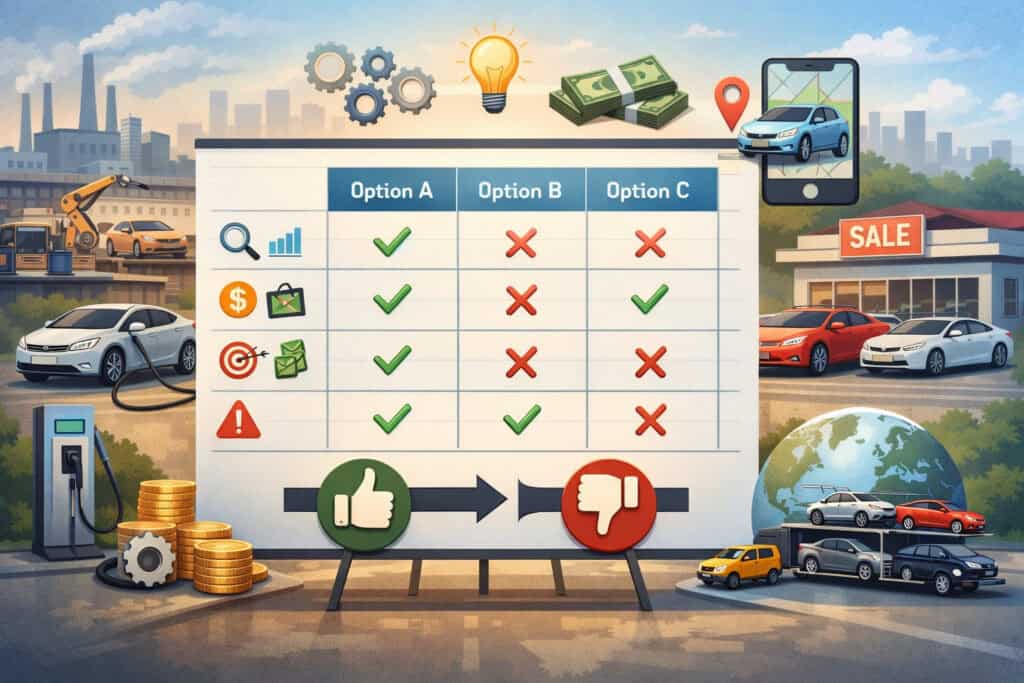
Most people choose an automotive business model based on what looks profitable on the surface: “cars are expensive, so selling cars must be lucrative.” The reality is that the automotive industry is a bundle of different businesses stacked together—retail, lending, logistics, service, warranty risk, marketing, compliance, and customer retention.
If you don’t pick a model that matches your strengths and capital, you’ll feel constant friction: too much inventory risk, too much lead cost, too many chargebacks, too many compliance headaches, or too little cash runway.
A smarter way to choose an automotive business model is to score each option on five dimensions. First is capital intensity: do you need floorplan financing, large down payments for inventory, or expensive facilities?
Second is operational complexity: reconditioning, titling, lender relations, service bay throughput, and claim processing can overwhelm teams without systems. Third is margin composition: are you dependent on front-end gross, or do you have recurring revenue from service plans, parts, subscriptions, or fleet contracts?
Fourth is risk exposure: interest rates, used-vehicle price volatility, delinquency, and regulatory enforcement can hit some models much harder than others.
Finally, look at repeatability: the best automotive businesses reduce customer acquisition cost over time through retention, referrals, memberships, and service relationships.
If you evaluate every automotive business model through that lens, the “best” option usually becomes obvious for your situation—even if it’s not the flashiest.
Market realities shaping every automotive business model right now

Every automotive business model is being reshaped by affordability pressure. Consumers are increasingly payment-driven, and long loan terms can hide total cost while amplifying negative equity risk.
This matters because when customers shop by monthly payment, you need either (1) cheaper inventory, (2) better financing partners, (3) alternative ownership structures like subscriptions or flexible leases, or (4) value-added bundles that justify the payment.
Another major force is fee transparency and regulatory scrutiny. Hidden add-ons and surprise fees have created reputational damage in parts of the market, and policy attempts to reduce deceptive pricing have been active—even when specific rules get challenged or struck down.
That means the long-term advantage will go to businesses that can win with trust: clean out-the-door pricing, documented inspections, and a clear menu for optional products.
At the same time, profit gravity is shifting toward fixed operations—service, parts, and warranty work—especially when vehicle margins compress. Multiple industry analyses emphasize the growing importance of service profit, and the evolving vehicle mix (including EVs) is changing what high-value service work looks like.
Finally, distribution is evolving. Many automakers and industry strategists project movement toward more digital retail and experiments with the agency model, where the dealer role can shift away from inventory risk and toward customer delivery and service.
Whether or not an agency becomes dominant in your segment, it’s a signal: owning the customer relationship and owning service capacity will matter more than simply holding inventory.
Franchise dealership automotive business model

The franchise dealership automotive business model is the classic full-stack approach: new vehicle sales, used vehicle sales, finance & insurance (F&I), parts, and service under one roof.
It can be extremely profitable, but it’s also one of the most capital-intensive models because it often requires manufacturer facility standards, specialized staffing, and access to floorplan financing.
Where franchise dealers win is volume leverage and multi-department gross. Even when new-vehicle margins tighten, a strong store can produce durable profits through F&I penetration, service retention, parts sales, and trade-in acquisition.
Service and parts become especially important during periods when vehicle affordability reduces turnover. Industry commentary continues to highlight that fixed operations often carry profit resilience, even when sales-side gross is pressured.
The biggest risks are inventory carrying costs, interest-rate exposure, and competitive lead costs. If you’re dependent on paid leads and you don’t build a real retention engine, your customer acquisition cost can balloon.
Another risk is structural: as digital retail improves and automakers experiment with direct-to-customer pathways, dealers may be pushed to differentiate through experience, delivery speed, and service excellence rather than simply being the default sales channel.
To modernize this automotive business model, winning operators tend to do three things: build a service-first customer lifecycle, implement disciplined used-vehicle sourcing (trade-in and local acquisition), and standardize F&I ethics and compliance so profit doesn’t depend on gray-area tactics that damage trust.
Independent used-car dealership automotive business model
The independent used-car dealership automotive business model is appealing because you can enter without a franchise agreement and you can specialize—economy cars, trucks, luxury, imports, or local favorites. But independence also means you must create your own trust signals and financing ecosystem.
This model makes money through front-end gross (buying right, reconditioning efficiently, pricing intelligently) and back-end gross (lender reserve where permitted, service contracts, GAP, and ancillary products).
In tighter affordability cycles, independents that thrive usually become experts at (1) sourcing vehicles below retail replacement cost, (2) running fast and consistent recon processes, and (3) presenting transparent condition disclosures and warranty options so buyers feel safe.
Used-car buyers are increasingly sensitive to “junk fees” and surprise add-ons, and reports of unexpected fees have drawn negative attention.
If your independent automotive business model relies on confusing fees, it may produce short-term profit but it weakens long-term SEO, reviews, and referral flywheels. A cleaner path is to be the store known for out-the-door clarity, inspection reports, and fair financing.
Future-facing independents are also building service capacity and lightweight memberships (oil changes, tire rotations, inspection discounts) to turn a one-time sale into a relationship. As margins fluctuate, repeat service visits help stabilize cash flow and create trade-in pipelines that reduce auction dependence.
Buy Here Pay Here automotive business model
The Buy Here Pay Here (BHPH) automotive business model is fundamentally a finance-and-collections business wrapped around vehicle retail.
You’re not just selling a car—you’re underwriting a customer and managing a payment book. When done well, it can generate strong yield and repeat customers, but it also demands risk controls, compliance discipline, and collection professionalism.
The profit engine comes from down payments, portfolio yield, fee structures that comply with state laws, and the ability to keep vehicles running so the customer can keep paying.
A major operational truth is that service and collections are inseparable: if the car breaks and the customer can’t get to work, delinquency rises. That’s why many BHPH operators build in-house service, partner with repair networks, or include limited maintenance bundles.
Recent industry discussion highlights trends like more rigorous reporting expectations and the use of modern analytics and AI to manage underwriting and operations. There’s also ongoing attention to the stability of subprime lending ecosystems, including lender distress and restructuring news that can affect liquidity and buyer demand in the ecosystem.
The biggest “fit” question is whether you truly want to run a lending business. If your team is uncomfortable with credit policy, documentation, repossession compliance, and customer hardship processes, this automotive business model will be stressful.
But if you build a fair program—clear terms, consistent treatment, reliable vehicles, and supportive service—you can create a durable niche with strong retention.
Service-first repair shop automotive business model
A service-first automotive business model—general repair, specialty repair, tires, collision sublet coordination, ADAS calibration partnerships—can outperform sales-heavy models in stability. You’re paid for labor and parts, not dependent on volatile vehicle prices. And when affordability is stretched, people keep vehicles longer, which increases maintenance demand.
Industry commentary has emphasized that fixed operations have become a larger profit priority as sales margins compress, and the vehicle mix is creating new types of service opportunities.
Even if you never sell a car, you can build a strong business around inspections, maintenance, and trust-driven repairs. You also build something powerful for the future: customer relationships tied to “keeping you on the road,” not “selling you something.”
To win with this automotive business model, you need throughput discipline. Bay efficiency, technician productivity, parts availability, and accurate estimates determine profitability.
Marketing also looks different: local SEO, reviews, and repeat reminders often beat expensive paid lead funnels. The highest-performing service businesses design “lifecycle programs” (maintenance schedules, text reminders, seasonal checks) that increase frequency without feeling pushy.
Future prediction: as vehicles become more software-defined and driver assistance features expand, more shops will differentiate through diagnostics capability, calibration access, and partnerships with mobile specialists.
At the same time, the best service businesses will invest in customer experience—online scheduling, clear photos/video inspections, and transparent pricing—because trust is the new competitive moat.
Subscription and flexible access automotive business model
The subscription automotive business model sells access rather than ownership. Customers pay a monthly fee that can bundle insurance, maintenance, and the ability to swap vehicles. This appeals to buyers who want flexibility, are uncertain about long-term commitments, or prefer a “single monthly price” experience.
Market research firms project significant growth in vehicle subscription markets through the end of the decade, framing subscriptions as a fast-growing alternative to traditional ownership structures.
Other industry research covering 2025–2028 focuses on subscriptions, flexible leases, and usage-based ecosystems as a broader “access economy” in mobility.
But the subscription automotive business model is not easy money. It’s an operations-and-utilization game. You must manage depreciation, mileage, damage, downtime, insurance costs, and reconditioning cycles.
The math only works when utilization stays high and churn is controlled. This is why many successful subscription programs target specific segments: corporate mobility, short-term relocations, seasonal residents, or professionals who value flexibility enough to pay a premium.
Dealers exploring subscriptions often position it as a hedge during affordability pressure: instead of losing the customer who can’t stomach a long-term loan payment, you offer a flexible option that keeps them in your ecosystem.
The long-term advantage is customer data and retention—subscription customers can become future buyers, and they generate predictable monthly revenue when managed well.
Fleet and commercial contracts automotive business model
Fleet is one of the most underrated automotive business model choices because it can create predictable demand, lower marketing spend, and recurring service work.
Fleet customers care less about showroom experience and more about uptime, total cost, and speed. This model includes local delivery fleets, trades and contractors, municipal vehicles, and business-to-business leasing support.
Revenue comes from vehicle sales or leasing margins, upfitting and accessories, scheduled maintenance contracts, tires, and priority repair programs.
The key is building a system that minimizes downtime: pickup and delivery service, fast parts ordering, loaner coordination, and clear communication. When done correctly, fleet contracts create a moat because switching costs are real—businesses don’t want to retrain staff on a new process every year.
This automotive business model also pairs well with a service-first strategy. As fixed operations becomes a more central profit center across automotive, fleet service relationships can stabilize the whole business. Another advantage is resilience: while consumer sentiment can swing quickly, businesses still need vehicles to operate.
Digital-first marketplace and broker automotive business model
A marketplace or broker automotive business model focuses on matching buyers and sellers without carrying traditional inventory. This can include lead-gen sites, concierge buying services, dealer-to-consumer platforms, and niche marketplaces (classic cars, work trucks, EVs, exotics).
The advantage is lower inventory risk. The disadvantage is you must win attention online, and attention is expensive.
This model typically monetizes through referral fees, dealer subscriptions, transaction fees, financing referrals, transport coordination, inspections, and add-on products like warranties.
The reason this automotive business model is growing is simple: more buyers want a digital journey, and industry strategists expect ongoing movement toward online-first retail and new distribution structures.
However, a broker model must solve trust. If you can’t guarantee vehicle condition, title clarity, and dispute resolution, you’ll drown in chargebacks and bad reviews. Strong operators build standardized inspections, escrow-like payment flows through compliant partners, and buyer protection policies that are clear and enforceable.
Future prediction: marketplaces will become more specialized. Generalist “list everything” platforms will compete on price and scale, while niche platforms will win with expertise, verification, and community trust.
If you’re choosing this automotive business model, the best SEO strategy is usually to own a niche keyword universe with deep content, real verification, and strong review signals.
Hybrid models: the most realistic way to build a durable automotive business model in 2026–2030
If you want an automotive business model that can survive margin compression and market whiplash, hybridization is usually the answer. Pure retail (only selling cars) is vulnerable to rate spikes and inventory swings.
Pure service is stable but may cap growth if you never build higher-ticket revenue streams. Pure subscription is complex without operational maturity. But blending two compatible models can create resilience.
A common winning hybrid is independent used + service-first. You generate front-end gross on vehicles, then you retain customers with maintenance plans and honest service. Another is fleet + service contracts, where your sales pipeline is relationship-based and your service bays stay full with scheduled work.
For higher sophistication operators, subscription + service + remarketing can work: you run a controlled fleet, keep utilization high, then remarket vehicles through your own channels.
This is also where finance matters. Dealership profitability discussions repeatedly highlight that back-end products and finance processes can move the needle, especially when structured ethically and transparently.
The trick is not to become dependent on one lever that can be regulated, commoditized, or disrupted. Build a business that can win on multiple fronts: trust, operational speed, service retention, and smart sourcing.
Legal, compliance, and risk controls that should shape your automotive business model choice
No automotive business model should be chosen without a compliance plan. Vehicle titling and disclosures, advertising rules, lending and collections laws (especially for BHPH), privacy expectations for digital retail, and fee transparency requirements can all determine whether your operation is scalable or constantly under threat.
Recent consumer coverage and reporting has amplified attention on surprise fees and add-ons, reinforcing a simple reality: even if something is technically allowed in a state, deceptive presentation can still destroy reputation and invite enforcement.
In addition, affordability pressure means more customers will scrutinize contracts and shop harder, so clarity is now a competitive advantage, not just a compliance item.
If you operate in multiple states, build your model with state-by-state variability in mind: dealer licensing, doc fees, warranty rules, lemon-law concepts for used vehicles, repossession procedures, and required disclosures.
You don’t need to fear regulation—you need to design for it. The best automotive operators treat compliance as product design: clear menus, documented inspections, signed acknowledgments, and audit trails.
FAQs
Q.1: What is the most profitable automotive business model today?
Answer: The most profitable automotive business model depends on your strengths and market. In general, models that combine multiple profit streams—vehicle gross, F&I products, service retention, and recurring revenue—tend to outperform single-stream models.
Industry commentary also shows that fixed operations can be a stabilizing profit center when sales margins are pressured. If you want durability, aim for a model where service and retention are not optional.
Q.2: Which automotive business model is best with limited capital?
Answer: If capital is limited, a service-first automotive business model or a broker/marketplace approach can reduce inventory risk. A small independent used lot can also work if you source carefully and keep inventory lean.
The key is avoiding heavy floorplan exposure before your marketing, recon, and pricing systems are proven. Start with a model that can generate cash quickly without betting everything on inventory appreciation.
Q.3: Is the subscription automotive business model a trend or the future?
Answer: Subscription is likely part of the future, but not always as a pure standalone product. Market forecasts show strong growth expectations for subscription segments, and broader research emphasizes access-based mobility options through 2028 and beyond.
The winning approach is often hybrid: subscription + service + disciplined remarketing, or subscription targeted to niches where utilization stays high.
Q.4: How do I choose between used retail and BHPH?
Answer: Used retail is primarily an inventory, reconditioning, and marketing business. BHPH is a lending and collections business with vehicle operations attached.
If you don’t want to run a finance book—or you don’t have the compliance and process maturity—choose the traditional used-retail automotive business model and partner with lenders. If you do choose BHPH, treat underwriting, documentation, and customer support as core competencies, not side tasks.
Q.5: What changes should I expect through 2030?
Answer: Expect more digital-first journeys, more experimentation with distribution structures like the agency model, and more emphasis on service and retention as competitive moats.
Also expect payment sensitivity to remain influential as consumers finance larger balances over longer terms. The strongest automotive business model will be the one that can flex: multiple revenue streams, strong customer trust, and operational excellence.
Conclusion
The best automotive business model is not the one with the biggest headline margins—it’s the one you can operate consistently, compliantly, and profitably through changing conditions.
Affordability pressure and long-term financing dynamics are shaping customer behavior, making trust and value more important than ever. At the same time, the profit center of gravity is moving toward service, retention, and lifecycle relationships, especially when vehicle margins are volatile.
If you want a durable path from 2026 to 2030, build an automotive business model that reduces dependence on one fragile lever. Combine sales with service. Combine the fleet with maintenance contracts.
If you pursue subscriptions, treat it as an operations game, not a marketing gimmick. And whatever model you choose, design for transparency and compliance from day one—because reputation is now one of the most valuable assets in automotive.